

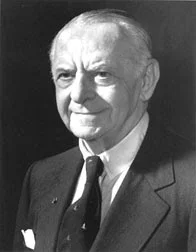
The story of Armand Hammer affected my early life. He was a hero to me. I have always admired him as one of history’s finest “deal-makers” and creative entrepreneurs. He believed that we are here to do good and that it is the responsibility of every human being to aspire to do something worthwhile, to make the world a better place than the one he found.
“The first thing I look at each morning,” declared Hammer, “is a picture of Albert Einstein I keep on the table right next to my bed. The personal inscription reads, “A PERSON FIRST STARTS TO LIVE WHEN HE CAN LIVE OUTSIDE HIMSELF,” in other words, when he can have as much regard for his fellow man as he does for himself.
While in medical school he had taken over Allied Drug and Chemical Company, salvaged it from bankruptcy and built it into a respectable business of 1500 employees. Before he began his internship at Bellevue Hospital in 1921 Hammer sold his company for $2 million and traveled to Russia for 6 months where they were experiencing a terrible typhus outbreak following the bloody Bolshevik revolution. Once in Russia, they invited Hammer to join a small team of advisors traveling for three days into the Ural Mountains to assess the starvation, sickness and dying. The trip changed his life. He asked one of the local officials how much grain it would take to feed the starving people? “A million bushels,” was the reply. Grain was selling at the time for $1 a bushel. So, Armand Hammer agreed that he would take his own money and buy the necessary grain. Word of the offer immediately hit the desk of Lenin in his office in Moscow. He fired off a telegram to the official:
“What is this we hear about a young American chartering grain ships for the relief of famine in the Urals?”
Replied the official: “It is correct.”
Lenin: “Do you personally approve this?”
Official: “Yes, I highly recommend it.”
Lenin: “Very good. I shall instruct the Foreign Trade Monopoly Department to confirm the transaction. Please Return to Moscow immediately.”
At Armand Hammer’s meeting in Moscow, Lenin picked up a copy of the Scientific American magazine that he had been reading. Even though he deplored the capitalism of America, yet he realized that Russia would not ultimately make it without “inventions, machines, and development of mechanical aids to human hands. Russia today is like your country was during the pioneer stage. We need knowledge and spirit that has made America what she is today . . .”
Lenin and Armand Hammer became good friends and Lenin moved Hammer to the “Sugar King’s Palace” across from the Kremlin. Later, Armand Hammer was granted by USSR exclusive concessions for the importing of products from thirty eight American companies, like Allis-Chalmers, Ford Tractors, U.S. Rubber, Underwood Typewriters and Parker Pen. He bartered Russian furs, caviar, minerals and lumber for the hard currency that was necessary to finance the operations. Armand Hammer’s desire to make others “better off” changed his destiny: “Life is a gift” he would say, “and if we agree to accept it, we must contribute in return."
The Despair of Selfish Accumulation & the Joyful Adventure of Relinquishment
One of the greatest gifts I ever received was the classic economic concept of “scarcity, choice and cost” at a relatively early point in my career. I was able to grapple with the concept of “how much is enough?” I was confronted with the ideas of sustainability, balance and relinquishment in my own life.
The theory and art of accumulating assets and the acquisition of influence and power have become the curriculum and catechism of my culture. Rank materialism drives and shapes the behaviors of our business communities and entertainment enterprises. That same spirit of accumulation and power even drives and shapes the entitlements of the welfare state. Greed, advantage, and one-ups-man-ship are what we eat for breakfast.
I realized that just because I had the abilities to earn and accumulate wealth for myself wouldn’t necessarily make me a happy man. Often, my mind would go back to the stories of my childhood heroes introduced through the books my mother read to me. Those heroes seemed to be a happy lot because they “did well” in order to “do good.” I was doing really well but I wasn’t necessarily doing good. In the deals I was putting together everybody was ending up better off—financially. But I wasn’t helping them be better people—or myself, for that matter.
In our business dealings we ended up with a lot of high energy, testosterone-driven moguls as partners. They were fun to be with but the more I studied them the more I concluded that they were not happy people either. None of them had successful home lives. I was painfully coming to the realization that I had been sold a false dream. Whatever it was that we were all chasing would never be caught. I fought tooth and nail to keep from reaching that conclusion. In my quiet times, however, I had to admit such compulsive behavior made me an addict. I was addicted to the accumulation game. I was doing well, but I wasn’t doing good!
In the process something transformational happened at my core. I began to see the futility of trying to accumulate enough material things to make me happy. At that point I was open to a more excellent way. I was ready to pursue goodness and abandon self accumulation. I never took a vow of poverty or promised to wear a hair shirt. I just wanted to break the addiction to the power of selfish accumulation. From that time on, I have actively and sincerely tried to pursue the concepts of sustainability, balance and “relinquishment.” I changed from a person bent on “getting” to a person bent on “giving.”

I began learning how to take my hands off the things that would last for a short time so that I could lay hold of the things that would last forever. The best business trade I ever made was to exchange what I could not keep for what I could not lose.