


During the thirty years I have traveled internationally, I traveled literally millions of miles to more than 150 countries and became very familiar with not only all types and shapes of aircraft, but, also, all types and shapes of travelers. Since the cabins had become my adopted abode, I was tempted upon occasion to Velcro my family pictures to the plastic walls just to help me feel at home. I even learned to enjoy the company of my flying sojourners.
I boarded a morning flight out of Frankfurt and headed for Colorado. Sheri wanted to know if my travels originated in Frankfurt. I asked if her flight to Dulles meant Washington, D.C. was her final destination. She said her company sent her to Germany quite often, and she enjoyed traveling because she liked to observe all the people. Then she asked me, “Where is your favorite place in the whole world?” I responded, “There is a 25 acre spot in Colorado on a crystal clear mountain stream and blanketed with majestic trees. A romantic fire crackles in the gigantic fire place of the old log and stone house. “Wow,” blurted Sheri, “Have you been there on vacation?” “No, I live there every day when I am not constrained by this seat belt!
“Sheri, you said that you enjoy observing people as you travel, what have you observed so far on this trip?” “The thing that impressed me this morning at the airport,” Sheri confided, “was the high percentage of folks who looked terribly unhappy . . . and I suppose I looked as disgruntled as the rest of them. Except for this pleasant conversation, my own life is sort of bummed. It’s beginning to dawn on me that I am running faster and faster, chasing something that I can’t really identify. For certain, I’m not catching whatever it is I’m running after.”
“Is it possible,” I asked, “that someone or something, or perhaps the entire culture, has instructed all of us that we should be in hot pursuit everyday and spend our energy to the last dregs in order to lay hold of whatever it is that we are all supposed to be chasing?” I went on, “Sheri, don’t answer this unless you feel comfortable doing so. “What was it that made you get up this morning and go through the hassle and security procedures to get on this flight?” She studied her hands that were folded in her lap and pensively mumbled something about “economic security” and “happiness.”
“This is none of my business,” I replied, “But I am very curious, just how much economic security would it take to make you really happy?” Her reply came surprisingly quickly, “About twice as much as I am presently making!” Then she grinned sheepishly. “Yea, I think more money, about twice as much, would give me a good shot at personal security. That would be enough to make me happy!” The captain came on the intercom with some announcements, and we put a bookmark in our conversation. But Sheri was not through talking.
“You know something?” Sheri asked, “It just hit me. I am presently making twice as much as I was making two years ago and now I am back into the same emotional cycle, saying the same things over again, ‘I need about twice as much as I am making to make me secure and happy.’Who keeps moving the bar up on the high-jump standards?” We laughed together.
“Sheri,” I continued, “just one more question from a fellow traveler . . . If money were not the issue, what would your list look like that would really make you happy?” “I want to feel worthwhile,” she confided. “I would want to be involved in some worthwhile things. I would want to personally enjoy some love, some fun, some friendship and respect from my family and a few other people. And, I guess, I would like to leave some kind of legacy when I am gone.
"Then Sheri said something absolutely brilliant, “You know, none of those things I just listed is available on the open market or e-bay. Therefore, I guess, if something isn’t priced on the market, then you can’t buy it. And if you can’t buy it with money, then, just possessing twice as much of the stuff called ‘money’ perhaps is not the answer. I guess I’ve been looking for happiness in the wrong places! What a wonderful observation I have made today!”
When Are You Strongest?
I began traveling to Chiang Mai, Thailand, with my Burmese friend, Daniel Kalnin, in 1996. Earlier, he had flown to Denver to ask me to help him with his "Barefoot Doctors" program. "We are training village people from the closed country of Burma," he explained. "We instruct them in basic health care procedures in Chiang Mai, then, send them back into their hill-tribe villages. They return as the only 'doctors' in their areas. I don't have any medical goods to send back with them, and I also need help in training them."
Both the man and his story had intrigued me. He was a quiet, dignified Asian in his 50s. His request was straight forward, his urgency and sincerity compelling. I knew that most of the universities and institutions had been closed in Burma, now called "Myanmar," because the paranoid new government had feared the possibility of insurgency on the campuses.
The training process stretched over a 3-year period. Those chosen by their villages to be trained walked out of Burma, usually illegally, and crossed into Thailand and stayed for one month in each of the three years. It would sometimes take three weeks for them to make the journey on foot. The term, "Barefoot Doctors" described well the picture of the simple Burmese villagers walking barefoot among their people caring for the sick and injured.
The first time I visited one of the "Barefoot Doctors" training sessions in Chiang Mai, there were 21 candidates enrolled. Following the training sessions and dinner, I would encourage them to tell me about themselves and their experiences. They all told me how inadequate they felt as they traveled back home knowing they were the only ones in their villages with any medical or emergency information. Everyone looked to them for help. But they also shared that when they received a call for help there was a certain power and confidence that came over them as they faced the emergency.
One woman told me how God had helped her understand how to fabricate an IV- starting device and get some sterile water into a dying boy's body while the entire village looked on. The boy lived, to the astonishment of everyone.

Another lady cried as she told me that the previous year she had returned to her village after having received two of the three annual training courses. "I was called in the night to the home of my dearest childhood friend. She was very sick. I had enough training to determine that she was having a severe appendicitis attack. But I had never done any procedure such as that. My friend begged me to help her. I knew if I did not do something she would surely die.
"Then the lady explained, "I went into another dark room. I prayed to God and raised my hands up toward Him and told Him that I didn't know what to do with my hands and mind, but I didn't want my dear friend to die. I was the only person who knew anything about medical things. We put my friend on her kitchen table and I began the procedure. I was able to perform the procedure and my friend is alive today. It was a miracle!"
As that precious hill-tribe Burmese lady shared her story with me that night, I remembered a quote from Pope Paul VI, "Nothing makes one feel so strong as a call for help." She had heard the call for help. She was emboldened enough to ask God to help her in an impossible situation, and God made her strong in her weakness so that she could successfully respond to the incomprehensible challenge.
The Eternal Goad

Haiti’s squalor, poverty and chaotic governance lay naked for the whole world to see, following Haiti’s recent epic earthquake disaster. No one could look away and ignore the failed social and economic experiment. Something was wrong . . . and had been wrong for a long time. Of course, I had tears of gratitude in my eyes as I scanned the media coverage and watched the millions of dollars worth of medical goods donated by Project C.U.R.E. being flown from the decks of US Navy ships by Navy helicopters directly to the front lines of the terrible disaster. But our determination to help Haiti did not just start with the recent earthquake.
In 1996, I had been summoned to Port-au-Prince to assess the local hospitals and arrange for donated medical goods to be delivered from our US warehouses. Of Haiti’s 7 million people, 4.5 million were children. Fifteen out of every 1,000 children died from malnutrition, dehydration, infection and HIV Aids. Dr. Frank Thomas, director of the central hospital, accompanied me on the assessment study. We walked through stuffy passageways, ducking into large open wards crowded with sick and dying people. The tumult and turmoil was reminiscent of war hospital scenes from Gone with the Wind or Dr. Zhivago. There was no such thing as privacy and one person's groans or screams were piled upon everyone else's misery.
As Dr. Thomas and I walked along one of the outside walls of the children’s ward, we passed a closed door. Through the door I could hear the screams and wailing of some tormented soul. I nudged Dr. Thomas with my elbow and winked as I asked, “Psych ward through there?” He stopped in his tracks and opened the door to the outside. The sun had not yet burned the jungle mist from the Haitian morning. At the foot of the stairway was a very young woman kneeling in the moist soil. Her face and hair were a mess. I could tell she had been lying face down in the mud, and the tears had washed down through the dirty face and had fallen on her starched white blouse. The noise she was emitting was not crying. She would raise herself out of the mud and begin with a low guttural moan. As she straightened up, the wailing would crescendo into an agonizing scream . . . then sobs, so deep she could have been vomiting.
Dr. Thomas took hold of my arm and pointed back through the doorway and into the children’s ward. “Look over there where all the babies are lined up lying on that long wooden plank.” I looked across the large room and saw, perhaps, ten babies lying side by side. At either end of the plank was an IV station with a baby tethered to an infusion tube that was connected to a bag of saline hanging from a rusty IV pole. “We have only two infusion stations for the dehydrated babies. They must wait in that line until it is their turn. That young mother’s baby could not wait long enough to receive the infusion. He just died and they wrapped him in a towel and carried him away. This young mother intuitively knows her precious baby didn’t need to die.”
I looked away from the room and back out at the tormented young mother. At that moment I could not move. I felt her grief start in the back of my head, down over my shoulders through my thorax and into my abdominal area, across the fronts of my thighs and into my shins. I didn’t just feel sorry for her . . . I didn’t just feel compassion toward her . . . at that moment, I owned her grief!
After a bit, I could walk again and Dr. Thomas and I moved back into the hospital and gently closed the door. In my warehouses in the US I had thousands of IV stations and thousands of bags of saline solution! Sympathy and compassion were not enough; I had spiritually become engaged.
The grief and compassion that I had experienced was not guilt . . . but it was a goad. I had been prodded by eternity. From that time on, I would endeavor not to stumble, not to take my ease, but to press on, to push to the desperate locations where the need would not wait for my own convenience. I would endeavor with all my heart to arrive in time in the future so that it would not be necessary for the precious young mother to fall in the mud of Haiti, weeping for her lost child.
No wonder I was so happy to see those US Navy ships unloading millions of dollars worth of Project C.U.R.E. donations into Port-au-Prince!
The Law of Planting
One of the greatest life lessons I ever learned was taught to me by the gentle rice farmers of Vietnam. I have traveled into nearly every province of Vietnam helping them rebuild their health care delivery systems. They would explain to me "Don't judge each day by the harvest of rice you scythe, but by the seedlings that you plant."

In the verdant stretches of Phu Tho province, north of Hanoi, tradition holds that the patient peasants learned how to perfect the skill of domestic cultivation of rice over 4,000 years ago. They learned they could grow three simultaneous crops each year by staggering the planting calendar. It was there that the method of "puddling" was perfected, where the internal structure of the soil was manipulated, so that there would be a minimal loss of water through percolation. Then they discovered that by transplanting "clums" of one- to six-week-old rice seedlings into the flooded soil of the paddies, they could out-smart the weeds and rodents, and thus greatly increase their production of the rice by giving the seedlings a head start.
Of course, there were efficient methods of tending and harvesting that were developed over the centuries. But, intuitively, the Asians came to supremely respect the ritual of the planting: "Don't judge each day by the harvest of rice you scythe, but by the seedlings you plant." They knew that the maturation, growth and harvest would be there, as sure as the rising sun, if they had been faithful and diligent in their responsibility of properly planting the seedlings.
Many times in the early days of giving birth to Project C.U.R.E., I would become tired to the bone and tempted with discouragement. We were always planting, planting, planting. Where were the results of the garnered donations of medical supplies and pieces of medical equipment? Where were the anticipated good results of all the dangerous travels and meetings and volunteer hours and efforts?
Our present culture does not just suggest, but rather compels us to go directly to the "bottom line" as the single criterion of our worth and value . . . "What is the size of your harvest, today?" But, instead, let your success be judged by your diligence and faithfulness in continuing to plant the seedlings, and the harvest will take care of itself.
Today, I revel in the knowledge that thousands and thousands of lives around the world are being saved right now through the seedlings that were planted over the past 25 years at Project C.U.R.E. The fact that I can plant a "clum" of rice seedlings today that will soon become a harvest, and the fact that I can plant a bit of knowledge in the hearts and minds of others and it becomes their very own, and the fact that I can give a joyful smile to another and receive another in return, gives me the absolute assurance that the law of the planting and the harvest is valid and real.
If you are tempted today to be discouraged because the culture has pressured you to judge each day by the harvest you captured . . . look up, take a deep breath and realize that the only factor that will absolutely guarantee that you will not realize a rewarding harvest is if you neglect the diligent planting of the tender seedlings!"Don't judge each day by the harvest you scythe, but by the seedlings you plant."
Giving While Living
I’ve heard it said: IF YOU’RE GIVING WHILE YOU’RE LIVING . . . THEN YOU’RE KNOWING WHERE IT’S GOING!
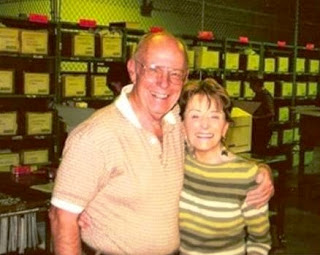
Dr. Merl Jacobsen and his wife, Barbara, certainly never waited until after they were gone in order to begin their giving. In an attitude of celebration they have given unreservedly of themselves as well as their acquired possessions. Having made the decision to be givers while they were still alive, they have thrilled at being able to watch the multiplied benefits of their generosity in venues all around the world.
I recall when, in the early 1990s, Barbara and Dr. Merl came to me as excited as prom pals. They had fallen madly in love with Project C.U.R.E. and suggested having a party at their home on Ketring Lake. “We want to invite all our friends from Denver’s medical community and get them introduced to this amazing organization.” And a party we had, indeed! The prerequisite for attending was each medical person had to bring a piece of medical equipment, a batch of fresh medical supplies or old fashioned cash as a donation. Barbara’s party theme was “Africa” and even the catering personnel dressed up like lions and zebras. When the party was over it was necessary to retain a truck to haul all the donations back to our Project C.U.R.E. warehouse!
But the love affair with giving grew with intensity and soon Barbara and Dr. Merl were leading our medical teams into Bolivia, Senegal, Tanzania, Ethiopia (and 8 other African countries) and even China. They became living portraits of the axiom, “If you give light, people will find the way.” They were freely dispensing the light of help, hope, and unselfishness.
The Jacobsen’s infectious enthusiasm for giving began affecting the lives of hundreds of people in the Denver area. Barbara became affectionately known as “Project C.U.R.E.’s “Angel Ambassador,” and the energized couple recruited hundreds of people to come to our warehouse to help them sort, package, and ship medical goods into over a hundred countries around the world. They had discovered the joy of giving!
As devoted Rotarians, Barbara and Dr. Merl helped spearhead an effort to raise $250,000 for the purchase of Project C.U.R.E.’s new warehouse and international headquarters. Like the multiplication miracle of the loaves and fish, that amount eventually multiplied into nearly one- and-one- half million dollars. And even in the time of tragedy, when their beloved grandson, Peter, was killed in a rock climbing accident in Yosemite National Park, the Jacobsens reached deep into their reserve of love and compassion, and in memory of Peter gave comfort, joy and peace to those of us who grieved and mourned the loss of Peter.
Our world is learning a great truth: “What I hoard I lose . . . What I try to keep will be left and fought over by others . . . What I give will continue to return forever.” What the Jacobsens learned was that, “What you’re giving while you’re living . . . you (and thousands of others) are knowing where it’s going!” May we experience early the joys and rewards of giving while we are still alive.
How to Help Everyone
Following the collapse of the old Soviet Union, Project C.U.R.E. witnessed some of its most dramatic humanitarian work in the Republic of Ukraine. One day I heard President Ronald Reagan say something that startled me and helped me through those hectic days, "We can't help everyone, but everyone can help someone."
On one of my trips I had been invited to perform "needs assessment studies" on hospitals and clinics in the Ternopil and Liviv areas of Ukraine. The director of the large hospital was my host. He told me how it was the driving passion of every Ukrainian to escape Ukraine and move to America. But even though he had been offered a very lucrative position in USA, he returned quickly to Ukraine and rededicated his life to rebuilding the health care system in his own country. He said, "I can't help everybody, but I can make a difference."
In the city of Liviv, Lloyd and "Biggy" wanted me to take a detour from the assessments and see the soup kitchen they had established for street kids. The boys and girls were never placed in an orphanage, but left on the streets to fend for themselves. "We can't feed everybody, but this is a start." I left with the echoes in my ears of Ukrainian orphans singing around cauldrons of steaming stew.
My new Ukrainian friend, Meeche, had stopped in a hallway where he had grabbed a large plastic-handled knife and began sharpening it on a stone. He had requested that I accompany him to see if Project C.U.R.E. could supply medical goods to the wretched clinic at the large prison in Liviv. "Are you really crazy enough to think you can take that knife into the prison with us?" I asked. Meeche grinned and we headed for a state-run store on a narrow back street where people were pushing and shoving to get to the counter. We bought enough loaves of bread to fill our crumpled boxes, and a small case of packets that contained about two cups of sugar each.
Down the block we parked our old car in front of some frightening gates of solid steel. Only when we were on the inside did I realize the expanse of the prison built of stone and covered with razor wire. With guards surrounding us, Meeche drew out his large knife and cut each loaf of bread in quarters. Loaded down with the bread, packets of sugar, little bags of candy and a box of Ukrainian Bibles, we followed the armed guards through the entry process, into the main building and up to the second floor. Inside, the stench threatened to gag me. I was introduced to the nurse who was in charge of the clinic and all medical matters at the prison. She was a hardened ex-military vet in her 50s, whose experiment with blonde hair had backfired. She showed me her pitiful clinic and literally begged me for anything medical.
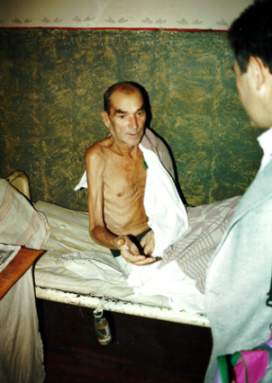
Each ward in the prison hospital was secured by solid steel doors, and additional doors of bars and locks. There was only one small, barred window per ward, high up on one wall and sealed tightly. The farther down the corridor, the more severe the cases in the large open wards. At the very end were the advanced cancer wards. These were all very sick patients who were prisoners, but confined to the prison hospital wards. Their severe illnesses had become their own death sentences.
The old Soviet system of medical care and prison treatment was diabolical and inhumane. But into that nightmarish world, Meeche and his friends would go and take bread, packets of sugar, little bags of candy and a word of hope contained in a small Bible written in their own language.
I shall never have erased from my mind those scenes of suffering, nor will I forget Meeche and his friends saying, "No one else cares for these lost souls. But we can help begin making our beloved Ukraine a better place by taking love to them." I somehow knew that one day Ukraine would be better again!
You were right, President Reagan, "We can't help everyone, but everyone can help someone."
Joy Around the Campfire
My journeys around the world the past thirty years have profoundly convinced me that if you plan to travel from success to significance in this lifetime, you will do so over the road of compassion. Your true measure of greatness will always be determined by your care for others ... not the accumulation for yourself. I know that it sounds a bit revolutionary, but the pulsating motivation behind your drive for accumulation should be the recognized opportunities for making other people "better off."
We had traveled to the fascinating, but terribly needy, country of Tanzania with our free medical clinics. Our doctors and nurses on that trip were mostly from the Vanderbilt University community, and we had excitedly looked forward to what could be accomplished within the borders of the Serengeti. The night before we were to pack up and leave the Serengeti, we had all gathered to relax with tea and biscuits around an open pit fire at our rustic campsite. Our team had been overwhelmed the previous days by the raw-edged medical needs of desperate people.
I knew that would be the last night I would spend for a while under the starlit sky of the majestic Serengeti. My mind had gone back to the words of Dr. Albert Einstein,"A person first starts to live when he can live outside of himself." Our medical team was totally spent, physically, but bursting with joy and satisfaction. They had outperformed their own expectations. They had lived to the limit . . . outside themselves.
We had all been privileged to share the experience of a lifetime by taking the talents God had given to us and unselfishly using those talents to ease the pains of terribly hurting people half way around the world. There were scores of kids who needed immediate attention for malaria, serious skin problems, or even tetanus. Others suffered with severe respiratory problems, chicken pox, or TB.

Two days before, we had all witnessed the dramatic episode where the talented medical team had been able to "bring back to life" a young girl who had been in a deep coma and had been carried to the medical site by her grieving mother. David White had leaned over the limp body of the girl as she lay on the makeshift examination table with IV tubes in her that dangled from the rafters of the dirty building. He spoke softly into her ear, "little girl, Jesus loves you ... we love you ... your mother is here ...open your eyes, sweetie." She not only opened her eyes but the next day walked with her mother back across the Serengeti to their home!
On the last day of our clinic a middle aged mother had been brought to us. She had accidentally tripped and fallen into an open cooking fire the afternoon before. She had not only received terrible facial burns, but the fire had also destroyed one of her eyes, removing it from the socket. Nowhere else on the Serengeti could she have received emergency help or medications to relieve the excruciating pain. Our team had cleansed and treated the wounds, packed the burned eye socket, and had left ample medical supplies and instructions with family members for taking care of the injured mother in the weeks ahead.
The medical team experienced true joy that last night, because during the past week they had been reminded of one of life's great secrets. If we are to live fulfilled and satisfied lives, we must move outside the tightening circle of our own personal concerns and start investing in the lives of others. There is something miraculous and wonderful about not only giving away your riches but, also, giving away yourself! In the process of giving away yourself you will discover the surprise package of true reward and eternal fulfillment. What I hoard, I lose . . . what I try to keep will be left and fought over by others . . . but what I give to God and others will continue to return forever.It's no wonder Dr. Albert Einstein's comment that, "A person first starts to live when he can live outside of himself," makes so much sense! Come to think of it . . . he was a pretty smart guy!
The Magic of the Experience (cont'd from "Food Angels)
I had observed lots of other feeding programs around the world, but never had I witnessed it accomplished in such orderly fashion. Each child received two slices of bread. All stood quietly as they devoured the bread slices. Monica then passed out plastic cups that were soon filled with the thick nutrient drink.
Heather circulated among the kids, looking for the ones suffering from malnutrition. She would walk up and pop a flavored vitamin pill directly into the hungry child's mouth. Nearly all the smallest children received the vitamins. "No one else would do this if I didn't," Heather told me as I followed her from child to child.

The last food handed out to the kids was some sweet puffed rice treats out of a giant plastic bag. Monica went to each child and pulled out all the puffed rice treats she could gather in her two hands and gave it to the child. The children were trained to pull up the front of their little dirty shirts and make a pocket to hold the goodies. That way, no empty plastic bags were left to litter.
Then came the zinging "teachable moment" of the whole "Food Angel" operation. Heather called an older child over to the back of her truck and showed the child some shoes and clothes she had brought with her. She asked the older child whom he thought the shoes and clothes would fit. Then Heather had him take the clothes to that person. "You see," she whispered to me, "I have just involved that child in becoming a loving caregiver. He will never forget that feeling for as long as he lives!"
I was thinking about Heather the other day when I received a message on the social network from a lovely mother who had taken her daughter to our Project C.U.R.E.warehouse in Tempe, Arizona. She, much like Heather, wanted to set up an experience of care-giving that her daughter would never forget:
". . . we live in Gilbert, AZ and were able to volunteer at your (Project C.U.R.E.) warehouse in Tempe. That has been one of the most memorable things my daughter has done.Seeing the needs of others, and her love of science, she has decided to attend the University of Arizona and study medicine. It's because of people like you who encourage and inspire other generations to continue with an important cause. We look forward to continuing to help out with Project C.U.R.E." It is a great privilege, and an incumbent responsibility, that each of us makes it possible for those around us to have the magic of the experience of learning how it feels to make other people "better off."
When Heather's hungry children had gobbled up their bread slices and had finished drinking their gruel, Monica and the two men collected the plastic cups, poured some fresh water out of an old gas can into a large plastic pan, and began washing the cups for the children at the next feeding station. A daily ritual of tender, loving kindness unseen by the outside world. Unnoticed? Not on your life: " ... assuredly, I say to you, inasmuch as you did it to one of the least of these My bretheren, you did it to Me." Matt. 25: 40 NKJV
Food Angels
"What you do is what you believe . . . the rest is manipulative psycho-babble."
In the destitution and squalor of South Africa I found the real deal. No talk . . . all walk. On the outskirts of Johannesburg hundreds of fathers and mothers were dying and many hundreds of children in the shantytown communities were left as orphans as a result of the HIV/AIDS pandemic. Refugees kept pouring into the hopeless shantytowns from neighboring countries looking for food and work.
For some reason Heather and her three friends, known as -the "Food Angels," had taken it upon themselves to feed and clothe a portion of those abandoned children. Three of the four were of Scottish decent and five years prior all three had chosen to leave their lives of sufficiency and move into the squalor of the shantytowns.

Heather took me over to the edge of the dirt trail and pointed to three trees off on the western landscape. "Our shanty is near the center tree. You can barely see our shack from here. We moved out here five years ago. It really surprised the people to see the only European-looking people moving into a shanty with no toilet or water. This has been our home and this is our beloved work," said Heather, an older woman who could not disguise the physical results of a harsh life. Her husband's shaggy beard was matted and mostly gray, his bushy hair held down by an old black stocking hat.
The quartet had settled on five locations throughout the crowded shantytown communities. At exactly the same time every day they would show up at the designated feeding spots. Heather and her small group traveled in two vehicles throughout the shanty camps. One was an old blue car with a rack attached to the top. Fifty-five small plastic stackable chairs in colors of blue and red were fastened to the rack by a worn rope. The other vehicle was a small white pick-up truck with a camper shell on the back.
The group would go to grocery distributors and bakeries located in the Johannesburg area where they would be given loaves of bread, raw vegetables and large plastic sacks filled with puffed rice snacks. Another distributor gave them cases of a malty nutrient drink sold as a dietary supplement. I studied the ingredients and was impressed. Surely, no child would starve to death if they were consistently getting looked after by Heather and her crew.
On Tuesday, Anna Marie and I traveled over the rutty trails of the shantytowns with the "Food Angels" on their rounds. At the first stop, scores of ragged, dirty kids had gathered, cheering and waving. Upon arrival, Heather's husband unloaded the 55 blue and red stackable plastic chairs.Monica was the fourth member of the group. She was a teen who had been orphaned when small and had become the song leader, cheer leader and crowd controller at the feeding stations. Monica had the shanty kids sounding more like a children's touring choir than a bunch of ragamuffin HIV/AIDS orphans.
"This is the only meal these kids will get today. Most of them are AIDS orphans. See that little boy over there by the truck? He has AIDS. See that little girl over there? She has AIDS and is noticeably dying. And see that seven-year-old boy there? He has AIDS passed on to him by his mother before she died.That boy is the son of a witch doctor here in shanty town. See his beads and leather straps? But he is also dying of AIDS. We just keep showing up and loving these precious children. We can't take them all home with us, so we have come to make our home with them.
"What you do is what you believe . . . the rest is manipulative psycho-babble."
(To Be Continued)
First in Line
I always chortle a bit at the homespun wisdom, "the early bird gets the worm, but the second mouse gets the cheese!"
In our culture we have been fed the breakfast of champions and coached in the necessity of being first in line. It's really important to always be first in line . . . or is it?
Recently, I was in the quaint Balkan country of Bulgaria. I loved it enough that I wanted to go back at the first opportunity. I had agreed to travel from Colorado to Sofia, Bulgaria to work with Mr. Carl Hammerdorfer, the Country's Peace Corps Director. With the Peace Corps and Project C.U.R.E. working together as a team, we were able to accomplish some very ambitious projects of rebuilding and refurnishing some strategic medical facilities in Bulgaria.

The curious history of Bulgaria dates back to the 5th and 6th centuries B.C. Genghis Khan had traipsed through the region with his bloody band and left his influence everywhere. The severity of the subsequent Roman occupation altered the social fabric as well as the landscape. Remains of the Roman walls, forts, ports and coliseums are abundant. The Ottoman Turks later raped the women, pillaged the economy and defaced the real estate, as did the communists more recently. While visiting the thriving cities of Plovdiv, Sofia and Bourgas, I pledged that I would one day return on my own time and do some antique procurement.
One Tuesday was spent assessing a medical facility in the area of Starosel. Near the site was an ancient ruin that had just recently been unearthed. It dated back to the 6th century B.C., and consisted of some cult temples and wine-making operations of the Thracian Sect. The Bulgarian landscape in that district was punctuated with earthen mounds that the farmers had plowed around for many centuries. Their curiosity recently had driven them to dig up some of the mounds and explore the contents. They discovered the evidence of rumored traditions from past centuries.
Tradition held that the Turks had multiple wives. But when the husband was killed, or died of natural causes, his favorite wife would be buried with him. Since it was a great honor to be buried with the husband, and thereby seal your place of honor and importance in history, disputes would often break out among the surviving wives as to who was the most favorite and who would be first in line to be buried with the husband.
So, to settle the disputes in a terminal way, the two top contenders would be bound together by leather straps at one ankle and one wrist. There was no way to get away from each other. Then they would each be given a dagger and allowed to settle the dispute by death. The one successful survivor would then be killed as well and placed in the tomb with the husband for posterity of fame.
Many of the earthen mounds have been excavated now, and scientists indeed have found such fatal wounds as knife punctures to the skull in the wife's skeleton.
When I heard of this morbid tradition, I thought to myself, "there surely must have been a diplomatic way to defer all that posterity and glory to the other jealous contender by simply acknowledging that you were definitely not the most favored, and even share some anecdotal stories of how you had messed up along the way and not fully satisfied the husband at some point!"Demanding to always be first in line seems to me to be pretty costly and may deserve the consideration of at least another 30 minute "rethink." Sometimes it just might be more prudent to be the second mouse and keep the cheese.