Group Process

TESTING

Dr. James W. Jackson

July 3, 2012

“In school, you’re taught a lesson and then given a test, in life you are given a test that teaches you a lesson.”  Tom Bodett

 It seems to me that life is designed and structured to place me in situations where I am supposed to learn something.  It also seems that if I learn something from the situation I end up better off, and I am better able to cope with the next set of circumstances. It also seems that the result of the testing process can be used as somewhat of a predictor of the outcome of the next set of circumstances, as well as a predictor of my suitability for a certain purpose. So, the teaching is the test and the test is the teaching.

 I’ve been intrigued by life’s testing process. I have tried to observe how it not only works out in my personal life, but, also, how the process has worked in the living history of Project C.U.R.E. We do a lot of things differently today in collecting, warehousing, and distributing donated medical goods than we did twenty-five years ago when we started. In the beginning, I had some very traumatic and disappointing experiences working with the corrupt customs people in places like Romania and India. Now, we are successfully working in over 125 countries in the world and predict that the future will get even better.

One predictable component of the testing process is difficulty. Testing was not necessarily designed to be easy, but it is inconveniently effective, and because of its brutal efficiency, it is surprisingly sustainable. Difficulty is not always a bad thing. I have come to embrace difficulty as part of the method of learning and assessing.

There seems to be at least two types of testing. The Greeks made the distinction by using two different words.  Dokimazo: Here, the testing has almost an expected outcome of approval. When a doctor sits for his licensing examination he is there expecting that he will pass and receive his plaque of approval to hang on his wall and be able to legally start treating sick patients. Or, you might be testing to see exactly how much gold is in the rock you just discovered in the creek.  Peirazo: In this case, the object of the test is to measure the limits. My mental picture is of a classroom of young engineers competing to see who can make the strongest model bridge out of flimsy balsa wood. The winning student is the one who has constructed the bridge that will hold the most weight without breaking. Usually, this kind of testing carries with it some overtones of sinister destruction or evil interference.

But, I have decided regarding my own life adventure, that regardless of the classification, method, or intent of the testing, I will accept it with confidence knowing that the testing encounter has within it the seeds of possibility for helping me become a better and more fulfilled person. I believe that all those circumstances can work to bring about good in my life.

In 2007, I was traveling about two hundred-fifty days a year in some really awful international locations for Project C.U.R.E.  While in the country of Togo in West Africa, my body was invaded by some nasty bugs. Later, it was cultured as a highly aggressive mutant strain of African e-coli. When I returned to the U.S., my doctors worked feverishly to save my life. “We hate to inform you of this, but we are running out of time and alternatives, nothing is working and your body systems are shutting down.” Their efforts finally paid off and I began to rally. Presently, the e-coli have not all been discovered and destroyed. The problem occasionally reoccurs and I again get very sick. Of course, it has been difficult. Of course, it has not been fun. I had the opportunity to become caustic and bitter about the situation.  But some great things have come out of that episode.

Now, I am limited in my international travels. If I were to be in Nepal and the sickness were to reoccur, I would not make it home alive. However, that circumstance of testing was perhaps the best thing that could have happened to Project C.U.R.E. and ultimately to me. Until that time, I was nearly the only person performing needs assessment studies on the hospitals and clinics we were targeting around the world. Without the needs assessment studies no donated medical goods would have been shipped. In order for Project C.U.R.E. to expand it had to grow beyond me. Now, there are twenty-five or more of our people out doing what I had been doing.  Now, Project C.U.R.E. is growing greater in effectiveness every day, and I am experiencing fulfillment and maturation.

I choose to invite growth. I choose to invite times of testing. I choose to embrace difficulties. I am continuing to learn that it is not the set of circumstances in which I find myself, but how I respond to those circumstances that makes all the difference in the world.


Regarding Inheritance

Here is another bit of cultural folklore I picked up in the market places of this old world that I pass on to you for your consideration.

“If you want your children to love each other forever, don’t leave them any money when you die.”

As one old guy told me, “Happiness is being retired and spending all of my kid’s inheritance before I die.” And, of course, there are the serious admonitions like, “Sometimes the poorest man leaves his children the richest inheritance.”

Generally speaking, our culture is not bound by strict ethnic traditions, wherein lies part of the problem. Problems seem to arise where the passing on of the inheritance is determined by a type of logic positioned somewhere between a well-thought-out estate plan and a knee-jerk whim. Jewish traditions lean toward the oldest son receiving twice the amount as the other sons. Other eastern cultures have the daughters receiving nothing, or the sons receiving twice the amount as the daughters. In some matrilineal countries I have visited, the inheritance is passed down only from the mother to the daughters.

To complicate the situation in our culture, our government entities have decided that unless you have a valid will, wherein you have legally expressed how your inheritance will be divided, you are declared to have died “intestate,” and the government will decide where your wealth will end up. Seven out of ten people in the United States die without leaving a legal will. Making sure you have a valid will before you die is a grave responsibility!

The practice of passing on property, money, and rights gets a little knotty when it comes to perceived inequities of the recipients. It seems that the least responsible expect the most, and those who have been the least frugal expect the lion’s share. And we haven’t even mentioned the catch-all accusation, “oh yea, ‘what’s-his-name’ was always the favorite.”

It seems to me that inheritance squabbles center on at least three areas:

  • Arithmetic: “The appraisals and evaluations are wrong. It should have been more.”
  • Attitude: It is a temptation in emotional situations involving money to let it become a “heart issue” of attitude rather than a “head issue” of logic and common sense. That is when you hear, “It’s just not right . . . it’s just not fair.”
  • Affection: “I loved our parents more than any of the other siblings did. I was always there for them; I should have received more.”

I love the old Yiddish bit of advice: “He who comes for the inheritance is often made to pay for the funeral.” Perhaps the inheritance issue that trumps the feelings of ill will when there is money left, is when there is no money left and no provisions made for the expense of those seniors in their last years. Senior expenses and deaths can also mean the inheritance passes on liabilities and debts. Now, that issue will cause some squabbling amongst the siblings.

Isadora Duncan may have captured the issue well when she declared, “The finest inheritance you can give a child is to allow it to make its own way, completely on its own feet.”


Regarding Money

It’s fun to stand in the market place of a community far away from your own country and have a translator explain to you the daily conversations between the locals. As an economist, my life is richer for having taken the time to practice the art of intentional listening. I pass on to you, for your consideration, one such bit of local wisdom: 

“If you want to teach your children about money

 . . . it’s better if you don’t have any.”

One fact is agreed upon universally: There are more wants than there is available money. Ultimately, we have to choose where we spend our money. That seems to be the hitch. Cultures characteristically try to teach their offspring something about those choices and that very tradition reveals a lot about the teacher as well as the student. In 1758, philosopher David Hume said: 

“Money is not, properly speaking, one of the subjects of commerce, but only the instrument which men have agreed upon to facilitate the exchange of one commodity for another. It is the oil which renders the motions of the wheels more smooth and easy.”

You only work in order to trade your labor supply for the supply of some other worker. Money, the common currency, is relied upon simply as a convenience and accepted because of confidence. Money is sort of an interim landing spot. You may want to exchange your labor for some currency in order to postpone a current consumption in anticipation of consuming something in the future. It is more convenient to carry around some currency in your pocket than to try to carry in your pocket a month of your labor! Credit cards are an additional convenience, but not truly money in that they have to be paid off with yet another transaction of money. However, when you stop having confidence in any form of money it ceases to be used as money. 

There has nearly always been some type of money in existence, but no one person simply sat down and invented money. And as history reveals, some folks, inside or outside the ruling government, sooner or later start tinkering with the control of the value of the currency for their own express benefit. 

So, if it is so important for a culture to pass on to its offspring the wisest and most prudent practices for handling money, why would someone in the marketplace say: “If you want to teach your children about money . . . it’s better if you don’t have any?”Here are some of my observations to add to your own ideas.

  • The convenience of money is an addiction and tends to sever the rational connection between the product of your labor and the money itself. Money becomes the issue, not labor. Mom and Dad look to the money as the object and usually one person takes on the role of a human ATM machine. If something is desired, money is used to fulfill the need or impulse, even if the interim convenience step of the credit card is needed. But the link between the fruits of labor and the ATM machine becomes lost, especially for the next generation.
  • Convenience for the present generation transforms into entitlement for the next generation. When the connection between the product of your labor and the human ATM machine becomes blurred, the kids are tacitly taught they are entitled to whatever is viewed as necessary.
  • Generally speaking, money and credit cards become so convenient that if they are available, the money will be spent.
  • Frugality demands discipline. If there is money readily available it is almost impossible to effectively teach frugality. The effort just isn’t convenient.
  • When caught up in “ATM thinking,” it is very difficult to teach that over time the value of the money being used almost always shrinks. So, expediency of the present trumps a well planned system for savings and investment for the future. The kids end up without the foggiest idea about savings and investments. “Somebody will always supply an ATM machine.”

Sadly, most lessons about money are caught rather than taught. The next generation, unless there is some form of intervention and transformation, will usually follow an increased trend of expediency and convenience rather than frugality and discipline. It takes real focus and discipline to teach the next generation about issues of money. The good news . . . it can be done!


Connect the Dots

The way to connect the two big dots called “Goals” and

 “Achievements” is by a straight line called “Discipline.” 

~Dr. James W. Jackson

The Mission Statement of Project C.U.R.E. is to identify, collect, sort, and distribute donated medical supplies, equipment and services, based on imperative need. That is the objective. That is the big dot labeled Goal. But how do you connect that big dot to the other big dot labeled Achievement?

When noodling the mental model of Project C.U.R.E. in 1986, it all seemed very simple. I saw overwhelming need for medical supplies and pieces of medical equipment everywhere. Good people were dying for lack of the simplest and most basic medical items. Surgeries were not being performed for lack of sterile latex gloves in the operating rooms. Dehydrated children were dying for lack of IV starting kits. Strep and staph infections attacked otherwise healthy people when they went to a hospital because of the unsanitary conditions. The need was gigantic! 

On this side of the ocean, medical warehouses and hospitals were full of overstocked medical goods. To my simplistic mind, it seemed like a pretty straightforward assignment: take the things not being utilized here and transfer them to people desperately in need of the goods over there. Then everyone concerned would bebetter off

It all seemed so simple, even when diagramed out on a piece of paper. But, connecting those two dots of Goals and Achievements was not, and still is not, simple. I used to wonder why someone had not made it work before. Now I know. It costs millions of dollars to freely give away the miracle of life and hope. I began to understand the liability factors faced by the medical manufacturers once their products left their control. 

Hard costs involved in collecting and warehousing the donated goods seemed prohibitive. Sorting, inventorying, and preparing the medical goods for shipment demanded computers, telephones, trucks, forklifts, pallet jacks, boxes, and shipping supplies. Insurance policies had to be purchased to cover people, loads, equipment, and buildings. Fuel and maintenance costs had to be met for the trucks and pieces of equipment, as well as payments for necessary utilities. Those expenses multiplied when we began to open up operations in other cities. 

An additional factor interfered with our connecting the dots of Goals and Achievements. It was the nightmarish task of shipping through corrupt customs departments found in foreign countries. And we were not just shipping into one port but, eventually, thousands of recipient facilities in one hundred twenty-eight countries. So, how do the dots get connected? Discipline is the key. 

As Project C.U.R.E. grew, and we were trying to connect the dots, at least four disciplines were involved: 

1. The discipline of believing: We had to believe so tenaciously that what we were doing was the right thing to do, that we could actually see by faith that the project could and would be done.


2. The discipline of focus: Without laser focus, chaos, confusion, and failure will result. Focus is remembering what you want so vividly that all your energies move you toward accomplishment.


3. The discipline of perseverance: Nothing can dissuade you. You will make one more phone call and absorb more “no” responses than anyone else has in history. But it will come to pass.  

4. The discipline of sharing the accomplishment: No great thing is achieved by oneself. You are not that smart, clever, good-looking or strong. We need God, loyal friends, team members, and collaboration to make a difference for good in this world. We must utilize discipline to share in that goodness with others around us.

The way to connect the two big dots called Goals and Achievements is by a straight line called Discipline. 

Stepping Stones

"Every act of kindness defines your character

and becomes a stepping stone toward heaven." 

-Dr. James W. Jackson

We become the sum total of every moment and every event of our lives on earth. Each episode forms our story and writes in time the adventure of our life. The enjoyable experiences, as well as the tough spots we encounter, set up the occasions that demand our responses. Our responses, then, set into motion the consequences of our intentions. And lo, and behold . . . we then have what we callcharacter. That character becomes our temporal as well as our eternal identity. But, character is built one episode at a time.

One of the great privileges afforded me as I traveled to nearly every corner of the world, was being able to quietly observe the countries, the cultures, and the character of the people. Though the mores and folkways were vastly varied, the core similarities of the people were astounding. Many times I was overwhelmed at the responses of the individuals to the opportunities of goodness presented to them.

While working in Lilongwe, Malawi, in eastern Africa, I encountered a delightful twenty-two year old man named Fletcher Mutandika. I listened carefully as he verbally un-wrapped his story for me:

One night an old, shriveled woman came gently, but insistently, knocking at the apartment door of the boarding school Fletcher was attending. She was holding an emaciated baby between her two hands. She began pleading for enough milk to help the baby stop crying. Fletcher looked at the starving baby and quizzed the old grandmother. He found that her daughter and husband both had HIV/ AIDS and had died recently. She could not care for yet another orphaned child. This was the grandmother's desperate attempt to keep the live baby from being buried with the dead mother. Fletcher was faced with a defining moment. How he would respond would set into motion far-reaching consequences.

Fletcher's own mother had been orphaned when she was just ten years old. As Fletcher was growing up his mother had told him of what it was like to grow up alone, with no family. But, God's love had eventually allowed Fletcher's mother to go to school and marry a young man, who later became a Presbyterian preacher in his native country of Malawi.

While Fletcher was standing in the doorway something happened inside of him. He not only came up with some milk for the baby, but he also took the starving baby to receive medical attention. Sadly, it was too late to save the child and she was buried with her mother three days later. Fletcher decided in his heart that from that point on he would get involved in trying to help with the orphan situation in Malawi.

A census had been taken about five years earlier showing there to be over a million orphans in Malawi alone. Old grandparents who should have been having someone look after them were still trying to take care of fifteen or twenty little kids. Many of the grandparents' children had died of HIV/ AIDS related illnesses, leaving all their living offspring to be raised by someone else. It was not uncommon for a child to be orphaned two or three times. Their parents would both die, and they would be taken in by an aunt or uncle, who would also subsequently die and would leave all the kids to go somewhere else. Nor was it uncommon for young children to be heads of households trying to raise their brothers, sisters, and cousins after the death of their parents. But with no adults around, who would teach the children how to cook, plant, tend the goats, or even fetch water?

By age twenty-five, Fletcher was operating his own Day Care Center for orphaned kids in Lilongwe, Malawi. He was caring for 750 orphans in his program. But his care concept had an interesting twist to it. He didn't want to break up the extended family if it could be prevented. Instead, he wanted to make it possible for the families to retain some of their original identity. He would not take the kids on a full-time basis, but gave them a place to go before school and after school, and even helped finance the purchasing of school uniforms, and helped pay the fees for the orphans. After school the kids would flock to Fletcher's pavilion where all would receive a good, hot meal. Then, he sent them off to a relative's hut to sleep for the night.

Every act of kindness bestowed on those 750 orphans continued to define Fletcher's character. Every episode was forming the story of his life. Even to this day, Fletcher continues to build stepping stones to heaven not only for himself, but for countless others in the country of Malawi.

(This story is an excerpt from Dr. Jackson's Field Journals soon to be available on a subscription-only basis.)


Giving From an Empty Bucket

Before giving away something from your bucket, make sure there is something in your bucket. 

Compassion in a culture is an extremely valuable commodity. In many cases it is priceless. Compassionate people who are involved in humanitarian endeavors are usually pretty tough on the outside, and can function well in undesirable circumstances. But, many times on the inside they are way over on the thin side of the bell curve when it comes to fragility and vulnerability. Sometimes their hearts are even bigger than their heads. 

Lately, I have been made aware of the tragedy that occurs when compassionate people continue to give and give out of their buckets to meet the needs of others around them, but neglect to take care of their own physical, spiritual, and emotional well being. They keep reaching into their buckets and dispensing to others what is needed to help and heal. Then one day they reach into the bucket fully expecting to perform their compassionate actions as usual. As they reach deep into the bucket they discover that it is empty. The only sound from the bucket is the sound of their knuckles coarsely rubbing on the metal of the bottom of their own bucket. Then the trauma and tragedy of the situation becomes observable. 


If we do not have a plan of action for refilling and maintaining our own bucket of physical, spiritual, and emotional well-being, we are already in trouble. You just can’t give out of an empty bucket. When that happens our entire culture suffers the loss. 


While traveling throughout the world delivering health and hope through Project C.U.R.E., I would be in as many as twenty-seven countries in one year. I would see more filth and cockroach-infested hospitals, and experience more pain and misery and death and dying in thirty days than most people would see in a lifetime. A thousand times my heart would be broken. Many times in my hospital tours I would have to hide around a corner just to cry. I had to judiciously guard against an empty bucket. 


I realize this is personal, but I’m going to share with you from my own action plan just one of the things that helped me keep my bucket full. It became God, my family, my wife and my home that served to protect my bucket. The following is an unedited entry from my travel journal for November 4, 1998: 

I breathed in deeply until my lungs were filled to absolute capacity. I slowly exhaled and then filled my lungs again with the crisp Colorado mountain air. Someone in the glacier-torn canyon was burning logs in their fireplace and the slight scent of wood smoke mixed with the rain drenched smell of pine needles quietly, but emphatically, announced to my senses that I was home. I was home, safe within the locked iron gates that blocked the rest of the crazy world from trespassing across the bridge into the sanctuary we had called home for over 29 years.  
I listened with new ears to the creek in front of the house as the water noisily splashed over rocks deposited there thousands of years earlier. I gazed again in wonder at the majesty of the stately blue spruce, ponderosa pines and Douglas fir trees pointing their spires up and out from my yard into the misty heavens. I was home. Home was where, inside the old stone and log walls of the house, we had raised our sons and enjoyed the warmth and thrills of nearly a third of a century of Thanksgiving and Christmas holidays. Home was where I kept returning at every opportunity possible to rejoin the embrace of my childhood sweetheart and very best friend, Anna Marie . . . the girl who had turned my head and heart in high school, and through the ensuing years had totally captivated my respect, passion, and admiration. I had realized that if I could spend time with any girl in the world, I would certainly run home as fast as possible and spend that time with Anna Marie. I was home.  
At that moment I experienced absolutely no fear at all about some airport predator in Lagos, Nigeria, about whom the security people would warn me, “Don’t deal or even talk to any people at this airport . . . you have what they all want and they will kill you to get it.” No fear within my sanctuary about drinking parasite infested water that would make me deathly ill, or about inadvertently eating food contaminated with the hepatitis virus. No fear there of being involved in an automobile or airplane accident in some remote third world country, or contacting some strange and incurable disease, or getting robbed as I walked along some strange street in some desperate neighborhood halfway around the world. I breathed in deeply once again and refilled my lungs to capacity with the crisp autumn air of my Colorado haven. I was home.  
I didn’t used to realize how important it was to be grounded somewhere specifically when I would spend a large percentage of my life spinning and flying at the end of an unpredictable tether. But, now I was observing what was taking place in my life. I was keenly realizing that when God had directed and expected me to go and function in a very insecure environment, he had already overly compensated me with objects and situations of immeasurable security in order to keep me adequately stabilized on my journey. Not just a few times had I laid in some unfamiliar bed in a foreign country and had my mind return to my home. At that point I had been allowed to regain peace of mind and heart as I mentally walked along the babbling creek and listened to the singing of the rare songbirds of the Rocky Mountains. Many had been the times when I would fall asleep feeling the warm comforting arms of Anna Marie wrapped around me, giving me the security and confidence of her love, even though we were miles apart. God had prepared for me to go long before I was ever expected to go. And upon my return home from the latest thirty-day trip throughout Africa, I was reminded once again of God’s extremely generous expression of faithfulness and provision in my life. I was home.  
(Dr. JWJ’s Travel Journal; November 4, 1998) 

Before giving away something from your bucket, make sure there is something in your bucket. 

Counter Trade and Barter

I want to post this important concept in your subconscious mailbox now so that it gets stored in the inbox of your brain before the hectic days of the coming election and 2013. In the meantime, over your hot cup of coffee or while you are commuting to work, consider this for a moment. Almost overnight we have injected over thirteen trillion “dollars” of new money into our present system. The U.S. Treasury prints paper money and mints coins, but the Federal Reserve System alone is authorized to place them into circulation. All the newly created money will be “monetized” into the system. The most dramatic method for altering the money supply is through the monetizing of the Government’s deficit spending by the Federal Reserve System’s buying and selling notes and securities of the U.S. Treasury. [Another way to say it is that the government spends and spends on credit, and the FED prints up new paper money to cover all the debt.] The method somewhat delays the damaging impact of inflation, but can’t stop it. 

But, I don’t want to fill this space with a discussion about inflation. I have, however, observed in my work around the world over the past thirty years scores of countries that radically abused their currency systems. Perhaps chief among those experiences was my working directly with President Jose Sarney of Brazil, when the inflation rate in that country was running over three thousand percent. 

Instead, I want to talk here about coping. I want to talk about considering ideas and a mindset now that can sustain you in tough financial times, and foster confidence and peace of mind. No, I have nothing to sell, but I will offer some ideas that are free. 

Utilizing counter trade and barter is simply trading what’cha have for what’cha want. You have been doing it since you were born and already you are good at it. You used it exclusively until you got addicted to using a money system that you presumed was more convenient. When you were a baby you had it figured out that two whimpers, four cries and two screams would get you one clean diaper. You were bartering peace and quiet for your basic needs! Later, you learned that you could barter good behavior for acceptance, approval, and commendation. You became a pro. You took what you had and made it into what you needed. 

Historically, during times of economic depression, inflation, or abusive taxation, the barter system has always revived, outweighing the convenience of the regular money system. The more worthless money becomes, the more likely it is that commodities will become “money.” What’s new is that we are once again entering an economic period where bartering will be necessary because of the abuse and manipulation of the money system. 

Once you begin kicking the money habit and start thinking in terms of value instead of price tags, you will discover that you can trade for about anything. My point is very simple: If you can barter for things that you would regularly pay cash for during the month, then you will not have spent the cash that you regularly would have spent.Unspent cash left over at the end of the month is the equivalent of a raise . . . and that is even better than having to earn more money! 

It is not unreasonable to believe that you could trade for dry cleaning and laundry, a car or truck lease, tires, batteries, car pooling, fresh produce, dairy products, butchered beef, frozen foods, clothing for you and the kids, baby-sitting, landscaping, painting, house repairs, school uniforms, sports equipment, dance lessons, guitar lessons, piano lessons, etc. In other words all that you otherwise would have paid for during the month with cash, or worse, a credit card. If you have what the other person needs, and he has what you need, then the deal can be made and each ends up better off. Usually, it is a case where “ye barter not because ye attempt not.” You are probably already doing something like shoveling the neighbor’s sidewalks in exchange for baby-sitting. 

There are three basic steps to take that will get you started: 1) make a comprehensive list of what you want or need; 2) make another creative list of what you have available for trade; 3) Discover someone with whom to trade — from grocery store bulletin boards, internet “want ad” lists, church groups, school groups, swap meets, etc. You don’t even need to discuss “price.” Just stick with your idea of value and what works for each party. You will really be disadvantaged in the future if you remain addicted to a manipulated currency system. 

This short discussion has dealt with only counter trade and barter as it relates to personal needs. But, there is a whole exciting world out there that includes business, real estate, commodities and services. Additionally, international counter trade and barter deals are fully utilized every day of the year. It is estimated that between forty and fifty percent of all East-West trade utilizes counter trade and barter. As countries become choked by debt and experience international “credit unworthiness,” (such as we are currently experiencing) it is to their benefit to become experts in counter trade and barter. 

Over the past thirty years I have spent my life in over one-hundred fifty countries where I witnessed some significant trade deals. For example, Mexico sent oil and sulfur to Brazil in exchange for petrochemicals, soybeans, steel mill and oil-industry equipment in transactions valued in billions of dollars. I was personally involved in “debt for equity swaps” with sovereign countries when I founded Project C.U.R.E.The principles are all the same. And I am so grateful that one day it dawned on me that those principles could be utilized for more transactions than just making a fortune. I found that we could take commodities of the health care industry and actually exchange them for the health and lives of thousands and thousands of beautiful people all over this world. That’s the power of counter trade and barter.


The Arrow of Fear in the Quiver of Control

I’m sick and tired of being made afraid. 

When it comes to the issue of controlling the hearts and minds of the people, there are several lethal arrows in the quiver of control that have been effectively used throughout history. None is more lethal and none used more often than the arrow offear. In fact, it is the one essential arrow for the politician’s success. If you can get into the head and heart of the constituent, and establish the spirit of fear, you have at the same instant established the spirit of dependency. Abdication welcomes control . . . all in the name of protection and peace of mind. 

While traveling in Zimbabwe, I experienced the many times President Mugabe dispatched his military and police units to race through the city streets in the middle of the night with sirens blaring, lights flashing, and horns honking to strike fear in the hearts of the sleepy citizens. The frightened citizens would awaken thinking, “Oh, it’s awful, and scary, and dangerous out there, and I do hope that our president will take care of us.” 

Hitler’s confidant, Herman Goering, claimed, “Naturally, the common people don’t want war neither in Russia nor England, nor for that matter in Germany. That is understood. But, after all it is the leaders of the country who determine the policy, and it is always a simple matter to drag the people along, whether it is a democracy, or a fascist dictatorship, or a parliament, or a communist dictatorship. Voice or no voice, the people can always be brought to the bidding of the leaders. That is easy. All you have to do is tell them they are being attacked, and denounce the peacemakers for lack of patriotism and exposing the country to danger. It works the same in any country.” 

I recall from the 1950s and 1960s my very first awareness of a leader’s control by fear. Newsreels showed President Abdel Nasser of Egypt sounding all the alarms in Cairo, rousing all the people out of their beds and into the streets for defense drills, saying the British and French were coming to kill them because he had taken control of the Suez Canal. The next night he would order the people out of bed and into their defense positions because President Qasim of Iraq, or the troops from Saudi Arabia or North Yemen were on their way to kill them. Nasser kept the people of Egypt in a continual state of fear and confusion. And they loved him and supported him for it because he was the only one who could take care of them. Ironically, to quell them and gain their confidence, he promised them universal health care, subsidized housing, building of vocational schools, and minimum wages. Nasser came closer to unifying the Arab world than anyone in recent history, and fear was his sharpest arrow. 

In any one given day media reports can swamp you with fears of individual loss of net worth through increased taxation, coming hyper-inflation, loss of freedom on the internet, nuclear bombs from Iran or North Korea, government’s inability to pay social security, military pensions or Medicare, death panels for those over seventy-five, epidemics, natural and man-made disasters, bank failures, further loss of liberties, loss of electrical and communication grid systems, failure of our money system, foreign intrusion or radical domestic upheavals, increase in killer diseases, and on and on . . . . Most fears are based on some percentage of truth, so at best, we deal with half truths. The problem with our species is that we usually glom onto the wrong half. And once we begin to let fears terrify us, the quality of our personal life diminishes. Seneca said, “Where fear is, happiness is not.” If we allow our minds to become focused on fears — created by whomever — those fears will choose our destiny, because fear is the enemy of logic and effectively robs the mind of all its powers of reasoning and acting. 

So, what’s to be done? If it is a legitimate concern and you can do something about it, then do it. If you need to vote, then vote. If you need to protest, then protest. But, don’t let the fear possess you. Let go of the fear. You need not be made afraid any more. Dale Carnegie used to say, “Action breeds confidence and courage. If you want to conquer fear, do not sit home and think about it. Go out and get busy.” 

From what I observe, there seems to be a positive correlation between the amount of fear that possesses me and how unusually concerned I am about myself. I find that I am less apt to be made afraid if I can get my thoughts off myself and I start concentrating on helping someone else become better off. That just may be one reason why our fifteen thousand volunteers at Project C.U.R.E. are such a happy lot. They have discovered that as you focus your attention on helping other people become better off, even if they are on the other side of the world, the super-imposed fears that were once yours seem to lose their grip and start slipping in their influence over you. 

I don’t want to be made afraid anymore! Fear is the darkroom where negatives are developed, and I no longer need to be a part of that picture! 


Speechless

You don’t always have to communicate by talking if you are transparent enough to let people see the love that is in your heart. 


One of the most proud and impressive episodes that occurred in Project C.U.R.E.’s history of helping needy hospitals around the world took place in the country of Ukraine. I began traveling to Ukraine shortly after the collapse of the old Soviet Union. By 1996, Project C.U.R.E. was not only helping to change the health care system in Kiev and smaller cities, like Zitomer, but also, in the university city of Vinnitsa. In addition to donating hundreds of thousands of dollars worth of medical goods into the Pirogov Medical University in Vinnitsa, we had also donated and shipped over eighteen tons of medical library books to the university’s library. With that gift they could boast of having the finest English language medical library in all Eastern Europe. 

I returned to the old Soviet Union and to Ukraine in September, 1996, with Dr. Mark Johnson and several other wonderful people from Vanderbilt University. It was Dr. Johnson’s first venture away from the sophisticated hospitals of Nashville, Tennessee and the Vanderbilt Medical Community. He was young, but had already gained a great deal of respect in the medical community as an urologist. In addition to the donated medical goods brought to Vinnitsa by Project C.U.R.E., Dr. Johnson spent his own money to purchase urological items that he intended to leave at the university when he returned to the U.S. 

Dr. Johnson's mission was to find and train the medical university’s finest urology and obstetrics/gynecology surgeons and professors. He would instruct them in the use of the advanced techniques, and then leave the high‑tech instruments for them. They would be the first in the whole area of the old Soviet Union to be trained in how to use the equipment and perform the procedures. 

The targeted university doctors and a few nurses were approached and invited to a meeting at 10:30 the next morning in a consultation room near the operating theaters. A Ukrainian translator agreed to be there to interpret for us. At 10:30 we had all gathered in the room . . . everyone that is except the translator. We quickly burned up the few known Russian and English words of greeting as we introduced ourselves to each other. But, still there was no translator. All were glancing at their watches. These were very busy people. 

Then Dr. Johnson did a brilliant thing. He said nothing, but smiled and took the laparoscope and the cystoscope out of their storage cases, along with some containers of capsules, and carefully placed them on the conference table. Next, he took out a black felt pen and some paper and started drawing pictures. The doctors and nurses looked around at each other and smiled at this creative young doctor who wanted to share with them so much that he was not going to let a little thing like a spoken language get in the way of their communicating. The doctors and nurses closed in tightly around Dr. Johnson so they could better see what he was drawing. Now, they were talking the same language, body language. 

In the old Soviet Union they were experiencing a lot of problems with gynecological oncology, urinary incontinence, cysts, uterus bleeding, bladder and kidney infections, and also, dysfunctional prostates in males. Up to that time, the only surgical method available was highly invasive surgery. And in Ukraine those procedures were fairly archaic and crude. 

As Dr. Johnson proceeded with his art class the physicians began to chatter. Some could not keep their hands off the scopes that were on the table. With the scopes and some pictures, Dr. Johnson began to demonstrate the new concept of minimally invasive diagnostics and surgery. Some of the surgeons had either read a little about the procedures or had seen pictures in medical journals. But this was the first time they had someone explain to them the use of the instruments . . . especially with the unique method of not employing words. They knew well their own problems and recognized quickly the advantages of decreased blood loss, decreased pain, less chance of infection from the surgery, and shorter stays in the hospital. 

Dr. Johnson ended up spending most of the day with the university doctors. As you can imagine, by that time they had translators galore! Their delight could hardly be contained when they realized that the new equipment would be left with them for the future. They begged Dr. Johnson to join them in the operating theater the next morning, where they would have him operate on their patients and allow them to further experience the use of the scopes. They even invited him to dinner that evening to celebrate their new friendship. 

The next morning we all put on our scrubs and went into the operating theater. Dr. Johnson’s new friends placed on his head the typical tall, Russian stovepipe surgical hat indicating their love and respect for him. Most visitors to their university hospital, who experienced the situation where the translator failed to show up, would have just packed up and headed back to the hotel. But Dr. Johnson’s care and concern for them compelled him to set aside the necessity of communicating with words. He became transparent enough to allow the doctors and nurses to see into his heart and respect him for his willingness to bypass the need to use words. 

I wonder, how many times in the past my communications would have been far more effective had I just stopped the flow of words, proceeded with my task, and been transparent enough to let others see the intent of my heart? 


Cultural Economics

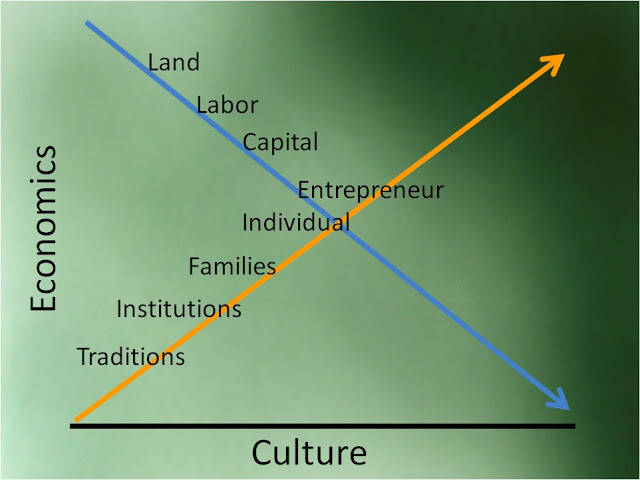
Global transformation, national transformation, corporate transformation, and even personal transformation take place at the intersection of Culture and Economics.
(Dr. James W. Jackson,  "THE HAPPIEST MAN IN THE WORLD: Life Lessons from a Cultural Economist”)

I am a Cultural Economist, and I am compelled to make this obvious announcement: People have something to do with economics!There is a temptation to view the study of economics as a complicated and intimidating hodgepodge of charts and graphs used by corporations and governments to manipulate the consumers and persuade the voters. However, the study of economics is a valuable interdisciplinary study, and it is sad to see that so many educational institutions have dropped the teaching of the subject to our students. 

Traditional economics concerns itself with the process of how we efficiently allocate and manage our resources of land, labor, capital, and the entrepreneur, and how we choose to organize the production of goods and services. We take our collected data and apply it to chosen charts or matrices so that we can project our conclusions into the future on the basic assumption that future reality will be an extension of past reality. It is easy to visualize the iconic economist with his wire-rimmed glasses observing something taking place in the real world . . . then retreating to his study to research if that which he has observed could actually work in theory. 

But, it is good for us to remember that economics is all about people. It is the people with their emotions of love, joy, surprise, anger, sadness, and fear who make up cultures. And it is cultures that affect economics. And, likewise, economics affects cultures. Wherever you find the clashing of culture and economics, you will find the process of transformation taking place. For example: 

Global: Observe what is happening in Greece. Rioting is taking place in the streets since May, 2010. The violent protests are over unemployment, inflation, corruption, the national debt crisis, and implementation of austerity measures. In Greece and elsewhere around the world Global Transformation is taking place at the intersection of culture and economics. 

National: A quick comparison of the issues represented within the U.S. by the Occupy Wall Street group and the Tea Party group will reveal the extent of the national transformation presently taking place. Occupy Wall Street is a protest movement employing civil disobedience to support their demands for wealth redistribution through “opposing cutbacks and austerity of any kind,” and eliminating corporate influence of the financial services sector over the government. The Tea Party opposes continued excessive spending and waste, U.S. national debt levels, excessive taxation, and it demands government adherence to the Constitution. 

Corporate and Individual: Change at the corporate, and the individual level as well, takes place at the intersection of culture and economics. Wherever the components of the culture, e.g., traditions, institutions, families, and individuals intersect with components of economics, e.g., resources, labor, capital, and the entrepreneur . . . that’s where change takes place. 

We all stand at the curbside of that intersection. Each of us participates in the flow of history as it passes through that intersection. At that intersection we actually become the “change agents” of history. 

Cultural Economics is the branch of economics that concerns itself with the relationship of culture to economic outcomes. It studies how various aspects of societal cultures interact with economic events, behaviors, and conditions. A given culture will influence our political systems, traditions, religious beliefs, our formation of institutions, and even our value ascribed to individuals. And, conversely, economic philosophies and systems have the power to affect and shape our cultures. 

Economics is not a “Dismal Science” as Thomas Carlyle referred to it in his essay written in 1849. It is an exciting adventure when the studies of economics and culture are combined. It can open our eyes to the understanding of motives, methods, behaviors, successes, and failures regarding the stewardship of our world’s resources and human endeavors. Perceptions and persuasions sway even our purchasing patterns. Our economic environment has the flexibility of metamorphosis in reaction to current events and preferences. That makes the study of Cultural Economics an exciting study.