CRISIS REVEALS CHARACTER

The outright arrogance of the Soviet leadership occasionally caught me totally off-guard. One of the favorite sayings leveled at me as I traveled throughout the Soviet Union was Nothing ever goes wrong here, because nothing ever can go wrong here.If one of their Five Year Economic Plans failed miserably, or there was a costly industrial accident, there was an ingenious cover-up promoted, but never an admission of a mistake. That historic attitude spawned an international catastrophe in 1986 in Chernobyl, Ukraine. 

The disaster took place during a systems test on April 26 when, due to faulty design and inappropriate and inefficient actions of the nuclear staff, an explosion and fire released immeasurable quantities of radioactive contamination into the atmosphere. Sixty percent of the heavy fallout landed directly in Belarus, Ukraine, and Russia; the rest was spread throughout the USSR and Europe over the following four years. 

The Soviet Union authorities in control of the Chernobyl nuclear power plant tried to cover up the whole episode. They never warned the innocent plant workers of what was happening; the 3,000 military men who were sent in to control and clean up the mess were not informed of the risks; and the leadership simply delayed evacuating the 350,400 residents of the city of Prypiat and effected areas. Only after radiation levels set off alarms in Sweden, did the Soviet Union admit that an accident had occurred. 

No one will ever be able to accurately measure the past deaths or predict the future deaths resulting from the Chernobyl disaster. The Chernobyl Forum estimates that the eventual death toll could reach 204,000 emergency workers, 116,000 evacuees, and 270,000 residents of the most contaminated areas. Among the billions of people worldwide who were exposed to the radioactive contamination from the disaster, nearly a million premature cancer deaths occurred in the years following1986. 

In June, 1996, I had a meeting in Minsk, Belarus, with a military commander named Peter Ivanovitsch. He had been a commander of the Soviet Army in Afghanistan in 1986. On April 27, 1986, he was ordered to take 2,900 of his men into Chernobyl to help. When he returned from Chernobyl they noticed that they were all getting sick, but the communist government said that it was impossible their sickness had anything to do with Chernobyl, and dismissed their being sick as coincidence. Soon many if his men began to die. They organized themselves to try to help not only the invalids being left as a result of the disaster, but also to try to bring food and aid to the families of the rescuers who had already died.

The communists still refused to help, saying that their claims were not valid even though the men who went in on the rescue attempts were all seriously affected. The majority of the men had died by the time of my meeting with the commander. Peter was enlisting Project C.U.R.E.’s help to supply medical goods for the remaining families. He was forty-three years old, but knew he only had a very short time to live. 

My next meeting that day was with the Bishop of the Evangelical Union in Belarus. When the evacuation of Prypiat was taking place, there were a number of pastors who had accepted the challenge to go into the nuclear plant area and minister to the victims. They were pastors who had faced the oppression of the Soviet leaders in the past and had survived. The Bishop had warned them of the high risk involved, but the brave pastors traveled into the areas of heaviest radioactive fallout and ministered to the hurting people. Even though all those pastors died, they were the ones in the story that displayed true strength of character. 

Common logic would have us believe that character is developed in the time of crisis. I doubt that. Very little character was being built by the Soviet leadership during the Chernobyl disaster. We are tempted to say that in a time of crises we will rise to the occasion . . . probably not, unless we have been consistently developing strength of character before the crises. Pressure proves the product . . . crisis simply reveals the character.


Relinquishment

One of the greatest gifts ever offered to me was the insight that Life is way too short and too valuable to spend it on selfish pursuits of material accumulation and greed. I will be forever grateful that I was given a second chance at life. It was as if a King had purchased my life and had given it back to me when I was about thirty years old. I jumped at the chance, and I now realize that as a result of that gift I was able to sidestep a lot of unpleasant consequences in my life that would have been set into motion as a result of continuing my lifestyle of hard charging greed and accumulation. 

At the crux of that whole episode was the principle of relinquishment: the decision to let loose of my personal and exclusive rights to the use of my talents and abilities for selfish accumulation in favor of pursuing goodness and endeavors for helping other people become better off. Our culture and our own nature program us to accumulate, acquire, and hoard. But as Kenny Rogers used to sing, “you got to know when to hold ‘em and know when to fold ‘em.” I was able to move from a life-philosophy ofgetting to one of giving. That is a world-changing difference. 

There was a certain mystery to it all. I had feared that in moving from getting to givingI would some way forfeit the entrepreneurial thrill of the adventure of life. I was wrong. I was challenged even more to expand my knowledge base and management skills in the pursuit of goodness. I needed to become the best technician possible in order to exponentially multiply the effectiveness of my efforts— but for a different reason. Instead of dealing with the nightmarish results of an adventure of greed and selfish manipulation, I found myself basking in the warm sunshine of true self-fulfillment and accomplishment. I was a happy man! 

In our “tea room” at our home in Evergreen I have, among many other memory-enhancing objects gathered from the four corners of the earth, a “knight” standing in shining armor.

During one of my flight segments between Ulaanbaatar, Mongolia, and Frankfurt, Germany, I began thinking about the idea of relinquishment and accomplishment and especially about the gratitude I feel for having received a second chance at life. I closed my eyes, there in my airplane seat, and thought about my suit of armor back home on display. I reached up and grabbed my pen and jotted down these words about relinquishment:

RELINQUISHMENT


         Since the King had bought my life that day, all the while of my life is spent

                In a jousting match of life vs. death, yes, a tournament calledRelinquishment.  

I mount my steed in armor gear with my helmet visor down in place

To block the view of outside things and force my focus on the race.


It always seems when the flag is dropped to start the deadly game,

                 I'm matched against the unbeatable foe who taunts me with his skill and fame.

              How shall I ever win this match with a smaller horse and a slight bent lance?

        My foe defeated his last nine men; I'm number ten without but a chance.


                  I study his horse and the length of stride. I notice his pomp from atop his mount

                I tell myself it's not flash or style, but who's left atop at the end will count.       

 This game in which I find myself is not a self‑pride thing                    

              I'll charge my foe with death in mind to serve up love and honor for my King.


The flag is dropped; the charge begins, in fury advances my foe.     

And through my visor I see his lance, I feel the thunderous blow      

And as we pass close to the rail I feel the bleeding wound,              

 But I tell myself I'm not finished yet; I am not yet flat on the ground. 


I'm still atop; I turn my steed and spur for another charge.              

  My lance is level, my balance good, my foe seems now not so large.

  As we charge again, I feel his lance with a stinging hit to my arm.      

                 But our glancing blows their marks had missed and neither delivered its harm.


 One more charge as we turn again, our horses blow and snort.        

This is a contest of life and death not just a fanciful sport.                

          I've learned from rough encounters past to render up your foe quite dead.

    You aim at the chinks around the heart and leave quite alone the head.


      My lance, indeed, has found its mark; there was success within this try.

 He left an opening near his heart; he was holding his lance too high.

I wheel my horse before the King, I stand down in midst of pain.    

I see the blood on my saddle spilt, but my armor is sparking clean.


             Then comes the chalice and winner's wreath, the spoils of the victor's gain.

I take the trophy in my hand, but refuse all the glory and fame.      

I had not fought in the joust this day to win for myself a thing,        

         I had fought to the death the challenging foe to bring honor to my King.  


With satisfaction beyond compare I hand to the King my prize.       

     I see Him receive with a gracious hand; I see a smile within His eyes. 

 What else can I do for the King to express my gratitude,                 

But offer my life to his service grand with a surrendered attitude?   


What can I do with the things I receive, the trophies which to me are sent?

  I can give them to the King in an act of love . . .                                

                             In an act of Relinquishment.                                                                                                            Dr. James W. Jackson


The Main Thing

Steven R. Covey gives us some of the best advice available when he reminds us that “The main thing is to keep the main thing the main thing.” 

As a cultural economist, I deal continuously with the economic trilogy of scarcity, choice, and cost. Everything that exists is a scarce commodity. That is not just to say that there is an immediate shortage of something—like we would refer to in the old simile that something is “as scarce as hen’s teeth”—because there aren’t any hen’s teeth. But something is deemed scarce because everything that exists has alternative uses. People have unlimited wants and needs and they can come up with more uses for the capital or commodities than those resources in existence. Scarcity is called the “basic economic problem,” meaning that the problem always exists. 

Ultimately, a choice has to be made to determine how a resource will be used. People have to choose the alternative they most highly desire. Sometimes, it is thought that cost deals only with dollars and cents. But in a truer sense, the cost of the alternative you choose is the loss of the value of the next highest alternative that was foregone in selecting it. In other words, the real cost is the value of the alternative you could have had but decided to do without. 

When we talk about the admonition “The main thing is to keep the main thing the main thing,” we are dealing with the subject of priorities, which is the arrangement of precedence and preference regarding certain resources, supplies, or services. We first have to decide what is the main thing? Secondly, we have to decide to keep that main thing at the top of our priority ranking. 

Consistent priority ranking is a difficult assignment on a personal basis. It is even a tougher assignment on an international and cultural basis. Let me share a situation with you from my travel journals: 

Shortly after the tragic genocide situation in Rwanda, I traveled in a Volkswagen van from Kampala, Uganda, to Kigali, Rwanda. There had been over one million people murdered in the short span of 100 days during the Hutu-Tutsi slaughter. It was one of the most heart-breaking incidents I had experienced in over thirty years of international travel. Limbs of dead bodies still protruded out of shallow graves. The economy was in shambles, and all was chaos. For the most part, the world totally ignored the tragedy and even the UN and the US refused to use the word “genocide” and chose not to send help. Project C.U.R.E. went there to help. 

Upon my arrival in Kigali, I met with a lady named Christine. She was in her thirties, very knowledgeable and articulate and was in charge of administering the offices of the cabinet members. She was openly supportive and appreciative of Project C.U.R.E., and I presented to her the inventory list of the cargo container from Project C.U.R.E. that had just arrived. She took the time to brief me on the genocide situation and I asked her if she had stayed in the country or fled to another country. She said that she had stayed in Kigali, and had witnessed the bloody attacks on the innocent citizens. 

Christine also acted as the Minister of Rehabilitation and Social In­tegration. She asked about crutches, wheelchairs, and prosthetic equipment for those who had been left disabled by the war. They were in desperate need, and no one else was coming to their aid. A million people had been murdered, and there were hundreds of thousands of other suffering human victims. 

I expressed my surprise that others were not quickly coming to their aid: “While I have been in Kigali, I have seen scores of new, white Toyota Land Cruisers and new Land Rovers driving the streets of the city with the fanciest and newest of optional equipment added on. I have seen many NGO personnel sitting and conversing in the restaurants of Kigali. I just presumed that all those resources had arrived in Rwanda to aid in the horrible genocide crisis.” 

Christine hesitated, then turned and looked out the window. “I’m sorry you saw that. No, those new resources and personnel are not here to bring help to the victims of the genocide. They have come as a result of a new grant of over fifty million dollars to further the ongoing study of the eating, mating, and sleeping habits of the gorillas in our forests. I wish there were some way to get our priorities straight.” 

Keeping the main thing the main thing sometimes becomes a knotty problem. As mentioned earlier, we are the ones that ultimately have to make the decisions regarding the arrangement of precedence and preference of all resources, supplies, or services. People have unlimited wants and needs and they can come up with more uses for the capital or commodities than those resources in existence. But the old economic trilogy of scarcity, choice, and cost can help us remember that we first have to decide what the main thing is and secondly, we have to decide to keep that main thing at the top of our priority ranking.


DELAYED GRATIFICATION

The one thing we do know about instant gratification is that we can’t quite experience it soon enough. Our culture seems to claim a birthright for instant and lavish gratification. Delayed gratification, however, is one of the keys to cultural well-being. Overcoming the demand for instant gratification is necessary for healthy achievement and fulfillment on a personal level as well as a cultural level. 

We can experience a world of difference when we are no longer addicted to indulging in instant gratification on our way to a larger and more meaningful reward. Delayed gratification can be thought of as instant gratification saved and leveraged for later usage. When gratification is delayed, we are indirectly saying that we can handle the lack of a reward now, and that we are confident of the benefits that will be coming our way later on. That confidence involves informing our mind, emotion, and will that it is worth persisting toward the greater goal even at the expense of not consuming the immediate gratification. 

I witnessed one of the most impressive examples of the principle of delayed gratification in Africa while on a Safari in the Masai Mara of Kenya. At the break of dawn, we quickly gulped our coffee and loaded into the game van to shoot some photos of the magnificent birds and animals of the Mara in their early morning activities. 

Almost immediately upon leaving camp, we began seeing hundreds of wildebeests, Thompson gazelles, warthogs, zebras, impala, topi, and Cape buffalo. We were even fortunate enough to get some shots of two black rhinoceroses . . . then came the thrill. We spotted a mature male lion and a young female just returning to their pride following a night of hunting. They encountered a large herd of Cape buffalo beginning their day of grazing. The buffalos had assigned huge male sentinels to the edge of the herd to warn and protect the others. 

As we viewed the ordeal from our safari van, the male lion carefully stalked the buffalo guard. They paired off staring at each other. The buffalo began to snort and bellow and paw the ground, throwing his head of massive horns from side to side. But the male lion was not to be intimidated. He just began circling the big bull. Meanwhile, the young lioness began to creep into the scene. Now, the buffalo was confused as to which he should watch. Several times he bellowed, lowered his head and charged the male lion. The male lion retreated a few paces as the female crept closer. When she got too close, the buffalo charged at her to move her back. At that moment the male lion attacked the bull from the rear by jumping high onto the tail of the bull. The lion sank his sharp teeth into the bull, ripping the hide and laying open the back bone section about eight inches above the tail. The bull was temporarily paralyzed. As quick as lightening, the female was back at the tail with the male, and they each grabbed a jaw full of upper vertebra. The big bull went down, sitting like a dog unable to move. That allowed for the lion’s unguarded access to the bull. Right then an unusual thing happened. Without any apparent reason, the lions backed off and stood looking at the helpless bull, as if to say, "Get up and keep walking around. We have confidence that we've got you but we will discipline ourselves and not kill and eat you now. We will wait and have fresh, juicy meat at our own discretion.” They escorted the big Cape buffalo over to the thick savanna grass and laid down, one on either side of the bull. They would simply delay their gratification and multiply their enjoyment by postponing their consumption. They didn’t need a refrigerator to keep the meat fresh; all they needed to do was to keep the huge bull alive until they were hungry. 

The emotional mastery of impulsive indulgence is also necessary to overcome the majority of personal problems people encounter. Overwhelming debt, crime, obesity, sexually transmitted diseases, the breakdown of personal relationships, and the selfish violation of intimate trust have their roots in the inability to practice delayed gratification. There is not a long-term positive correlation between quick rewards and positive benefits. I personally believe that even in business the characteristic that best defines an entrepreneur is the ability to utilize the concept of delayed gratification. 

Stanford University professor, Walter Mischel, tested four-year-old kids on their impulsive indulgence behavior and delayed gratification. The children were asked to stay in a room together for fifteen minutes with a marshmallow in front of each child. If they hadn’t eaten the marshmallow after fifteen minutes, they would get another one. So they would get two in total. Two thirds of the students ate their marshmallow, and only a third lasted the fifteen minutes. They followed up fourteen years later and learned that all of the children who were able to delay gratification had good grades, good prospects, and good relationships with their teachers. The average SAT score of those that had waited to get two marshmallows was 210 points higher than the others. In the study, delayed gratification was related to people being self-reliant, trustworthy, dependable, eager to learn, able to cope with frustration, and more competent academically. On the other hand, accepting instant gratification was associated with people that were more likely to be indecisive, stubborn, impulsive, overwhelmed by stress, prone to jealousy, envy, and a lower self-image. If you are a business person, a student, a parent, or any other participant in our culture, the subject of delayed gratification merits a second look. Who knows . . . maybe you could end up with even more than one additional marshmallow?


TAKING THE RISK

The very fact that you are alive tells me that you are encountering risks. Leo Buscaglia, the late inspirational speaker known as “Dr. Love,” claimed, “The person who risks nothing, does nothing, has nothing, is nothing, and becomes nothing. He may avoid suffering and sorrow, but he simply cannot learn, feel, change, grow or love. Chained by his certitude, he is a slave; he has forfeited his freedom. Only the person who risks is truly free.” We usually describe risk as being a state of uncertainty where there are possibilities of loss, catastrophe, or other undesirable outcomes. Of course, the other side of risk includes the possibilities of gaining something of value to you. 

When I was young and starting out in business, I always felt that I could well afford to run the risks of failure, because in failure I really didn’t have that much to lose. I could take the lumps, count the costs, pick up the pieces, and start over again. I didn’t mind going out on a limb, because that was where the fruit was growing. My attitude was that if I pushed to the very brink, I would be shown a way to proceed on the ground, or else I would be taught how to fly. After all, how was I to know how far I could go in a venture if I hadn’t run the risk of going too far? 

But the more I accumulated, the more the idea of risk became an issue. The more I had to lose, the more I seriously considered my options, choices, and consequences. I learned several times that I was very vulnerable and had a lot to lose. That prompted me to start developing some skills of risk assessment and some practices of risk aversion. I was discovering that in my business dealings I was developing arisk attitude, and I began measuring my decisions against a rather clumsy gauge ofrate of gain vs. rate of ruin. Somewhere in the adventure, I was being exposed to concepts like fear of loss and regret. 

When I became involved in international business and traveling with Project C.U.R.E., I was glad I had learned some things about risk-taking. There were situations in Afghanistan, India, Iraq, Palestine, Russia, Zimbabwe, Nigeria, and even Kenya, where the risks involved my very life and safety. It was God’s protection, some carefully made decisions, and the help of many friends in over 150 countries, that averted the serious consequences of some of those perilous risks.

In one of my Project C.U.R.E. offices, I had a map of the world affixed to the wall. One day I made a statement to the people visiting me: “If you were to stand on this side of the room and throw a dart at the map, providing the dart did not land on water or snow, within a three inch radius of the dart I would have a friend who would be willing to risk his life to help me out of danger.” 

That was a rather audacious statement, I know. But it was based on the fact that I had worked in nearly every corner of the world, and the unusually positive influence of Project C.U.R.E. had enabled me to develop many deep-rooted relationships with people who would have put themselves in harm’s way to come to my rescue. 

Taking a risk is an interesting concept. It includes the possibility of loss, injury, or at least the inconvenience of an imposing circumstance. And there is a notion thatchoice has something to do with whether or not the outcome is altered. Risk-taking can get complicated. The consequences of my risks can splash over into other people’s lives around me and affect their lives and well-being. We are hardly ever isolated, stand-alone objects in situations that include risks. The consequences set into motion by our choices will usually invade the lifestyles of our family and friends. In reflecting on my statement regarding the map in my office, I realize that I probably would have been in a high-risk circumstance, or there would have been no need for someone to come and help me. The willingness of my friends to come to my rescue would imply that they would be placing themselves in a risk-taking situation because I was already in trouble. 

Our culture teaches us to seek the position of safety and security, but as Mark Twain used to say, “Necessity is the mother of taking chances.” And I am in theologian Paul Tillich’s corner when he says, “He who risks and fails can be forgiven. He who never risks and never fails is a failure in his whole being.” 

I personally believe that no noble thing can be accomplished without taking risks, andordinary people can do extraordinary things if they are encouraged in the confidence to stand tall and fully engage those calculated risks.


ALL THAT IS NOT GIVEN IS LOST

One of the universal principles of stewardship is that I can hold on too tightly and lose everything, but it is possible to give away and become richer. The spirit of selfishness and hoarding trumps wisdom and blocks me from the subtle insights as to what and when I should let go. The tighter I grasp on to something, the more I squeeze it right through my fingers and it is gone. This principle is equally true for corporations, institutions, and individuals. Stewardship and benevolence just make good sense and good business. 

By watering other people, and reaching out to meet their needs, we actually water ourselves. What we hoard we lose; what we give away and plant in the lives of others returns to us in multiplied measure. And in the final analysis, all that is not given away is lost. Project C.U.R.E. is one of the best examples of how this principle works out every day in the real world. 

In the business model and operations of Project C.U.R.E., we are dependent upon donations from other people and institutions. The thousands of lives that are saved through the efforts of Project C.U.R.E. are a direct result of the benevolence of others. We go directly to medical manufacturers, medical wholesale businesses and end users of medical goods, and work with them. In a joint effort we collect, process, inventory, warehouse, and distribute those medical supplies and pieces of medical equipment to needy hospitals and medical clinics around the world. We openly explain the benefits to them and their businesses by our working together. Then we ask them directly to donate to us from their inventories. They believe in us and the cause we represent, and for the past twenty-five years they have generously given to us.

The medical industry is very special and unique in that it deals with extremely time-sensitive inventories. The majority of items we receive are marked with an expiration date. When we receive the donated inventories, we do not have the option or latitude to take our jolly-good time to process and deliver the goods to the needy international recipients. We are always under the time gun, and we must be good stewards of what we are given in order to maximize the greatest amount of good for the greatest number of people. 

It would be absolutely and criminally ridiculous for us to receive those donated inventories, put them on our warehouse racks, and say, “Oh, look at us and see how very wealthy we are with all the millions of dollars of goods we have in our warehouses.” Those goods were given to us to distribute to those with imperative need. We accept the responsibility of being trustworthy stewards. If we hoard the things that were given to us, and we simply sit on those valuable gifts, and they go right past the expiration dates for usefulness, we have then breeched our fiduciary responsibilities, and we are accountable. 

It is not a whole lot different with the valuable inventories of our personal lives that we have so generously received. And, like the time-sensitive medical inventories in Project C.U.R.E.’s warehouses, our personal talents and possessions are likewise time sensitive. All of our clocks are ticking—just in case you hadn’t noticed. Your personal inventories are overflowing, even if you don’t feel so wealthy today. 

What I hoard I lose. All that is not given away is lost. What I grasp too tightly, I squeeze right through my fingers and it is gone. But what I give away and plant in the lives of others returns to me in multiplied measure. As much as Project C.U.R.E. gives away each year, every time I walk through our warehouses there is more there than before. By watering other people and reaching out to meet their needs we actually water ourselves. We can hold on too tightly and lose everything, but it is possible to give away and become richer: richer in relationships; richer in quality of life; richer in personal expression, experience, and maturity; richer in wisdom; richer in more than money, but in true wealth, in the things that matter most in this life. 

Author, Oswald Chambers reminds us:                 

Whenever you get a blessing from God, give it back to Him as a love gift. Take time to meditate before God and offer the blessing back to Him in a deliberate act of worship. If you hoard a thing for yourself, it will turn into spiritual dry rot, as the manna did when it was hoarded. God will never let you hold a spiritual thing for yourself, it has to be given back to Him that He may make it a blessing to others.


Problem Solving

It seems to me that the true mark of wisdom is being able to see miracles in what everybody else sees as problems. That requires a new set of eyes. Norman Vincent Peale used to say, “How you think about a problem is more important than the problem itself – so always think positively.” 

Problem-solving is, in reality, only one part of the larger problem issue. Before you can arrive at the problem-solving function, it is necessary to correctly identify the problem and then accurately define the problem. Without the identification and clear definition of the problem, you will not be able to move from a given state to a desired goal. Most people would agree that problem-solving, sometimes referred to as ahigher-order cognitive skill, is one of the most complex processes of the intellectual function. It is a skill, indeed, and we usually are required to concentrate and work hard to acquire that skill because our normal tendency is to get so busy trying to mop the floor, we ignore simple acts like shutting off the running faucet. 

I’ve been encouraged by an adage of the old philosopher, Voltaire: “no problem can stand the assault of sustained thinking.” Perhaps that philosophical approach inspired Albert Einstein in his problem-solving: “It’s not that I’m so smart, it’s just that I stay with problems longer.” 

People sometimes ask me about what I was doing in Brazil before I started Project C.U.R.E. I was engaged in the exciting adventure of economic problem-solving. My prior economic commitments in the countries of Zimbabwe, Ecuador, Peru, and Venezuela acquainted me with the concept of Debt for Equity Exchanges, sometimes referred to as Debt Swaps

When I went to Brazil, I began working directly with Brazil’s president, Jose Sarney, and his chief economist, Antonio Bacelar. Brazil was experiencing runaway inflation of 3,000%. They had borrowed millions of dollars from US banks and were incapable of repaying those loans. They were in real trouble. Our first two steps in problem-solving were to identify the problem, then to clearly define the problem. Once we had accomplished that, we could start on solving the problem. 

Many of the US banks had been coerced by our government, the World Bank, and the United Nations to make sizable loans to foreign countries as economic relief measures. Instead of our government simply handing over large sums of money to the United Nations who, in turn, would hand out the monies to foreign countries, they pressured our banks to make the loans directly to those needy countries. That sounded like a great problem-solving strategy to bypass the inefficiency of the United Nations and the World Bank. 

The banks, following prudent underwriting procedures, insisted that the sovereign countries sign promissory notes guaranteeing the repayment of the loans. Perhaps the United Nations or the World Bank could have allowed the foreign countries to default on the loans by just writing them off as “bad debts.” But individual banks in America were under the tight scrutiny of the US Federal bank examiners and federal agencies like FDIC, and could not just write off their bad loans. 

Under the Nixon administration in the 1970s, when the US economy was cut loose from the gold standard, banks were allowed to use foreign sovereign debt instruments as credits toward their necessary fractional reserves. But it was considered high risk to make foreign sovereign loans, and it was utter disaster for the US banks should those foreign loans ever go into default. 

Not surprisingly, by the mid-1980s, many of the foreign countries were in default to the US banks. Some South American governments simply shrugged their shoulders and said, “Sorry, we can’t make good on our loan repayment commitments.” Once the foreign loan instruments were declared non- performing loans, the US banks had to start writing them off. If they had counted them as part of their fractional reserves, the bank’s total lending ratio would shrink by approximately twenty times the amount of the non-performing loan. Their assets and lending powers would begin to implode. 

The other part of the definition of the problem included the fact that the US banks could not accept and hold foreign assets to satisfy the loans. 

Now for solving the problem: We poured our efforts into putting together the Libra Proposal for Brazil that utilized the concept of Debt for Equity Swaps. An outside group of individuals, or an entity, would agree to purchase the bad loan at an attractive discount from the US bank, and their new note would heal the bank. Thereupon, the new holders of the foreign note would take the note to Brazil’s government that owed the debt and agree to swap the note for some of the country’s assets to settle the debt. Those assets could include government-controlled exports; natural resources like oil concessions, mineral rights, and raw land; real-estate, government-owned buildings, fishing rights, rights to ports and harbors; or any other service or commodity of equally agreed-upon value. Simply, the indebted country could use their own assets to settle the debt where they could not come up with cash to make the payments . . . everyone was better off. 

The key seems to be to focus on the identification and the definition of the problem with new eyes of creativity until the solution of the problem becomes apparent.


Adjusted Thinking

We can’t solve problems by using the same kind of thinking we used when we created them.”

-- Albert Einstein
The vast majority of the 150 countries in which I worked in the past thirty years were in dire financial straits. There were observable and definable reasons why those financial problems existed. Long-standing traditions of economic and cultural abuse remained as impediments to financial growth and the easing of poverty. Nearly all dictators promised free health-care and rural electrification for the masses; none sufficiently delivered on those promises. As a rule, most constituents were held to subsistence farming and the lack of access to markets. In order to break the restraint of such dictatorial bondage, a different kind of thinking was required. 

In the past two decades, some very creative ideas have been applied to those age-old problems. The implementation of cottage industries and micro lending programs made a significant impact upon market access, individual involvement in enterprise, and the alleviation of poverty. 

Prior to my founding of Project C.U.R.E., I was involved in the investment and real-estate development business. My success in earlier business ventures had partly resulted from a childhood understanding and use of basic concepts of old-fashioned counter-trade and barter techniques. The fundamental principle at the heart of a successful barter transaction and, in fact, the basis for all successful free market endeavors is that everybody in the deal must end up better off. Based on the barter and trade concepts I had included in my first book What’cha Gonna do with What’cha Got?, I received an invitation to speak at an economic gathering at the Ambassador West Hotel in Chicago on April 17, 1984.

The purpose for the closed meeting was to explore ways to increase market share into lesser- developed countries by use of international counter-trade and barter. We hoped that as a result of our deliberations we could find a way to bypass the unfair manipulation and corruption of the dictators and their cohort governments, who were skimming revenues off the top of the countries’ economies by means of exorbitant inflation and phony currency exchange rates. In attendance were top US leaders of commerce and international business. I shared with the group what I knew about the subject, but as the others began to discuss their experiences and needs, I listened very carefully. There was such a great need for what we were trying to accomplish in the global economy! We were endeavoring to solve problems by using a different kind of thinking than had been used when the economic problems were created. 

Many of the issues we were trying to resolve reminded me of what Armand Hammer, one of my entrepreneurial heroes, had encountered as an international businessman. Creativity and ingenuity would be the answer to working around the greed, corruption, and bureaucracy of the Third World markets and governments. 

About half-way through the guarded sessions, I began to realize that I was not there so much because I had a lot of magic bullets to offer, but I was there because there were things being said and concepts being proposed that I needed to hear. My thinking began to change during and after that Chicago meeting. 

Shortly after that meeting, and because I had been a participant, I was invited to attend a special economic focus meeting held in Indianapolis, Indiana, sponsored by the International Monetary Fund and the World Bank. In the welcoming speech of the gathering, we were told “You are all economists and we have brought you together to brainstorm how to develop practical economic models for lesser-developed countries. You are asked to be just as creative as possible, using such economic components as counter trade, barter, cottage industries, micro lending, incentive credits, or anything else you can think of. There are no holds barred as you put your economic models together.” 

The meeting leaders went on to explain that the people living in the Lesser Developed Countries (LDCs) would remain in bondage as long as they were controlled by the economic practices of repressive and manipulated governments. Changes would need to take place to free them from the systems of closed and oppressive economies. In other words, we can’t solve problems by using the same kind of thinking we used when we created them. 

We were divided into teams and seated at large round tables and instructed to get to work. We began by reviewing such classical economic concepts as scarcity, choice, and cost; land, labor, capital, and the entrepreneur; supply and demand; methods offiscal responsibility; closed economies vs. free markets. We discussed the need to have a responsible government that could guarantee the enforcement of contracts and agreements. We included the necessity of having exclusive rights of private property to hold or transfer, and free enterprise with the possibility of personal incentives and profits. At our table, we included anything else we could think of to work into the mix. 

The result of that meeting in Indianapolis was extremely significant, not only in its application to future programs in the LDCs, but it became one of the touchstones in the developing economic philosophy of the organization that eventually became known as Project C.U.R.E. And even to this day we are realizing, in even a greater measure that, we can’t solve problems by using the same kind of thinking we used when we created them.


SIMPLICITY AND SOPHISTICATION

Saint Augustine taught, “The world is a book and those who do not travel read only one page.” That’s good advice at twice the price. But, sometimes traveling far and wide presents a perplexing dilemma. Is a culture of sophistication superior to a culture of simplicity? What is the value of simplicity? Is simplicity to be sought after, or is it a default condition where there is no better alternative? Where does simplicity stop and sophistication begin?


Traveling in more than one hundred-fifty countries has required me to process a vast amount of sights, sounds, smells, values, unique cultural folkways, and inaccurate rumors. While growing up, I had been assured that my complex native culture was immeasurably superior to all the sad and disadvantaged cultures outside my borders. I found that teaching believable in some respects, but I also discovered that in comparison my culture was not one that much valued simplicity. 

In 1977, when Apple introduced the Apple II computer, New York agencies borrowed Leonardo da Vince’s quote, “Simplicity is the Ultimate Sophistication” as the slogan for their ad campaign. It was a clever attempt to redefine simplicity. About that time, I also heard someone say, “There is more sophistication and less common sense in New York than anywhere else on the globe.” 

During the thirty years of international traveling, I found myself fascinated and quietly drawn to the simple lifestyles and attitudes of many of the cultures where I traveled. I make no secret of my love for the northern provinces of old Burma. It took nearly five years before the present government officials of Myanmar allowed me to travel into the insurgency areas. I entered into a virtual one-hundred-year time warp. My mind often takes me back to Burma and the outdoor evening fires where everyone in the village gathered around to visit. I have vivid flashbacks of the crystal clear rivers that became roadways for our canoes as we traveled. Teenage boys and girls were in the river with short spears. As we moved down the river, I watched them put their heads under the surface of the water and swim until they spotted a fish. Then, with a quick thrust of the spear they would stab the fish, bring it out of the water, and deliver it up on the shore. Other men and boys were panning for gold nuggets from the river’s gravel bed. Young mothers along the river were tending their babies and small children and gathering water or washing clothes. 

I reveled as the early morning sun bathed the majestic Himalayan Mountains that separated Burma from India, Bhutan, and Bangladesh. Northern Burma wasn’t dirty and desperate like the places I traveled in Africa or India. It was safe, unlike Afghanistan, Congo, or Palestine. It wasn’t a land of poverty, even though they had no electricity, sewer systems or running water. The country was almost, in a classic sense, undeveloped, but it was not poor. Everything was neat and clean, and it was obvious that the people were not lazy or slothful in the least. They were well-fed and very happy, but they possessed very little of what we use to judge wealth or affluence. Their life was simple.

When we returned in the evening from our hospital and clinic assessment trips of the day, the villagers had already lit the fires and the candles. As we sat outside in the cool mountain night, we were served pre-meal treats of fried sticky-rice, crispy fried fish, fried chicken pieces, tea and little cakes, and, casaba roots to be dipped in fresh cliff honey and eaten along with the tea. 

I was expected to put away my western pants and shoes and wear my furnishedloungee and flip-flop sandals. The loungee was a length of fabric cut from a bolt and stitched together at the ends. There were no televisions, computers, or cell phones. The villagers gathered around the crackling open fire pits and told stories and sang folk songs as well as religious hymns. 

I would awaken about 5:00 a.m. to the smell of wood smoke from the fires around the kitchen building. They would already have the water heating for morning baths, and breakfast would be in the early stages of preparation. The menu consisted of cooked vegetables from the jungle, rice and meat, and topped off with freshly peeled and sectioned grapefruit to be dipped in fresh honey. 

I quickly learned to enjoy just standing around the early morning bonfire near the outside kitchen in my loungee with a hot cup of Burmese tea, getting dry and warm after my bath. In moments like that, I figured that if I should ever disappear, you could come looking for me in the pristine, high mountain jungles of Burma. With my tall stature, Scotch-Irish red hair, and light skin color I wouldn’t be hard to find, but my spirit, no doubt, would have blended in remarkably well. 

While in high school, I first heard people admonishing us to utilize the “KISS Concept.” I was all for it and my hormones seconded the motion. Then I found out that it was referring to the K.I.S.S. concept, an acronym for Keep It Simple Stupid. Thereupon, the phrase lost its emotional rush, but the logic and strategic impact stuck with me. I like simple.


But every time I am overwhelmed with the urge to escape to the world of simplicity, I am ambushed with a reality check. The only reason I traveled to those 150 countries in the world was because sophistication brings with it some advantages. I was drawn to those resource-starved countries because people were dying there without such advantages as sufficient health care knowledge and systems. I recall the absolute reality that when I was attacked in Togo, Africa, by a rare mutant strain of African e-coli, I would not be alive today if there had not been a sophisticated team of infectious disease doctors in Colorado who were prepared to tenaciously fight to save my life. I’ve decided to do everything possible to keep my life simple . . . and at the same time well-positioned to take full advantage of the benefits of sophistication.


MEMORIES

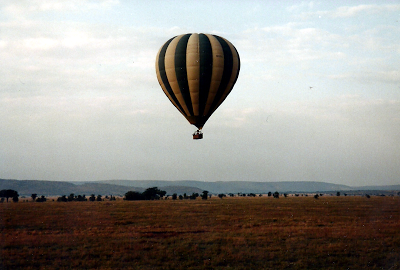
Memories come in all different shapes, colors, and intensity. Some are wonderful, some are awful. One of the most pleasurable memories I garnered from the past thirty years of international travel was when my host in Tanzania favored me with an exotic hot air balloon safari over the incomparable African Serengeti. At 4:00 a.m. I was taken in a Land Rover across the African plains to where our majestic, glowing balloon was coming alive. Fire and super-heated gases were being blasted into the still-limp balloon.

The sky was beginning to lighten, and faint colors of orange and pink bounced from the fluffy African clouds. Once we were settled into the basket and the cotton ropes that had tethered us to earth were loosened, we began to slowly ascend above the branches of the acacia trees. The pilot took us to a height of about two thousand feet. We viewed the vast number of animals on the floor of the Serengeti: herds of wildebeests, zebras, and gazelles, prides of lions returning from their nightly hunting, cheetahs, hyenas, elephants, and giraffes.

The pilot picked out a specific herd below and maneuvered the super-silent balloon back down to below the treetops where we could have reached out and touched the animals. Of course, when the pilot decided to ascend again, the sharp blast of the hot burner scattered the herd and we arose once more, high enough to pick another group of animals to visit in the ecosystem. The thrill of the two-hour balloon ride in the early morning as the sun began to bathe the Serengeti, and the adrenalin rush from experiencing so many wild animals close at hand in their regular morning routines, filled my emotional memory reservoir to flood stage. I would never forget that October morning.

The process of our minds that encodes, stores, and retrieves such Serengeti experiences is called memory. It is a lot like the cell phone camera of your heart that makes special moments last forever. It is the way of holding onto important things you don’t want to lose. As Edward de Bono once said, “A memory is what is left when something happens and does not completely un-happen.” And the memory has a way of encoding, storing, and retrieving a bit of heaven from which we cannot be driven, as well as a hell from which we cannot escape. The non-discriminating memory function processes the bad things as well as the good things.

Shortly after making the delightful trip to Tanzania, I made an absolutely devastating trip to Belgrade, Serbia, in old Yugoslavia. I was driven to the City of Nis, where thousands of refugees were seeking protection from the Bosnia-Herzegovina, Croatia, Kosovo massacres. Project C.U.R.E. had agreed to help by donating medical goods to the refugee centers. Nis had set up fifteen refugee locations. Our first stop was at an old crumbling hotel in lower downtown. The doctor with us from the Ministry of Health succinctly warned me, “Most of these people have already died inside in order to survive.” They had walked to Nis trying to escape getting shot in cold blood during the ethnic cleansing.

We started on the top floor of the hotel. A man and his family of eight, including his old parents, lived in one small room that had been a closet. They were surviving on macaroni. The man told me that one day men with guns came to his house and told him to leave right then and take his family with him or they would line them all up and shoot them. He was instructed that he could leave his blind father and old mother there if he wanted to, and they would kill them for him because they knew the old couple would slow down their escape. As they left, the men ransacked their house for any valuables, then burned the house and outbuildings so the family could never return to Kosovo. As they walked north, they turned and watched as all their earthly possessions went up in fire. There were over three million victims. That family was part of over two hundred thousand victims from just that part of Kosovo.

As we stood in the hallway of the fourth floor level, we were surrounded by women who looked very old. I was told that some were still in their 40’s. One woman had watched as her husband and sons had been shot. She and her daughters had been raped as they fled. Through her tears and occasional sobs, she shared with me the memories of her beautiful flowers that she loved at her home in Kosovo. “They burned everything. I have nothing. Now, I write poems but there is no one left to read them or listen to me.” 

On another floor, a younger woman ran to her room and brought some sort of a diploma to show me. The paper was watermarked and stained. There was no glass covering the print. Along with the framed document, she held two pieces of broken glass. She stroked the surface of the glass gently as if she were touching the soft skin of a baby’s face. As she stared at the glass, the pilot light of her memory sputtered in her eyes. “This is all I have left of my life and my family. Now, I have nothing and no one left. I am not sure how I came here. I am lost.” 

Some memories are wonderful . . . some memories are awful. Sometimes we have a choice regarding memories . . . sometimes we do not. However, I decided while standing in the old Hotel Park in Nis that I would actively choose to gather and store an abundance of good memories in my memory reservoir. I needed enough good memories to far outweigh the possibility of bad memories I might acquire. I would need all the good memories possible to sustain me for the rest of my days.