Scrooge, Jacob Marley & Business

We have spent considerable time on the curbside of the intersection of culture and economics. The time of discovery and review is time extremely well spent because that intersection is where transformation on this old planet earth takes place. The strategic components that make it across that intersection determine recorded history. 

We toyed with the idea that all individuals gathered at the intersection have carried with them their own personal market basket in which they have placed their most valuable and precious possessions. What the individuals take from their market baskets and inject into the historic action at the intersection will change the world. So, the question is proffered, "What'cha gonna do with what'cha got?" What is the most strategic and important component in your personal market basket that you could take out and inject into the traffic of the intersection of culture and economics? 

After spending years observing and participating in cultures and civilizations around the world, this is my personal conclusion: The most powerful possession you could take from your personal market basket and inject into the traffic of the intersection is . . . Virtue. 

I am going to insert here the retelling of one of the stories I included in my book, Love and Common Sense, (p. 163). It is a familiar story written by one of my favorite authors, Charles Dickens. It is a classic story about how Ebenezer Scrooge accepted a second chance in life to inject charity, mercy, forbearance, and benevolence into the mainstream traffic of his life and change his world by helping others around him become better off; 

Marley was dead as a doornail," starts out Charles Dickens in his Christmas masterpiece A Christmas Carol. "There is no doubt that Marley is dead. This must be distinctly understood, or nothing wonderful can come of the story I am going to relate." Dickens intends to give Marley a position of authenticity and place him in a position where no one could argue with his established wisdom. He was already dead, but now he had access to knowledge as to where he was and why he was where he was. Somehow, Marley had bargained for the chance to revisit his old, selfish business partner, Scrooge, and give him one more thin chance to mend his greedy ways
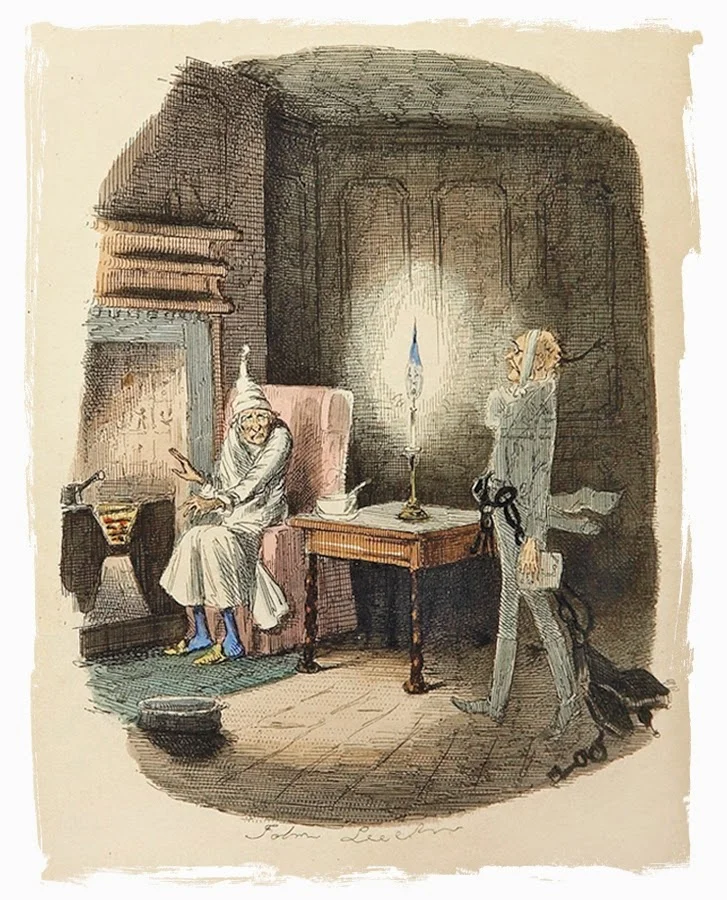

After Marley makes his scary entrance through Scrooge's double-locked doors, dragging his chains he had forged in life link by link, he gets down to giving Scrooge his other-worldly advice. 

"It is required of every man . . . that the spirit within him should walk abroad among his fellowmen, and travel far and wide; and if that spirit goes not forth in life it is condemned to do so after death. It is doomed to wander through the world - oh woe is me! - and witness what it cannot share, but might have shared on earth, and turned to happiness!" 

Scrooge stabbed at a chance to turn down the heat of Marley's message, "Speak comfort to me, Jacob!" 

"I have none to give . . . . No space of regret can make amends for one life's opportunity misused! Yet such was I! Oh, such was I!" 

Scrooge couldn't deflect the message, so he tries a little flattery, "but you were always a good man of business, Jacob." 

"Business!" the ghost cried, wringing his hands. "Mankind was my business. The common welfare was my business; charity, mercy, forbearance, and benevolence, were all my business. The dealings of my trade were but a drop of water in the comprehensive ocean of my business!" Then Jacob Marley's ghost went on: "I am here tonight to warn you: that you have yet a chance and hope of escaping my fate." 

I have personally tried to discipline my behavior over the years to revisit the words and spirit of Charles Dickens Jacob Marley, not only at Christmastime, but throughout the year. His powerful advice, however correct or incorrect his theology, is as necessary as oxygen. Mankind truly is my business; that's the "why" behind the past twenty-five years of Project C.U.R.E.! "No space of regret can make amends for a lifetime of misused opportunity." The common welfare is my business. Charity, mercy, forbearance and benevolence must be the mainspring and clockwork of my life every day. 

The message of Marley should remind us that the chains of life that we forge link by link, day by day, should not be chains that shackle us to the greedy accumulation of this world; rather, the crafted links should become chains that bind our hearts together with kindness, justice and righteousness on this earth. 

Next Week: Scrooge, Jacob Marley & Business, Part 2

(Research ideas from Dr. Jackson's new writing project on Cultural Economics) 

© Dr. James W. Jackson

Permissions granted by Winston-Crown Publishing House


At the Intersection: Vice vs.Virtue

All folks are gathered at the intersection of transformational change, and each person there possesses an amazing capacity for the phenomenon of evil as well as an astounding capacity for excellence of character and goodness. Early philosophers and prophets recognized these history-altering capacities, and wrote to enlighten the minds and give wisdom to their followers. The teachings and stories of Jesus, while he was on earth, are packed full of revelations regarding the battles of vice vs. virtue.

Plato, Aristotle, and later, the church leaders, like the monk Evagrius Ponticus, John Cassian, and even Pope Gregory, endeavored to formulate into lists examples of the deadliest of evil thoughts and sins. Tinkering with the list never stops, but the following list is a fine compilation of what has been considered over the centuries the most sinister and dangerous of vices . . .


                                             THE SEVEN DEADLY SINS

LUST

Carnal lechery or lust is a general term for an inordinate and intense desire to fulfill not only the need for things of a sexual nature, but also power, fame, money, or even food.

GLUTTONY

Taken from the Latin gluttire, depicting the gulping down or swallowing food excessively, but it also refers to gluttony, or Latin gula, as in the over-indulgence and over-consumption of anything to the point of waste.

GREED

Here is another attitudinal and behavioral sin of excess sometimes referred to as avarice or even covetousness. Usually greed is linked with the idea of a rapacious desire for material things in contrast to eternal values, and is connected to the violation of someone else’s value, rights, or dignity.

SLOTH

While sloth (Latin, acedia) has been explained differently over the years, it still basically refers to physical and spiritual laziness. When a person fails to develop spiritually, an attitude and behavior of rejection of God and grace takes place. Evil is said to exist where a person resists doing what should be done and when good men fail to act.

WRATH

Rage (Latin, ira) is considered to be uncontrolled hatred or anger and can demonstrate itself by violence and revenge that can even be passed on to future generations, or can manifest itself in self-destruction and suicide. The attitude and behavior of wrath rejects the provisions of God’s gifts.

ENVY

Envy is another sin of insatiable desire. It demands to be better and have more than others. The want is so strong that it will seek to deprive others of what they have, be it material things, abilities, status, recognition, or rewards.

PRIDE

One thing that most all lists agree upon is that the matter of pride is at the heart and center of all other deadly sins. It is at the root because it demands that it is first and best and all others and all else is secondary. In today’s vernacular the expression would be, “It’s all about me.” With unchecked pride there is no need to consider anyone else, not even God. Where pride is in control the entrenched narcissism shouts that “I am not just privileged and exceptional, but above all . . . entitled.”

                                             THE SEVEN CARDINAL VIRTUES

Throughout history, good men who have had concern for the betterment of their culture and a sincere desire to help other people be better off have endeavored to examine, and also teach, what they considered to be the fundamentals of goodness as a counter to the Seven Deadly Sins. It has been agreed upon by Christian thinkers, as well as many pagan philosophers, that virtue is the key building block of a successful life as well as a successful civilization. The behavioral consideration ofvices vs. virtue is at the very heart of the study of cultural economics.

The phenomenon of moral and wholesome character has been promoted by Plato, Aristotle, and other great philosophers and church leaders. Their desire is to protect not only the people standing on the curbside of the intersection, but also to protect the outcome of the flow of the traffic through that intersection of culture and economics. What happens at the intersection of culture and economics influences and shapes civilizations.

It should be of little surprise, then, that over the centuries righteous thinkers have also constructed lists of virtuous attributes intended to answer the influence of thedeadly sins:

CHASTITY

Abstaining from inordinate or improper sexual conduct according to one's state in life. Embracing purity of thought and behavior and achieving moral wholesomeness of character. Living a clean life of good health and hygiene promoted by cleanliness and restraint from indulgence of intoxicants, and avoiding temptation and corruption.

TEMPERANCE

Restraint and self-control. Prudence in regard to appropriate behavior, and proper moderation in the indulgence of natural appetites, passions, and especially in the use of drugs and alcohol.

CHARITY

Generosity and self sacrifice, benevolent attitudes and actions, especially toward those in need or in disfavor.

DILIGENCE

Steadfastness and persistence in accomplishing that which is undertaken; zealous and constant endurance in the effort to always guard against laziness of body, mind, and spirit, fulfilling the degree of care and concern required even when no one else is watching.

PATIENCE

Moderation through forbearance and perspective, a willingness to solve injustices and conflicts peacefully instead of choosing violence as an answer to conflict resolutions, the ability to bear delay, provocation, or misfortune without cluttering the situation with reactions of temper, irritation, or complaint.

KINDNESS

Thoughtful consideration, empathy, and accommodation displayed with a friendly demeanor and without prejudice, resentment, or ill will toward the recipient, a spirit of magnanimity combined with compassion and cheerfulness.

HUMILITY

Humility is everything that pride is not. It is a frank and modest estimate or opinion of one’s own importance, rank, or position, while invoking respect, honor, and value upon the position and person of another, it is the spirit of perceiving the correct value and relationship between you, God, and the world that God has created.

Origen, a second century teacher from Alexandria, insisted, “Genuine transformation of life comes from reading the ancient Scriptures, learning who the just men and women were and imitating them.”1 That would be his suggestion for the building of viable traditions that would eventually be nourished and supported by institutions.

Both Greek and Roman writers pushed the idea that the acquiring of virtue would be immensely aided by imitating the noble example of others. Seneca claimed, “Plato, Aristotle, and the whole throng of sages . . . derived more benefit from the character than from the words of Socrates. The way is long if one follows precepts, but short and accommodating if one imitates examples.”

In the third century, Augustine, then Bishop of Hippo, really cleared up the issue of invoking the practice of imitating in order to acquire traits of virtue: “Now we require many virtues and from these virtues we advance to virtue itself. What virtue, you inquire? I reply: Christ, the very virtue and wisdom of God. He gives diverse virtues here below, and he will also supply the one virtue, namely himself, for all of the other virtues which are useful and necessary in this vale of tears.”2

(Please allow me to end with this personal note: Regardless of the ancient writers, I find that I am not a very good imitator. But what became a great help to me regarding this battle between vice and virtue was my discovery of a possibility while reading the Scriptures. The Apostle Paul talked about “Christ in me . . . my only hope of glory.”(Col. 1:27) And then I read on and found that the Holy Spirit was eager to enter into me and begin living the life of Jesus Christ through me to the glory of God the Father. (Corinth. Galat. Ephe.) That made a whole lot of sense to me because it would be God’s virtue in me instead of me trying to trump up something of my own. It seems to have worked well, at least for this pilgrim who finds himself standing on the curbside of the intersection of culture and economics.)

Next Week: Scrooge, Jacob Marley & Business

(Research ideas from Dr. Jackson's new writing project on Cultural Economics)

© Dr. James W. Jackson  

Permissions granted by Winston-Crown Publishing House

At the Intersection: Curbside Capacities

Every individual stands on the curbside of the intersection of culture and economics. That is where global transformation, as well as any other change, takes place. Culture will influence, and indeed has the power within it, to change economic philosophy and economic systems at that intersection. Conversely, economic systems and ideas have the power to change a given culture. 

Just think of the potential capacity for change that is wrapped up in the individuals with their personal market baskets, gathered on the curbside of that intersection. Quite frankly, I find that potential dynamism quite fascinating. There is potential capacity to perform, to yield, or to withstand any and all components of culture or any and all components of economics as they try to intersect, collide, and pass through that intersection. The components that make it through to the other side of the intersection will determine history as it is recorded. 

I am additionally intrigued by the variety of emotional, moral, and behavioral capacities that influence the components of economics and culture as they pass through the intersection. The traffic flowing through the intersection of culture and economics seems to become super charged by the high octane fuel propelling the varied components as they pass through the traffic. 

As I have traveled to nearly every nook and cranny of this globe, and observed hundreds of people groups and the diverse examples of civilizations, I have been amazed at the human capacity to harbor and display the phenomenon of evil. I traveled throughout Rwanda on the heels of the terrible Hutu- Tutsi genocide. I was in Congo and Angola at the time of the mass murders. I personally viewed Pol Pot’s torture chambers located at the old high school in downtown Phnom Penh, Cambodia, and witnessed where hundreds of thousands of Cambodia’s best citizens were intentionally slaughtered by their own government.

I was in Bosnia, Kosovo, and Belgrade, Serbia and witnessed the atrocities taking place. In the little country of Nagorno Karabakh I watched the genocide by the Russian Fourth Army, the Azerbaijanis, and the Turks wipe out eighty percent of that small country’s male population, and it seemed that hardly anyone even noticed. I’ve spent time at the Holocaust memorials in Jerusalem, Israel, and Washington D.C. and asked the question, “Just how can this be?”

That same capacity for evil can likewise be observed in the law-ignoring greed of local governments, corporate heads, and homegrown community thugs, as well as even fraudulent social services recipients. 

But, history has also shown that the folks gathered at the intersection can receive and contain a remarkable capacity for virtue. It is possible for them to attain through invitation and development, excellence of character. And based on that excellence of character, they can choose to become agents and dispensers of kindness, generosity, fairness, sympathy, mercy, personal responsibility, justice, charity, gentleness, forbearance, righteousness, and benevolence. 

The individuals standing on the curbside of the intersection have the power and opportunity to ultimately determine history. But who will actually step forward and begin the process by taking the precious items from their market basket and injecting them into the flow of traffic? 

As I visualize this epic scene of the making of history at the intersection of transformation, my mind recalls an intriguing episode shared with me by a new friend as I traveled through Asia: 

        Past the seeker as he prayed came the crippled and the beggar and the beaten.

        And seeing them, the holy one went down into deep prayer and cried,

        “Great God, how is it that a loving Creator can see such things and yet do   

        nothing about them?”

       And out of the long silence, God said, “I did do something . . . 

        I made you.”

We who are standing on the curbside of the intersection of transformation have the power to influence the direction, timing, and outcome. How will we handle the opportunity? 

Next Week: Vice vs. Virtue

© Dr. James W. Jackson  

Permissions granted by Winston-Crown Publishing House


At the Intersection: Our Market Basket

Let’s pursue this concept of the intersection a bit more:

We are an integral part of this world of transformation and change. We have inherited this culture and economic system in which we exist and operate. We own our future and have been endowed with the power to personally choose between and amongst the myriads of alternatives that have been and will be presented to us on a daily basis. The choices that we select will, of necessity, set into motion consequences that will affect our lives, the lives of others around us, and even the future options that will be made available to us.

All of those transformational happenings will take place at the intersection of culture and economics. Whether we like it or not, each of us presently stands on the curbside of that intersection. From that position we are able to observe the intriguing and constant flow of traffic moving in front of us through that intersection. We are not, however, just standing on the curbside as disengaged and disinterested observers. We, along with all the others gathered, are highly involved in what passes through that intersection and the results of the continual flow of traffic. Transformation continually takes place and we are a part of it.

If we will observe carefully, we will see that every person standing on the curbside, including ourselves, is carrying a lovely market basket on his or her arm. Everyone has been shopping on the way to the curbside.

Placed inside those baskets are the most important and valuable items in the world. At the marketplace, on the way to the intersection, every person has been hunting, inspecting, and accumulating. The items are so very precious because each person has been actually exchanging a part of himself or herself for the contents collected and placed so very carefully into the lovely market baskets. So, everything collected has either been placed into those personal market baskets as a direct result of a purchase or of a gift exchange.

Since the cultural and economic systems belong to us, ultimately, we are the ones who determine what components pass through the intersection and what is declared as history on the other side. If the contents of those market baskets are powerful enough to alter and direct the flow of history, perhaps it would be important for us to examine just what makes up the contents of those personal and distinct market baskets. Just for fun, let’s see if we can figure out the contents and value of our own personal market basket:

· FINANCIAL POSSESSIONS:

Let’s do this through the equity approach: Take the replacement value of your market basket contents and then subtract any indebtedness: Savings accounts, cash, loans and accounts due you, stocks, bonds, pension plans, equities in businesses, partnerships, home, additional properties, autos, household goods, and other personal properties.

· PERSONAL POSSESSIONS:

Physical possessions of good health, good DNA, attractive characteristics, wholesome attitudes, intellectual possessions, past experiences, education, healthy emotional possessions, good decision making capabilities, temporal, or possessions of time (number of days you have left).

· RELATIONAL POSSESSIONS:

Your family, friends, and your influence on other people and situations.

· SPIRITUAL POSSESSIONS:

You are at peace with yourself, others, and God, kind, self controlled, generous, patient, and forgiving to your family and others, a life characterized by a deep sense of joy, consistency, gratefulness, a non-complaining attitude, and dependable.

· SPECIAL POSSESSIONS:

In addition to the other possessions in your market basket, God has given to you some special abilities. It is true, you may have refined them and put a lot of work and discipline into developing them, but you realize that they are special possessions given to you by a discerning God. List those special abilities that you feel are your strongest talents.

All individuals are standing on the curbside of the intersection of culture and economics. It is almost unfathomable when trying to comprehend the variety and value of the possessions that are held in the market baskets of those individuals. With those possessions, the individuals standing there have the power and opportunity to ultimately determine what happens at that intersection.

History will be determined by what those individuals will collectively decide to inject into that flow of traffic passing through the intersection. What will they be willing to take out of their market baskets and invest into the process of making history? What will they do to advance the procedure of resolution? What will they be willing to do to unsnarl the traffic and advance the proceeding of history?

All persons on the curbside face the same leveling question concerning the use of the possessions within their individual market baskets . . . What’cha Gonna Do With What’cha Got?

By injecting the possessions from their market baskets into the traffic flow of the intersection, they influence the direction, timing, and outcome of the flow of traffic and thereby determine history. The comprehensive and penetrating question becomes very personal . . . What’cha Gonna Do With What’cha Got?

Next Week: Curbside Capacities

(Research ideas from Dr. Jackson’s new writing project on Cultural Economics)


At the Intersection: Examples for the Matrix

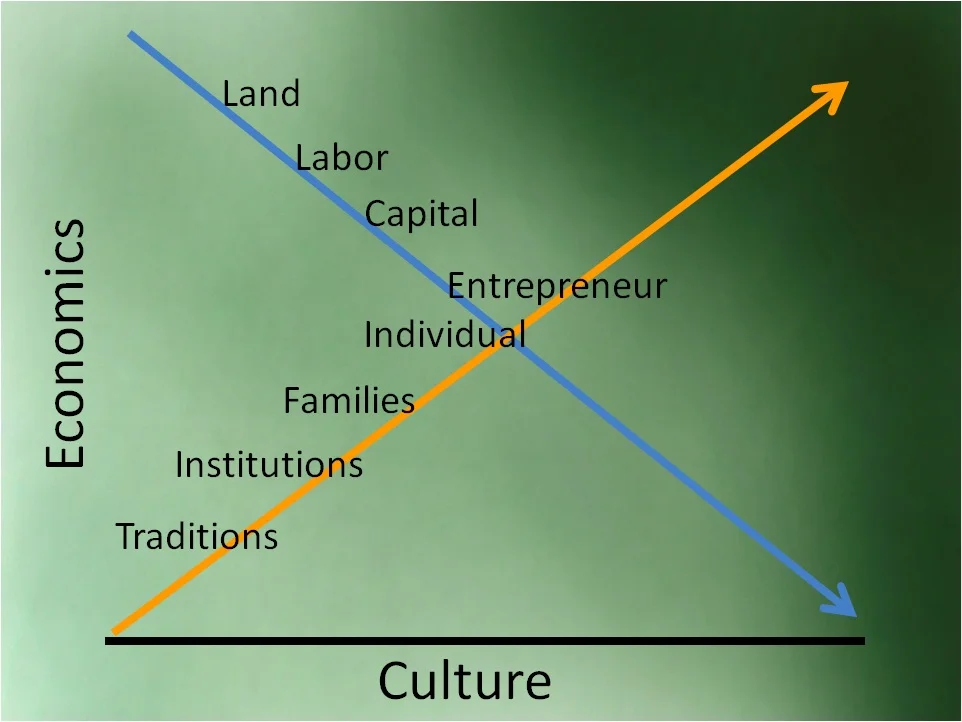
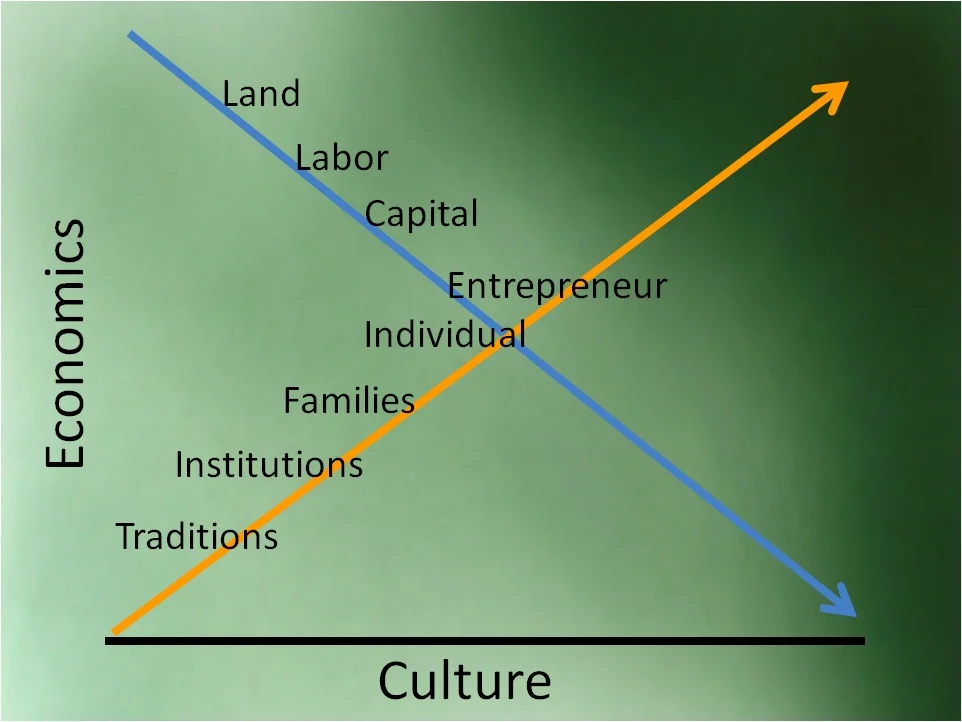
We have now discussed the components of economic production: Land, Labor, Capital, and the Entrepreneur, and also the components of our cultural structure: Traditions, Institutions, Family, and the Individual. Our premise is that Transformation takes place at the intersection of Culture and Economics. Wherever the components of Culture and the components of Economics cross in the intersection of real life, you can expect change.

I’m going to resort to the chalk board and see if we can walk through some common examples in order to see just how such a thing works. The components of Economics will be positioned along the left side of our matrix and the components of Culture will follow the bottom line. The dynamics of the situational example will determine the point of intersection and which of the components will be involved in the confrontation that sets up the incidence of transformation:

  • We talked earlier about the incredible global transformation that took place based on the intuition and action of Alexander the Great after being influenced by the cultural and economic insights of his personal teacher, Aristotle. He conquered the known world.
  • Two hundred seventy- one years later, Julius Caesar laid claim to Alexander’s dream and once again, transformed the global system at the intersection of culture and economics.
  • King James of England, in 1606, granted rights to a business investment company to establish the first American colony in an area designated as Virginia. But the second contract was made with another organization to establish a colony in America. That contract was born out of conflict and the desire for change and freedom. The Pilgrims were a group of settlers who had previously left England to seek relief and freedom in Holland. Disappointed there, they found investors willing to underwrite the expenses of a contract to colonize in America. On September 16, 1620, the Pilgrims set sail on the Mayflower and landed sixty-five days later. At the intersection of culture and economics, the Pilgrims employed their powerful traditions and even religious institutions and families. They set into motion transformation in areas of land use, labor, and capital and the individuals eventually realized the fruits of a new world


  • Eventually the American Revolutionary War between young America and England would be fought at the intersection of culture and economics. Institutions, traditions, families and individuals were pitted against each other on matters of land, labor, capital, and entrepreneurial enterprises.


  • Within recent years, China’s citizens have experienced immeasurable transformation due to national laws implemented in 1979 limiting the family’s size to one child per couple. I personally visited many orphanages throughout China and have been acquainted with the affects of the policy that was fully centered at the intersection of culture and economics. The policies were initiated to alleviate social, economic and environmental problems in China, but have set into motion firestorms of consequences.


  • A bit closer to home . . . we commonly experience the intersection phenomenon in controversial land use situations. Traditions endeavor to dictate how a certain piece of property will be used regardless of personal or institutional ownership rights. Or, a municipality may want to appropriate or condemn a property and build a big box store or commercial strip in order to generate higher tax revenues. The battle is waged at the intersection of culture and economics.


  • Divorce settlements, civil suits, and estate squabbles so very frequently find the principles yelling at each other in the middle of the intersection of culture and economics.


  • Individual families, also, find themselves hammering out philosophical differences at the intersection when it comes to making decisions regarding how they will earn and spend their resources.
Intersection Example Family Financial.png


  • Don’t be surprised when it dawns on you that this same matrix works even for such issues as dealing with the disciplining of the children, (Land = Resources, Labor = Activities, Capital = Rights and Rewards, Entrepreneur = Creativity and Independence). We can count on major transformation taking place at the intersection of culture and economics even when applied to the components involved in domestic situations.

We live in a world of transformation. It is good for us to concern ourselves with how we can more efficiently allocate and manage our resources and abilities. It is also to our benefit to discover and understand how various aspects of human cultures interact with economic events, behaviors, and conditions. Economic philosophies and systems have the power to affect and shape our culture, as well as our culture having influence on our political systems, inherited traditions, religious beliefs and the formation of our institutions. It is imperative to lay aside the notion that economic has only to do with money. It is also imperative to more fully comprehend the scope and sequence of culture.

As we move into a more complete understanding of the eight components listed herein, and see how they work together under a larger umbrella of cultural economics, our identification of problems and even our tasks of conflict resolution will be more easily accomplished.

Next Week: Our Market Basket

(Research Ideas from Dr. Jackson’s new writing project on Cultural Economics) 

© Dr. James W. Jackson  

Permissions granted by Winston-Crown Publishing House


At the Intersection: Cultural Components

Our stated premise is that transformation (global, national, corporate, domestic, personal) takes place at the intersection of culture and economics. We just finished discussing the four basic production components of economics: Land, Labor, Capital, and the Entrepreneur. Now it’s time to examine the cultural components.

It is necessary to have an agreed upon definition when discussing the concept ofculture. No, we are neither talking about growing a microorganism in a laboratory Petri dish, nor are we describing an artsy enlightenment trip to Carnegie Hall in New York City or an art museum in London. Culture, as we will be discussing, can be described as the inherited and shared beliefs, attitudes, feelings, values, ideas, customs, and social behaviors of a particular people.

There are at least four strategic components that are utilized in order to perpetuate a culture: Traditions, Institutions, Families, and Individuals. It is not my intention at this point to get involved in a thorough investigation or discussion of these four components. I must admit, however, that it is a temptation to get off track and share with you some of the incredible customs, traditions, and institutions I have witnessed in my world travels over the past nearly thirty-five years (everything from simple birthday celebrations to male and female rites-of-passage circumcision rituals of the Maasai tribe in Kenya and Tanzania). We will stay on point.

TRADITIONS

The term tradition comes from the Latin tradere that literally means to transmit, to hand over, to give for safekeeping. It is a belief or pattern of behavior in a community with special or symbolic meaning that has been handed down from generation to generation and might persist and evolve for thousands of years. The concept of tradition is viewed as a set of precedents valued by a culture and carries with it the notion of holding on to a previous time. Traditions are extremely important to a given group. History bears out those traditions are many times considered worth dying for. Wars have been fought and civilizations eradicated because of traditions.

INSTITUTIONS

Institutions are designed to formalize and perpetuate agreed upon traditions. They work to give structure, influence and even power to the sustainability of those social orders deemed most important to a people group.

On the surface, institutions look a lot like churches, hospitals, jails, banks, and schools. But, more formally, they describe normative systems that take care of regulating the distribution of goods and services, the providing for the legitimate use of power, the transmitting of knowledge from the present generation to the next generation, and the lending of structure to moral and religious matters. Institutions end up mediating the agreed upon rules that govern social behavior of a group.

FAMILY

As a component of culture, family has to do with kinship. Here again, this is not an involved dissertation on the current interpretation and aspects of the modern family.When dealing, however, with the premise that all transformation takes place at the intersection of culture and economics, the cultural component of family is paramount.

Family is considered more than just a basic social unit consisting of parents and their children, whether dwelling together or not. It extends to any group of persons closely related by blood, as parents, children, uncles, aunts, and cousins, etc.

Historically, kinship has played a huge role in developing, establishing, and perpetuating traditions. Likewise, the family units of a people group are the most powerful influence and factor of sustainability when it comes to the success of institutions.

INDIVIDUAL

Recall for a moment the list of production components of economics that we discussed last session: Land, Labor, Capital, and the Entrepreneur. We learned that nothing happens without the Entrepreneur. So it is with the components of culture . . . nothing happens without the Individual.

From the traditions, from the institutions, and from the family, the individual emerges as the ultimate building block of transformation and change.

Now we are ready to plug these eight components into our social economics matrix and apply them to the phenomenon of transformation.

Next Week: Examples for the Matrix

(Research Ideas from Dr. Jackson’s new writing project on Cultural Economics) 


At the Intersection: Components of Production

In economics the term utility refers to the satisfaction people get from the goods and services they consume and the activities they pursue, i.e. what it is that makes them happy. In order to understand how the system works, it is important to go back to the simple basics or starting blocks that are required to serve the interests of the people. There are four general categories of economic resources that are traditionally considered components of production: Land, Labor, Capital. and the Entrepreneur.

I suppose you could say that, “In the beginning” there were only two components of production: land and labor. Then the fellow doing all the labor, named “Adam”, figured it out that he would benefit greatly by taking a very sharp stone to kill the wild animal he was going to use for meat, instead of beating it or strangling it. He also enhanced the utility of the process by using yet a sharper stone as a knife to remove the hairy, tough hide of the animal before cooking it or trying to barter it to one of his buddies. At that point, he took a giant step into the position of the entrepreneur while also utilizing components of capital, thus making it four components of production rather than just two. Now back to the serious components of traditional economics.

LAND

By the term land economists mean nature, natural resources, the earth plus the heavens, and the seas. Simply stated, land is God’s gift to the children of men (Psalm 115:16). It is the untouched earth as we find it. That economic term includes everything on, above, and below the surface of the earth. It includes streams, lakes, minerals, forests, air, space, wild animals, plants, fossil fuels, and even rocks brought back from the moon . . . everything that man finds in his environment that is not a product of mankind’s labor.

Two things to remember about land and all things considered natural resources: First, they are found in nature and that no human effort has been used to make or alter them. Second, they can be used for the production of goods and services.

LABOR

The resource component called labor consists of the physical and mental talents of individuals used in producing goods and services. The services of airline pilots, teachers, welders, loggers, retail clerks, mechanics, professional football players, or rocket scientists are all included under the general heading of labor. Generally speaking, a person’s ownership in his or her own unique labor power is the greatest factor of production under that person’s command. That power is at the person’s disposal for exchanging in the marketplace for the many goods and services desired but not yet owned. The terms, free labor market or competitive labor market refer to a person’s being able to exchange or sell his labor power to the highest bidder on the one hand, and the bidder being able to exchange or purchase labor power at the best terms he can find.

CAPITAL

Capital is wealth intended to produce more wealth and is not yet in the hands of the consumer but still somewhere in the process stage of producing more wealth or income. In economic thought, capital, or capital goods includes all manufactured aids used in producing consumer goods and services. Included are factories, warehouses, distribution centers, transportation facilities, as well as items like stone knives, hammers, wrenches, drill presses, industrial robots, or other pieces of machinery. Economists refer to the purchase of capital goods as investments. Capital goods differ from consumer goods because consumer goods satisfy wants directly, whereas capital goods do so indirectly by aiding in the production of consumer goods.

The term capital as used by economists does not refer to money, but to tools and other productive equipment. Because money produces nothing by itself, economists do not include it as a basic economic resource.

THE ENTREPRENEUR

The entrepreneur takes the initiative in combining the resources of land, labor, and capital to produce a good or a service. Both a sparkplug and a catalyst, the entrepreneur is the driving force behind production and the agent who combines the other resources in what is hoped will be a successful business venture. The entrepreneur’s time, effort, and abilities invested do not guarantee any degree of success or profit. The risks may result in losses rather than rewards, and possibly, the entrepreneur will put at risk not only his or her invested assets but those of associates and stockholders as well.

But nothing happens without the entrepreneur . . . a special human resource who takes an idea and attempts to make an economic profit from it by combining all other factors of production. The entrepreneur is the individual who also takes on all of the risks and rewards of the business.

Students sometimes struggle with the concept of entrepreneur. It is a tricky word to spell and pronounce. It is a bit ironic that it was the French who attached the name that stuck to the functional concept, but it is a great word. For me, the easiest way to visualize and remember the function of the entrepreneur is to recall its simplicity. The only thing an entrepreneur really does is to take something of a lesser value from the economic system and place it back into the system at a higher value. That is all an entrepreneur does.

The primitive man simply took a common rock out of the system and returned it back into the economic system as a stone knife.

I feel blessed to be considered an entrepreneur. In our days of real estate development we performed a very simple and rewarding task. We took out of the economy struggling ranches that were not producing very much wealth and delivering almost no tax revenue to the county or state. We developed them into beautiful recreational and business sites in Colorado’s ski country and entered those sites back into the economy at a higher value.

When it was time to meet international needs for medical supplies and equipment for hospitals and clinics in lesser developed countries around the world, Project C.U.R.E. simply removed out of our economic system medical items of lower value, did a bit of enhancement and reinserted those medical items back into the international economy where they were desperately needed, and thousands and thousands of lives were saved in the process.

Wealth is generated from production. Poverty is perpetuated through non-production. It is very important for us to understand the utility that flows from the basic components of production: Land, Labor, Capital, and the Entrepreneur. 

Next Week: Cultural Components

(Research ideas from Dr. Jackson's new writing project on Cultural Economics)

© Dr. James W. Jackson  

Permissions granted by Winston-Crown Publishing House


At the Intersection: Culture and Economics

You and I live in a world of transformation. I predict that change is here to stay . . . unless something changes. My personal observations have convinced me that global transformation, national transformation, corporate transformation, domestic transformation, and even personal transformation take place at the intersection of culture and economics. Wherever the cultural factors of traditions, institutions, families, and individuals intersect with the economic production factors of land, labor, capital, and the entrepreneur, you can count on change.

It is exciting to see how the phenomenon of transformation takes place. Once you begin to recognize the function, you can better understand, and in some cases even predict, the associated behavior that results. When I was a kid, my grandfather used to tell me, “Jimmy, if you want to know why something happens . . . follow the money.” But I have discovered that if you really want to get a glimpse of why and how things happen you must follow that money trail down to the curbside of the intersection and observe what happens when the economic factors try to cross the intersection at the same time as the cultural factors.

In these next few articles, I am going to try to assume the assignment of presenting this facet of cultural economics so that we can better understand the idea of global, national, corporate, domestic, and personal transformation.

To begin, let’s establish some simple guidelines for our thoughts:

Traditional economics concerns itself with how we efficiently allocate and manage our resources—land, labor, capital, and the entrepreneur—as well as how we organize the production of goods and services. Economists collect this data and develop charts, or matrices, to project our conclusions into the future on the basic assumption that future reality will be an extension of past reality.

The subject of culture suggests an integrated set of behavior patterns learned by members in a society, but not necessarily inherited biologically. The behavior patterns, over time, become traditions that are passed on to future generations through institutions, family units, and individuals.

Cultural Economics is the branch of economics that concerns itself with the relationship of culture to economic outcomes. It studies how various aspects of human cultures interact with economic events, behaviors, and conditions. Ultimately, the study of economics is all about people with their needs, talents, abilities, propensities, and even their emotions of love, joy, surprise, anger, sadness, and fear.

A given culture will influence the political systems, traditions, religious beliefs, the formation of institutions, and even the value we ascribe to individuals. Likewise, economic philosophies and systems have the power to affect and shape our cultures.

In the year 336 B.C., a twenty-one- year- old was placed on the Greek throne following the assassination of his father, Philip. Young Alexander of Macedonia had been schooled at the feet of the Greek philosopher, Aristotle, who had made Alexander aware of a world that was fragmented economically into countless little city-states. Each dominion had its own government, money system, army, and customs.

With Aristotle’s help, Alexander began to comprehend the high cost of fragmentation, and in the next dozen years Alexander the Great “conquered” the known world for Greece. He conquered it with such interesting subtleties that more often than not the countries in his path simply threw open their gates and welcomed him in. He brought with him security, protection, and fairness, and encouraged free trade within his new world based on a dependable metallic coinage of gold and silver. The genius of that economic enterprise and availability rested in the fact that it did not cost his constituents more out of their purses for those additional benefits, but less . . . a whole lot less!

Where the citizens had been paying as much as seventy to eighty percent in taxes to operate their fragmented city-states, Alexander reduced those tax rates to around fifteen percent. Little wonder that they threw open their city gates and welcomed him with open arms!

But, alas, with no more worlds to conquer, Alexander the Great died at the early age of thirty-three as a result of a wild drinking party. His obtuse generals decided to divide up the empire and, along with the insecure propensity of the Europeans and Asians, the populaces began to move back to a model of fragmented city-states, no longer unified by protection and a stable economy. The Greek empire began to crumble, but his dream lived on.

Two hundred seventy-one years later, Julius Caesar laid claim to the dream of Alexander the Great, overhauled it, and began to implement the “great experiment,”Pax Romana.

The global economy was not nearly as fragmented as it had been prior to Alexander, and the Greek Philosophy, literature, and ideas of democracy had done much to break down the barriers between the Greeks and the barbarians. Julius Caesar, like Alexander, began building his empire, not through brutal conquest but rather through economic and political liberation.

Five years after he had taken over Gaul, Julius Caesar entered Italy, where Rome opened her gates and welcomed him as her new champion and leader. He made the stability of the Roman currency so attractive, the mildness of Roman taxation so alluring, the openness of world trade and commerce so desirable that his empire expanded by the force of demand. He treated the conquered nations with such secure leniency that even if they could have revolted, they didn’t.

The economy began to grow, trade began to flourish, and the Roman Empire was established. Julius Caesar perceived that individual initiative and creativity that was rewarded produced more individual initiative and more creativity, thus a more stable and wealthy empire. He also perceived that exorbitant taxation squelched individual initiative and creativity.

Each of those classic examples includes major global transformation taking place expressly at the intersection of culture and economics. Let’s take a closer look at the factors gathered at the curbside of that intersection of culture and economics.

Next Week: Components of production

(Research Ideas from Dr. Jackson’s new writing project on Cultural Economics)

© Dr. James W. Jackson  

Permissions granted by Winston-Crown Publishing House


Supposin': Bridge Back

Note: “Thank you” to everyone who took time to read and comment on the fourteen recent Supposin’ postings. I was encouraged by your responses to the positive approach of looking into the future. Just maybe, some of the material will make it to the final book edit and not just end up on the floor of the editing room. Our readership on the different digital sites continues to grow. This is a great time in history to be alive! JWJ

While we were in the midst of learning about Cultural Economics, I took the prerogative to amble on a bird walk through the subjects of scarcity, choice, and cost. Based on my years of observation, my hunch has been that by making the predisposition of scarcity and shortage our lodestar of life we end up with an attitudinal blood type of B Negative.

On our little walk, I was eager for us to discover that the birds of hope are everywhere, and we desperately need to listen to them sing. That goes equally for the new generation coming on as for the passing generation headed out. I agree with Mark Twain when he said, “There is no sadder sight than a young pessimist.” On the other hand, there is nothing so refreshing and stabilizing as a maturing generation of optimists.

I admit, while I was writing about all the hope and excitement resulting from the exponential growth of knowledge and information and the astounding miracles of new technology, I did receive some comments accompanied by raised eyebrows: “Don’t you see the mess our country is in?”

I am reminded of what Walt Disney used to say while he was attempting to build his dream of Disneyland: “I always like to look on the optimistic side of life, but I am realistic enough to know that life is a complex matter.” The simple answer is, “Yes, I understand that the world of ours is in a mess and that civility is very fragile.” Of my own volition I chose to spend time in over 150 countries of the world. I chose not to travel as a tourist, but travel to the political and cultural hotspots staying in villages, and so many times in personal homes in Africa, India, the old Soviet Union, Afghanistan, Iraq, Palestine, Laos, Cambodia, Burma, China, northern Pakistan, and the rest.

I tried to closely observe the personal and tribal customs, the local conflicts, the historic traditions, the economic practices, and to ask lots of questions of not only the government leaders, but also of the common people. Many of them became my personal friends who would confide in me when I pushed for hard answers.

I spent a lot of time in Russia and the old Soviet Federation as it was unraveling militarily, politically, economically, and culturally. I was there when the citizens of Ukraine stormed the poorly guarded armories and took weapons for themselves for their own protection. I also was made aware that really no one was successfully overseeing the watch care of the Soviet strategic weapons or military institutions of defense.

I learned that practically any military items could be purchased with the correct amount of currency and the right contact. I have also discovered that no one knows where all those rockets, bombs, missiles, and warheads have ended up.

I am not naïve regarding the possibility of losing all the exponential knowledge and information we have so marvelously stored on our incomparable computer systems and in the clouds. Nor am I blind to the fact that within the next thirty seconds we all could be jolted back into the dark ages without access to electrical grid systems, food delivery systems, information systems, communication systems, healthcare, transportation, or government services. None has a free hall pass or an exemption certificate tucked away anywhere for this one.

The U.S. Congressional Electromagnetic Pulse Commission, the Congressional Strategic Posture Commission, and several additional governmental entities have established that a direct nuclear attack on the U.S. is not necessary to wreak untold havoc on our entire population. All that is necessary is to detonate one nuclear warhead high above any part of our country. It would not be mandatory to even aim it in our direction . . . just straight up.

As the warhead detonates, the powerful electromagnetic pulse would generate the gigantic catastrophe. The nuclear warhead would not necessarily have to kill anyone immediately, because it would not need to explode on the earth’s surface. The concept behind the plan reminds me of what I heard the Marxist groups in Africa explain as the refugees were being herded to the refugee camps: “you don’t need to kill them all, simply force the fish to the lake and then drain the lake.”

An Electromagnetic Pulse attack would simply render as useless anything that used an electronic circuit or chip. Everything from a simple car part, to a pacemaker for your heart, to the complicated infrastructure running world banking and financing systems, to all the necessities that it takes to serve 300 million Americans, would likely be knocked out.

Our nation’s extreme vulnerability in this area makes the U.S. a very tempting target for this kind of attack. It would only take a small terrorist group or rogue nation to successfully carry out such an attack. It is estimated that it would take fewer people to carry out such an endeavor than it did for the hellish 9-11 mission. An innocent ship at sea carrying a forty-foot cargo container on the top deck would peel back a false top and become a one-time launch pad to send a small ICBM missile up with a stolen warhead to detonate somewhere between only thirty to three hundred miles above the earth. If the plan was to put the whole world back into the dark ages, it would take only four such innocent-looking ships strategically located at sea.

Mr. R. James Woolsey, former director of CIA is the chairman of the Foundation for Defense of Democracies. Mr. Peter Vincent Pry is the executive director of the Task Force on National and Homeland Security and served on the Congressional Electromagnetic Pulse commission. These men are so concerned about the devastating possibilities of such an attack that they finally went public with their concern in an article in Wall Street Journal in May, 2013. (1) (Recommended reading:One Second After, by William R. Forstchen, Ph.D., specializing in military history and history of technology)

The time that it would take to recover from a nuclear EMP attack has generally been estimated to be at least three years if the trauma were large enough to destroy large power grid transformers. Other estimates use twelve years for recovery time. With no money system intact, there would be a time of great economic failure. Whether this time of economic hardship is of short or long duration will depend upon the reaction of the people after the event. If the recovery period were long, civilization in the United States could reach a tipping point where recovery would become difficult or impossible.

In my opinion, the reason this destructive contrivance has not been utilized before now has to do with the character of our enemies. Those who would seek the demise of America want to not only capture the golden eggs of its wealthy civilization, but also inherit unscathed the goose that continually lays the golden eggs. If they are not careful, their greed could completely obliterate the goose in the process. And they know nothing as to how to create or restore the magic goose. They would rather wait and take it over from the inside and inherit the wealth-generating goose in good health.

Yet, another cast of rogues lusts not so much for the wealth of this nation, as for the introduction of a new era of world history, where with the timely aid of the EMP they could cripple America and allow for the marshaling of a major invasion of Israel and the grand and imminent ushering in of the 12th Imam, the Islamic messiah. I am certain that I have left out other viable options.

Yes, I understand that “this world of ours is in a mess, and that civility is very fragile.” I am aware that we extol and celebrate our history’s splendid periods ofenlightenment, maybe not realizing that every enlightenment period has been preceded by an era of the dark ages. But where does that leave those of us who were born into this enigmatic era?

When the stakes are high and the matter of character of the players is in question, anything can happen. I have discovered that in times like this if you will feed your faith, your fears will starve to death. So, don’t let your fears choose your destiny by default. Get your own personal house and your valued relationships in order. Do what is possible, and then relax and get back to seeing how many other people you can help become better off. Seneca, the Greek philosopher observed, “Where fear is, happiness is not.” If my mind is focused on fear and angst, it is almost impossible to focus on my journey to fulfillment. I choose to keep on being happy!

With all that having been explored, I think it is time we get back to working on the exciting subject of Cultural Economics.

Next Week: Exploring Cultural Economics

(Research ideas from Dr. Jackson's new writing project on Cultural Economics)

© Dr. James W. Jackson  

Permissions granted by Winston-Crown Publishing House


Supposin': A Look at Progress, Part 5

I must admit, I am having an absolute hoot researching the prodigious discoveries and inventions that are taking place right before our eyes. The doom and gloom folks have almost blinded our vision from seeing this astounding progress in motion. We are not aware of what is happening, therefore, we are subtly being stripped of the joy and excitement of the remarkable adventure.

We have discussed how technology is breathlessly trying to keep up with the exponential growth of information and knowledge that now increases by the minute. Additionally, the progress is accompanied by affordability, because the price of the technology pieces keeps coming down through new concepts of mass production. Integrated circuits with super star chips that communicate by radio frequencies instead of electricity, smart phones that can perform from the palm of your hand what it took a building full of equipment to accomplish just months ago . . . all that, plus biofuels not dug from earth but harvested from the oil created by designer algae.

All things we have been discussing have everything to do with cultural economics. We are being able not only to observe the scientific breakthroughs— the effect of the exponential information and knowledge on our culture— but also, the behavior of the world citizens as the progress and adventures move forward. What an exciting time to be alive!

I hope you have been greatly encouraged through reviewing this litany of recent progress. There is presently so much going on that it is difficult to decide just what extraordinary examples should be included in our Supposin’series. It sometimes helps, however, to put things into proper perspective. But, before we finish our little detour, I feel that I must share with you two additional examples of recent progress.

Since my first hearing of the 3-D printer, I was hooked. “How in the world can they do that?” Carl Bass, Autodesk software’s creator, has successfully produced the latest generation of digital fabrication. In the past few years, while traveling through India and some countries of Asia, I marveled at the exquisite pieces of art produced with the precise aid of computer controlled lasers, cutters, and shapers. They were trimming away unwanted parts of the material, be it wood, steel, glass, jade, precious metals, ice, or coconut shells to create a breath-taking masterpiece of art.

The new generation of software, however, makes another aspect of fabrication available. Today, they don’t just whittle away what is not wanted; they also add to the project what is needed. The additive aspect of the manufacturing process includes the computer telling the printer to lay down successive layers of materials, such as steel, glass, plastic, or some new and unique composite into a precise computer designed shape.

Soon, the new 3-D printers will be as readily found in the shop, office, or home as the standard inkjet printers of today. When that happens, fabrication and manufacturing will change forever. Whenever something breaks you will be able to fabricate the spare part on your own 3-D printer. Either, you can design your replacement part or go to the internet and download the digital instructions to your own computer and it will instruct your 3-D printer to produce the desired product.

I am an antique car buff, and I can hardly wait to get my hands on my first 3-D printer. Can you imagine being able to simply make your own missing carburetor part or missing piece of trim with your computer and 3-D printer? You can let your creativity run wild. I suppose an astronaut could even remake a broken part of his spaceship while in mid- flight. And prototypes for yet-to-be-invented technologies will be made in a fraction of the time it now takes.

It is my understanding that the medical industry is not only presently designing and fabricating life-like prosthetic pieces with the 3-D printers, but also designing vital body organs for replacement parts. I recently watched a television presentation where they completed on their 3-D printer a complete human skull to be used as a replacement for a person’s crushed skull. Remarkable!

One unique function of the 3D printer is the ability to create new types of materials never before available by weaving and embedding unique substances into the fabrics to give them less weight but increased strength, flexibility, and resistance to outside elements.

I have saved my last example of astounding displays of progress to honor one of my childhood heroes, former president General Dwight D. Eisenhower and his Atoms for Peace initiative of the 1950s. One of the most effective contemporary organizations dedicated to carrying out the Atoms for Peace dream is TerraPower. On TerraPower’s web page it speaks of one of the brightest minds in today’s world of exponential knowledge and information.

“Dr. Myhrvold shares the views of his peers at TerraPower that nuclear energy is the only proven generation source that can provide the large-scale, base load electricity needed to meet the world’s growing energy demands while combating global warming.”

Nathan Myhrvold and his Generation IV technologies are committed to offering carbon free energy to everyone in the world. Nuclear energy as an option of choice has never been stronger in preference than now. The energy industry is now seeing the error in our ways for having been led down a path away from the safe development of nuclear power. Forty years of continual bashing of the nuclear resource’s reputation and potential has also exponentially put us behind in the development of safe nuclear power. Hopefully, that bit of jaundiced manipulation has ended.

Nathan Myhrvold’s TerraPower teamed up with Bill and Melinda Gates and developed the Traveling Wave Reactor (TWR) that Myhrvold claims is the world’s most simplified passive fast breeder reactor. The TWR cannot melt down, has no moving parts, and can shut down its own reactors without human help or interference, The TWR does not require any nuclear enrichment operations, it requires absolutely no spent fuel handling, and requires no dangerous waste storage facilities.

The small scale nuclear reactor (SMR), about the size of a refrigerator, can be manufactured, assembled, and sealed at a safely controlled assembly plant. It is designed to run safely for fifty or more years, and then use its sealed case as its own safe burial casket. TerraPower and the Gates Foundation want to supply a build, bury, and forget, safe, and convenient power supply. This supply would not only be for cities and locales in America, but for the people in all the developing world who otherwise could never wait for dams, windmills, and electric distribution grids to be erected around the world to supply the energy needs.

The hotter burning Generation IV technologies make a whole lot of sense. It is possible to design the TWR’s small reactors to burn liquid fluoride thorium that is four times more available than uranium and does not produce any long- lived nuclear waste. Additionally, you could solve two problems at the same time, should you so desire. You could meet the fuel needs of the TWR, and at the same time, design it to burn up all the existing supply of old problematic spent fuel rods. “We could power the world for the next one thousand years just burning and disposing of the depleted uranium and spent fuel rods on today’s stockpiles.”

When the peddlers of doom, gloom, and fear are hawking their wares at the top of their lungs, it is prime time for the brave, forward- thinking, and creative folks to kick in and begin to articulate the message of hope, possibility, and abundance. Thanks, President Eisenhower for your dream to harness the power of the atom for peaceful purposes, I still like Ike.

And thanks to the thousands of brilliant inventors and scientist who are working hard to harness the mass of exponential knowledge and information now available to show us that things on this old world are not always as bad as we are led to believe. I cast my vote on the side of the exciting possibilities of the future.

Next Week: Bridge Back

(Research ideas from Dr. Jackson’s new writing project on Cultural Economics)

© Dr. James W. Jackson  

Permissions granted by Winston-Crown Publishing House