Systems Matter Part 3: From Theory into History

In this intriguing saga of cultural economics and social systems one more player needs to be introduced. Vladimir Lenin was the founder of the Russian Communist Party, the Leader of the Bolshevik Revolution, and architect of the first ever Soviet state. Had it not been for Vladimir Lenin, it is very probable that the theoretical writings of Marx and Engles would have remained as interesting conjecture and late night reading material. But it must also be said that without the systemized writings of Marx and Engles, Lenin would not have had the articulated basis for his brash and flawed experiment of organized communism.

The name Lenin was an alias. He was born Vladimir Llyich Ulyanov in 1870, three years after Marx had written Das Kapital. The oppression of the Russian culture had radicalized the entire Ulyanov family, and all eventually became involved in acts of revolution. Vladimir’s oldest brother Alexander was hanged for participation in a terrorist bomb attack in an attempt to assassinate the Czar, Alexander III. His brother’s execution is considered the tipping point for Vladimir’s overwhelming determination to succeed in his lifelong revolutionary exploits.

A picture entitled We Will Follow a Different Path portrays Lenin and his mother grieving over Alexander’s hanging, and for Vladimir that meant absolutely embracing the Marxist approach for total revolution and communism. It was Lenin who translated the writings of Marx and Engles into the Russian language. In 1889 Lenin declared himself a Marxist communist and said, “Give us an organization of revolutionaries and we will overthrow Russia.”(1)

Marx and Engles, as well as Lenin, saw the wealth and opulence of the Czars and the bourgeoisie class in Russia and Europe as an “object” or a thing. They truly believed that if the proletariat would finally become poor enough and hungry enough they would rise up en masse against the wealthy, plunder the riches, grab the golden egg of the Czars, and once and for all eliminate the upper class. Then they would be free to take their newly acquired goods, redistribute them amongst the proletariat, and they would all live happily ever after.

In order to see the plan successfully accomplished, it was absolutely imperative that there be a total revolution, a dismantling of all systems, a declaration of new ownership of all wealth, and the announcement of a fair and equitable plan for redistribution.

In 1905, the Czar Emperor Nicholas II became embroiled in a bitter war with Japan. The Russian rag-tag army lost nearly every battle and suffered debilitating casualties. The Russian people were sick of the war and sick of the costs of the conflict that left the economy in shambles. The famine and starvation that followed drove the people to the streets in protest of the Czar’s failures and a representation formally gathered to submit petitions of protest to the Emperor. The Emperor’s soldiers summarily shot and killed the bearers of the petitions. The stage was set for a rebellion and revolution.

But the Emperor moved quickly and agreed to concessions including the creation of a people’s elected legislation assembly called the Duma. Was it possible that could have been the turning point in history as much as King John of England agreeing to the signing of the Magna Carta at Runnymede?

The Magna Carta had been in place in England and had proven to be the cornerstone of liberty, and a viable defense against arbitrary and unjust treatment of the citizens, and the framework of liberty and enterprise. Was Czar Nicholas II not moving in the same direction? Would that model not have become Russia’s correction burn and opened the door to the free world and prosperity?

We will never know. Lenin returned to Russia from self-imposed exile. He was driven by the fear that an absolutely good revolution could go to waste. He was consumed by the memory of his hanging brother and his vow of total revolution and the crushing of all existing systems by the Marxist creed.

There might never be another prime opportunity for the violent overthrow of the Russian government to take place and the Marxist/Leninist experiment of communism instituted. What a shame it would be if the Menshevik Party could settle the dispute and receive from the Czar not only a sign of willingness to a movement toward reconciliation and representative government, but openness to ideas of democracy and free market.

There was too much historic potential to lose. Marx had propounded that the total overthrow of the Czar and the confiscation and control of everything would set communism in a position to also seize full control of the world by surrounding and isolating the capitalist nations of the west and also bring them to their knees. Resistance to Lenin was from the Menshevik Party. They feared that Lenin’s plans would lead to a one man dictatorship. In response, Lenin organized a separate entity with uncompromising mandates of total revolution and control. He now appealed not only to the peasants and the workers, but especially reached out to Russia’s discouraged and disenfranchised soldiers of the Czar.

Lenin was determined to win at any cost. He implemented tactics of terror and genocide to secure his power base. He initiated Red Terror to violently wipe out all opposition within the civilian population. The unchecked war between the revolutionary Red Army and the loyalist White Army raged for another three years.

The Czar and his family were deposed in 1917. They were whisked away and assassinated without hearing or trial. Lenin then proclaimed that Russia was a Soviet government ruled directly by soldiers, peasants, and workers. The people rejoiced. Lenin had won the revolution and had established the first ever Soviet Communist State.

Vladimir Lenin suffered two strokes in 1922, thought to be the result of the doctors not being able to remove bullets that were lodged in his body following a failed assassination attempt. He died in 1924 following another stroke at the age of 53. Joseph Stalin assumed the leadership of the communist Soviet State. He proved to be even more despotic and violent in his leadership than was Lenin. But he cleverly was able to solidify the population of Russia by encouraging a cult-like atmosphere that glorified the theories and teachings of Lenin that had been based on the writings of Karl Marx and Friedrick Engles.

Next Week: Systems Matter Part 4: Marx, Communism, and Cultural Economics

(Research ideas from Dr. Jackson's new writing project on Cultural Economics)

© Dr. James W. Jackson  

Permissions granted by Winston-Crown Publishing House


Systems Matter Part 2: Poles Apart

What is the most efficient method possible to successfully utilize the resources of planet earth in order to meet the needs of the planet’s inhabitants? Each answer will reflect the varied respondent’s world view. Two diametrically opposed views are represented by two different men who lived almost exactly a hundred years apart.

Adam Smith was a well trained and intuitive economist and teacher. He was raised in Scotland and influenced by an agrarian and mercantile culture that operated under the British monarchy. The country also operated under the significant prominence of the Magna Carta.

Until 1215, kings and queens had ruled England with an iron hand. But then, King John’s rebellious barons won from the monarchy a series of concessions that established for the first time a paradigm- shaking, constitutional principle. The signing of the Magna Carta established for the first time that the power of the king could be limited by a written document. It is historically considered the first nationwide emancipation document that became the cornerstone of liberty and the mainline defense against arbitrary and unjust treatment of the citizens.

In his studies, Smith became intrigued with the question “why are some countries rich and other countries poor?” It appeared that some countries experienced relative wealth and others knew only misery and poverty. Why did that difference exist?

Adam Smith’s intellectual curiosity compelled him to travel the world and conduct his research. Perhaps he could discover the reason why some countries were rich and others poor. Currently, most people just abbreviate the title of his book and refer to it as Wealth of Nations. But the true title of his book is An Inquiry into the Nature and Causes of the Wealth of Nations. His work explains what he found to be successful components of economic systems that were producing wealth for their nations and satisfaction for their constituents.

A hundred years later, on the other side of the world, another intellectual was writing. He, too, was writing within the context of his world view. Karl Marx was born in 1818 in Prussian Rhineland. The Marx family was Jewish, but disconnected from their Jewish faith. Karl’s father was appointed a local magistrate a year after his formal conversion to the Evangelical Lutheran Church. Karl Marx received no formal Jewish education, but his Jewish self- consciousness was unavoidable.

Marx’s educational background was eclectic and scattered. The doctoral dissertation that he presented to the University in Jena in 1841 was entitled The Difference between Democritean and Epicurean Philosophies. Young Karl Marx felt his task of philosophical reason was to

“Criticize whatever exists, whether in social institutions, religious doctrines, or the realm of ideas, for what exists is limited, always incompletely rational, and politically open, illusions, self deceptions, group delusions, plain factual errors were to be exposed, the incompletely rational, the spurious, and the idolatrous would be recognized, and partly by being known, righted .”

Philosophy, for Marx “turns itself against the world that it finds.” In 1842 he became first a contributor, then the editor of a politically extreme newspaper in Cologne, where he met Friedrick Engles, the son of a wealthy fabric manufacturer and merchant. A year later they moved to Paris and aligned themselves with French radicals and communists. In 1849 he was deported from France and moved to London.

Except for the brief time with the radical newspaper, Marx was unemployed and earned no money to support his family. For the rest of his life, Friedrick Engles had to give Karl Marx money to keep him in housing, clothes, food, and necessities for his family. In 1848, they together wrote Manifesto of the Communist Party, and in 1867 Marx wrote Das Kapital. The following is an example of Marx’s views regarding free market capitalism: 

''The bourgeoisie, wherever it has got the upper hand, has put an end to all feudal, patriarchal, idyllic relations. It has pitilessly torn asunder the motley feudal ties that bound man to his ‘natural superiors’, and has left remaining no other nexus between man and man than naked self-interest, than callous ‘cash payment.’ It has drowned the most heavenly ecstasies of religious fervour, of chivalrous enthusiasm, of philistine sentimentalism, in the icy water of egotistical calculation. It has resolved personal worth into exchange value, and in place of the numberless indefeasible chartered freedoms, has set up that single, unconscionable freedom — Free Trade. In one word, for exploitation, veiled by religious and political illusions, it has substituted naked, shameless, direct, brutal exploitation.''

Karl Marx spent his lifetime fully expecting that the masses of the world were going to suddenly and violently rise up at any time and completely abolish all elements of freedom, capitalism, and free trade in exchange for the redistribution of the wealth that they had not earned but could now suddenly possess by murder and brute force.

Even though the rhetoric continually emphasized that the governance of the proletariat would be carried out by the masses of the workers themselves, at the top there was never any question that a small group of elite thinkers and philosophers, the politburo, would be in total control of determining just how equal all the “equals” would be. Marx’s claim was that “the class struggle necessarily leads to the dictatorship of the proletariat.”

The most important principle of communism is that everyone is one and no private ownership of property or production is allowed. Previously accumulated wealth, property, and all means of production, as well as all wealth flowing from future production, is to be held by everyone and distributed to everyone equally, “from each according to his abilities, and to each according to his need.”

Additionally, under communism there is an abolition of all rights of inheritance; emigrants and rebels lose all property rights; all procedures of banking and credit are centralized and owned by the state, as well as are all means of transportation, communication, and education. Each person voluntarily submits to the state to determine occupation, education, residence, and lifestyle. Religion is outlawed and resistance to the state is punishable by death.

But there was always the enduring confidence promoted that through communism’s economic and political system of equality, protection, fatherly care, and provision for everyone, there would be lasting personal peace and sufficiency forever.

Next Week: Investigating Free Enterprise

(Research ideas from Dr. Jackson’s new writing project on Cultural Economics)

© Dr. James W. Jackson  

Permissions granted by Winston-Crown Publishing House

Systems Matter Part 1

While traveling and working in most of the countries of the world, I am continually amazed by the fact that most of the people living within those particular countries understand very little about how their political and economic systems work, or why they, the citizens, are expected to perform and behave in certain ways. They just do it!

In North Korea or Cuba, the people simply get up, put on a shirt, and climb into the back of a waiting truck and are hauled off to tend rice paddies or fields of pineapples. In Taiwan, it is necessary for the people to find their own way to work in order to sit all day long next to a conveyor belt and assemble very small parts for very big television sets. In America, a lot of people don’t even go to work at all. Why is that?

It all has to do with the economic and political systems that have been chosen and implemented in the different countries. As my graduate school major economics professor, Dr. Paul Ballantyne, used to insist, “It is abundantly clear that economic and political systems matter!”

National polls indicate that most American students neither understand how a market economy functions, nor grasp the most fundamental concepts underlying all economic systems(1) Perhaps the most influential economic work of the 18th century was a book entitled An Inquiry into the Nature and Causes of the Wealth of Nations, a book written by the Scottish economist Adam Smith (1723-90), explaining the principles of capitalism and free enterprise. He believed that governments should not interfere with economic competition and free trade, which is necessary for strong economic growth.

Adam Smith used to say, “Little else is requisite to carry a state to the highest degree of opulence from the lowest barbarism but peace, easy taxes, and a tolerable administration of justice: all the rest being brought about by the natural course of things." Adam Smith had a tremendous influence on the Revolutionary fathers of young America.

One hundred years later, German philosopher Karl Marx (1818-83) wrote perhaps the most influential economic work of the 19th century, Das Kapital. He disagreed with Adam Smith and wrote his work to explain the principles of collective communism. He argued that the only solution to the class struggle between worker and employer was for the government to own everything and totally control distribution. Marx believed “the class struggle necessarily leads to the dictatorship of the proletariat.” He also declared that the redistribution must be determined by an elite few, called the politburo, and they would make their decisions based on the idea, “from each according to his abilities, and to each according to his needs.” Socialism automatically becomes a by-product of this system.

Without being too simplistic at this point, let it be stated that all economic/political experiments being carried out by nations today are divided at the point of

                                          Income Growth vs. Income Redistribution.

The tensions between those two camps of economic systems are the fundamental reasons for the political experiments of the past 200 years. Free enterprise economies as seen at work in the United States and Canada have been primarily concerned with economic growth and expansion with a heavy emphasis on the freedoms of the individual.

The early communists believed that poverty, income inequity, and interpersonal oppression came because of free enterprise economies. In an endeavor to save the world they outlawed all market forces. As a result, some notable consequences can still be sited in places like the old Soviet Union and North Korea: millions of people starved, valuable resources were wasted and the economies damaged, sectarian violence quelled by brute force, basic lifestyles reduced to meager existence. And when the voluntary incentive to participate in the grand social experiment begins to fade away, pogroms of punishment and genocide have been relied upon to continue the desired political or economic results.

It will be well worth our time to discover and review for our own knowledge and security some fundamentals of the idea of free enterprise, the elements of free enterprise, the effectiveness of free enterprise, and perhaps even look at some alternatives to free enterprise.

Next Week: Systems Matter Part 2

(Research ideas from Dr. Jackson’s new writing project on Cultural Economics)

Permissions granted by Winston-Crown Publishing House


Scrooge, Jacob Marley & Business, Part II

(From Love & Common Sense, Short Stories from Around the World to Challenge Your Mind and Ignite Your Compassion, by Dr. James W. Jackson, p. 165).

I love the city of Rochester located where the Thames and Medway rivers meet and flow into the sea southwest of old London town. On the docks where Henry VIII once anchored his Royal Navy fleet, we operated the first of Project C.U.R.E.'s warehouses in England. Anna Marie and I spent a good amount of time in Rochester, the hometown of Charles Dickens. While in Rochester we fell in love again with the writings of the renowned cultural reformer. As we walked the quaint streets and ate in the local pubs we would imagine the different characters and the locations described in his novels. We even spent one Sunday in Charles Dickens' home on Gad Hill then visited areas he had described in the city of London. 

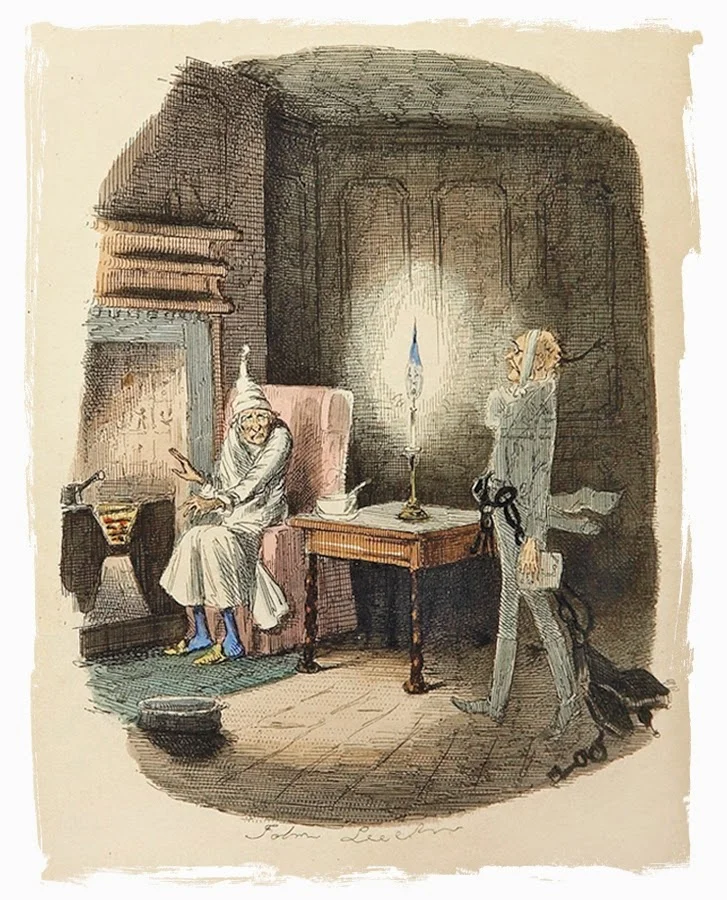
When Dickens describes Ebenezer Scrooge in A Christmas Carol, I live and breathe the story. I think that early in my career in the investment business in Colorado I met "Ebenezer Scrooge" several different times. "Oh! But he was a tight-fisted at the grindstone. Scrooge! A squeezing, wrenching, grasping, scraping, clutching, covetous old sinner! Hard and sharp as flint, from which no steel had ever struck out generous fire; secret, and self contained, and solitary as an oyster." 

"Nobody ever stopped him in the street to say, with gladsome looks, 'My dear Scrooge, how are you? When will you come to see me?'" 

But Marley had come to give Ebenezer a second chance at life. "Bah! Humbug!" 

Marley and the Spirits of Past, Present and Future literally scared the hell out of Ebenezer. Scrooge pleaded with the Ghost, "Answer me one question. Are these the shadows of the things that will be, or are they shadows of things that may be only? . . . " 

"Spirit," he cried, tight clutching to its robe, "hear me! I am not the man I was. I will not be the man I must have been. . . . I will honour Christmas in my heart, and try to keep it all the year. I will live in the past, present and the future. The Spirits of all three shall strive within me. I will not shut out the lessons that they teach." 

Ebenezer was awoke to the fact that he still had the precious gift of time in which he could make his amends. "I am as light as a feather, I am as happy as an angel, I am as merry as a schoolboy. I am as giddy as a drunken man. A merry Christmas to everybody! A happy New Year to all the world! Hallo there! Whoop! Hallo!"

In the end, "Scrooge was better than his word. He did it all, and infinitely more: and to Tiny Tim who did not die, he was a second father. He became as good a friend, as good a master, and as good a man as the good old city knew, or any other good old city, town, or borough, in the good old world. Some people laughed to see the alteration in him, but he let them laugh and little heeded them . . . His own heart laughed and that was quite enough for him." 

As I walked down the narrow streets of old Rochester, I joined Ebenezer in his unspeakable delight, that I, too, had been given an undeserved opportunity at a second chance. 

Let's spend a few more minutes learning from Ebenezer Scrooge and his decision to inject some good old fashioned virtue into the intersection of culture and economics. An investment from his personal market basket of virtues including charity, humility, and kindness, instead of the usual response of greed, wrath, and pride, in the end paid out remarkable dividends of goodness. That investment literally changed Scrooge's world as well as the world of Tiny Tim, Bob Cratchit, and hundreds of others.

Those who choose to invest virtue into the common affairs taking place at the intersections of life reap rich inner rewards by being able to personally see others gathered at the curbside becoming better off as a result.Suddenly, the words of wisdom spoken by Jacob Marley take on even deeper degrees of truth: "Business, mankind was my business. The common welfare was my business. CHARITY, MERCY, FORBEARANCE, and BENEVOLENCE were all my business. The dealings of my trade were but a drop of water in the comprehensive ocean of my business."

Next Week: Systems Matter

(Research ideas from Dr. Jackson's new writing project on Cultural Economics) 

© Dr. James W. Jackson

Permissions granted by Winston-Crown Publishing House 


Scrooge, Jacob Marley & Business

We have spent considerable time on the curbside of the intersection of culture and economics. The time of discovery and review is time extremely well spent because that intersection is where transformation on this old planet earth takes place. The strategic components that make it across that intersection determine recorded history. 

We toyed with the idea that all individuals gathered at the intersection have carried with them their own personal market basket in which they have placed their most valuable and precious possessions. What the individuals take from their market baskets and inject into the historic action at the intersection will change the world. So, the question is proffered, "What'cha gonna do with what'cha got?" What is the most strategic and important component in your personal market basket that you could take out and inject into the traffic of the intersection of culture and economics? 

After spending years observing and participating in cultures and civilizations around the world, this is my personal conclusion: The most powerful possession you could take from your personal market basket and inject into the traffic of the intersection is . . . Virtue. 

I am going to insert here the retelling of one of the stories I included in my book, Love and Common Sense, (p. 163). It is a familiar story written by one of my favorite authors, Charles Dickens. It is a classic story about how Ebenezer Scrooge accepted a second chance in life to inject charity, mercy, forbearance, and benevolence into the mainstream traffic of his life and change his world by helping others around him become better off; 

Marley was dead as a doornail," starts out Charles Dickens in his Christmas masterpiece A Christmas Carol. "There is no doubt that Marley is dead. This must be distinctly understood, or nothing wonderful can come of the story I am going to relate." Dickens intends to give Marley a position of authenticity and place him in a position where no one could argue with his established wisdom. He was already dead, but now he had access to knowledge as to where he was and why he was where he was. Somehow, Marley had bargained for the chance to revisit his old, selfish business partner, Scrooge, and give him one more thin chance to mend his greedy ways


After Marley makes his scary entrance through Scrooge's double-locked doors, dragging his chains he had forged in life link by link, he gets down to giving Scrooge his other-worldly advice. 

"It is required of every man . . . that the spirit within him should walk abroad among his fellowmen, and travel far and wide; and if that spirit goes not forth in life it is condemned to do so after death. It is doomed to wander through the world - oh woe is me! - and witness what it cannot share, but might have shared on earth, and turned to happiness!" 

Scrooge stabbed at a chance to turn down the heat of Marley's message, "Speak comfort to me, Jacob!" 

"I have none to give . . . . No space of regret can make amends for one life's opportunity misused! Yet such was I! Oh, such was I!" 

Scrooge couldn't deflect the message, so he tries a little flattery, "but you were always a good man of business, Jacob." 

"Business!" the ghost cried, wringing his hands. "Mankind was my business. The common welfare was my business; charity, mercy, forbearance, and benevolence, were all my business. The dealings of my trade were but a drop of water in the comprehensive ocean of my business!" Then Jacob Marley's ghost went on: "I am here tonight to warn you: that you have yet a chance and hope of escaping my fate." 

I have personally tried to discipline my behavior over the years to revisit the words and spirit of Charles Dickens Jacob Marley, not only at Christmastime, but throughout the year. His powerful advice, however correct or incorrect his theology, is as necessary as oxygen. Mankind truly is my business; that's the "why" behind the past twenty-five years of Project C.U.R.E.! "No space of regret can make amends for a lifetime of misused opportunity." The common welfare is my business. Charity, mercy, forbearance and benevolence must be the mainspring and clockwork of my life every day. 

The message of Marley should remind us that the chains of life that we forge link by link, day by day, should not be chains that shackle us to the greedy accumulation of this world; rather, the crafted links should become chains that bind our hearts together with kindness, justice and righteousness on this earth. 

Next Week: Scrooge, Jacob Marley & Business, Part 2

(Research ideas from Dr. Jackson's new writing project on Cultural Economics) 

© Dr. James W. Jackson

Permissions granted by Winston-Crown Publishing House

At the Intersection: Vice vs.Virtue

All folks are gathered at the intersection of transformational change, and each person there possesses an amazing capacity for the phenomenon of evil as well as an astounding capacity for excellence of character and goodness. Early philosophers and prophets recognized these history-altering capacities, and wrote to enlighten the minds and give wisdom to their followers. The teachings and stories of Jesus, while he was on earth, are packed full of revelations regarding the battles of vice vs. virtue.

Plato, Aristotle, and later, the church leaders, like the monk Evagrius Ponticus, John Cassian, and even Pope Gregory, endeavored to formulate into lists examples of the deadliest of evil thoughts and sins. Tinkering with the list never stops, but the following list is a fine compilation of what has been considered over the centuries the most sinister and dangerous of vices . . .


                                             THE SEVEN DEADLY SINS

LUST

Carnal lechery or lust is a general term for an inordinate and intense desire to fulfill not only the need for things of a sexual nature, but also power, fame, money, or even food.

GLUTTONY

Taken from the Latin gluttire, depicting the gulping down or swallowing food excessively, but it also refers to gluttony, or Latin gula, as in the over-indulgence and over-consumption of anything to the point of waste.

GREED

Here is another attitudinal and behavioral sin of excess sometimes referred to as avarice or even covetousness. Usually greed is linked with the idea of a rapacious desire for material things in contrast to eternal values, and is connected to the violation of someone else’s value, rights, or dignity.

SLOTH

While sloth (Latin, acedia) has been explained differently over the years, it still basically refers to physical and spiritual laziness. When a person fails to develop spiritually, an attitude and behavior of rejection of God and grace takes place. Evil is said to exist where a person resists doing what should be done and when good men fail to act.

WRATH

Rage (Latin, ira) is considered to be uncontrolled hatred or anger and can demonstrate itself by violence and revenge that can even be passed on to future generations, or can manifest itself in self-destruction and suicide. The attitude and behavior of wrath rejects the provisions of God’s gifts.

ENVY

Envy is another sin of insatiable desire. It demands to be better and have more than others. The want is so strong that it will seek to deprive others of what they have, be it material things, abilities, status, recognition, or rewards.

PRIDE

One thing that most all lists agree upon is that the matter of pride is at the heart and center of all other deadly sins. It is at the root because it demands that it is first and best and all others and all else is secondary. In today’s vernacular the expression would be, “It’s all about me.” With unchecked pride there is no need to consider anyone else, not even God. Where pride is in control the entrenched narcissism shouts that “I am not just privileged and exceptional, but above all . . . entitled.”

                                             THE SEVEN CARDINAL VIRTUES

Throughout history, good men who have had concern for the betterment of their culture and a sincere desire to help other people be better off have endeavored to examine, and also teach, what they considered to be the fundamentals of goodness as a counter to the Seven Deadly Sins. It has been agreed upon by Christian thinkers, as well as many pagan philosophers, that virtue is the key building block of a successful life as well as a successful civilization. The behavioral consideration ofvices vs. virtue is at the very heart of the study of cultural economics.

The phenomenon of moral and wholesome character has been promoted by Plato, Aristotle, and other great philosophers and church leaders. Their desire is to protect not only the people standing on the curbside of the intersection, but also to protect the outcome of the flow of the traffic through that intersection of culture and economics. What happens at the intersection of culture and economics influences and shapes civilizations.

It should be of little surprise, then, that over the centuries righteous thinkers have also constructed lists of virtuous attributes intended to answer the influence of thedeadly sins:

CHASTITY

Abstaining from inordinate or improper sexual conduct according to one's state in life. Embracing purity of thought and behavior and achieving moral wholesomeness of character. Living a clean life of good health and hygiene promoted by cleanliness and restraint from indulgence of intoxicants, and avoiding temptation and corruption.

TEMPERANCE

Restraint and self-control. Prudence in regard to appropriate behavior, and proper moderation in the indulgence of natural appetites, passions, and especially in the use of drugs and alcohol.

CHARITY

Generosity and self sacrifice, benevolent attitudes and actions, especially toward those in need or in disfavor.

DILIGENCE

Steadfastness and persistence in accomplishing that which is undertaken; zealous and constant endurance in the effort to always guard against laziness of body, mind, and spirit, fulfilling the degree of care and concern required even when no one else is watching.

PATIENCE

Moderation through forbearance and perspective, a willingness to solve injustices and conflicts peacefully instead of choosing violence as an answer to conflict resolutions, the ability to bear delay, provocation, or misfortune without cluttering the situation with reactions of temper, irritation, or complaint.

KINDNESS

Thoughtful consideration, empathy, and accommodation displayed with a friendly demeanor and without prejudice, resentment, or ill will toward the recipient, a spirit of magnanimity combined with compassion and cheerfulness.

HUMILITY

Humility is everything that pride is not. It is a frank and modest estimate or opinion of one’s own importance, rank, or position, while invoking respect, honor, and value upon the position and person of another, it is the spirit of perceiving the correct value and relationship between you, God, and the world that God has created.

Origen, a second century teacher from Alexandria, insisted, “Genuine transformation of life comes from reading the ancient Scriptures, learning who the just men and women were and imitating them.”1 That would be his suggestion for the building of viable traditions that would eventually be nourished and supported by institutions.

Both Greek and Roman writers pushed the idea that the acquiring of virtue would be immensely aided by imitating the noble example of others. Seneca claimed, “Plato, Aristotle, and the whole throng of sages . . . derived more benefit from the character than from the words of Socrates. The way is long if one follows precepts, but short and accommodating if one imitates examples.”

In the third century, Augustine, then Bishop of Hippo, really cleared up the issue of invoking the practice of imitating in order to acquire traits of virtue: “Now we require many virtues and from these virtues we advance to virtue itself. What virtue, you inquire? I reply: Christ, the very virtue and wisdom of God. He gives diverse virtues here below, and he will also supply the one virtue, namely himself, for all of the other virtues which are useful and necessary in this vale of tears.”2

(Please allow me to end with this personal note: Regardless of the ancient writers, I find that I am not a very good imitator. But what became a great help to me regarding this battle between vice and virtue was my discovery of a possibility while reading the Scriptures. The Apostle Paul talked about “Christ in me . . . my only hope of glory.”(Col. 1:27) And then I read on and found that the Holy Spirit was eager to enter into me and begin living the life of Jesus Christ through me to the glory of God the Father. (Corinth. Galat. Ephe.) That made a whole lot of sense to me because it would be God’s virtue in me instead of me trying to trump up something of my own. It seems to have worked well, at least for this pilgrim who finds himself standing on the curbside of the intersection of culture and economics.)

Next Week: Scrooge, Jacob Marley & Business

(Research ideas from Dr. Jackson's new writing project on Cultural Economics)

© Dr. James W. Jackson  

Permissions granted by Winston-Crown Publishing House


At the Intersection: Curbside Capacities

Every individual stands on the curbside of the intersection of culture and economics. That is where global transformation, as well as any other change, takes place. Culture will influence, and indeed has the power within it, to change economic philosophy and economic systems at that intersection. Conversely, economic systems and ideas have the power to change a given culture. 

Just think of the potential capacity for change that is wrapped up in the individuals with their personal market baskets, gathered on the curbside of that intersection. Quite frankly, I find that potential dynamism quite fascinating. There is potential capacity to perform, to yield, or to withstand any and all components of culture or any and all components of economics as they try to intersect, collide, and pass through that intersection. The components that make it through to the other side of the intersection will determine history as it is recorded. 

I am additionally intrigued by the variety of emotional, moral, and behavioral capacities that influence the components of economics and culture as they pass through the intersection. The traffic flowing through the intersection of culture and economics seems to become super charged by the high octane fuel propelling the varied components as they pass through the traffic. 

As I have traveled to nearly every nook and cranny of this globe, and observed hundreds of people groups and the diverse examples of civilizations, I have been amazed at the human capacity to harbor and display the phenomenon of evil. I traveled throughout Rwanda on the heels of the terrible Hutu- Tutsi genocide. I was in Congo and Angola at the time of the mass murders. I personally viewed Pol Pot’s torture chambers located at the old high school in downtown Phnom Penh, Cambodia, and witnessed where hundreds of thousands of Cambodia’s best citizens were intentionally slaughtered by their own government.

I was in Bosnia, Kosovo, and Belgrade, Serbia and witnessed the atrocities taking place. In the little country of Nagorno Karabakh I watched the genocide by the Russian Fourth Army, the Azerbaijanis, and the Turks wipe out eighty percent of that small country’s male population, and it seemed that hardly anyone even noticed. I’ve spent time at the Holocaust memorials in Jerusalem, Israel, and Washington D.C. and asked the question, “Just how can this be?”

That same capacity for evil can likewise be observed in the law-ignoring greed of local governments, corporate heads, and homegrown community thugs, as well as even fraudulent social services recipients. 

But, history has also shown that the folks gathered at the intersection can receive and contain a remarkable capacity for virtue. It is possible for them to attain through invitation and development, excellence of character. And based on that excellence of character, they can choose to become agents and dispensers of kindness, generosity, fairness, sympathy, mercy, personal responsibility, justice, charity, gentleness, forbearance, righteousness, and benevolence. 

The individuals standing on the curbside of the intersection have the power and opportunity to ultimately determine history. But who will actually step forward and begin the process by taking the precious items from their market basket and injecting them into the flow of traffic? 

As I visualize this epic scene of the making of history at the intersection of transformation, my mind recalls an intriguing episode shared with me by a new friend as I traveled through Asia: 

        Past the seeker as he prayed came the crippled and the beggar and the beaten.

        And seeing them, the holy one went down into deep prayer and cried,

        “Great God, how is it that a loving Creator can see such things and yet do   

        nothing about them?”

       And out of the long silence, God said, “I did do something . . . 

        I made you.”

We who are standing on the curbside of the intersection of transformation have the power to influence the direction, timing, and outcome. How will we handle the opportunity? 

Next Week: Vice vs. Virtue

© Dr. James W. Jackson  

Permissions granted by Winston-Crown Publishing House


At the Intersection: Our Market Basket

Let’s pursue this concept of the intersection a bit more:

We are an integral part of this world of transformation and change. We have inherited this culture and economic system in which we exist and operate. We own our future and have been endowed with the power to personally choose between and amongst the myriads of alternatives that have been and will be presented to us on a daily basis. The choices that we select will, of necessity, set into motion consequences that will affect our lives, the lives of others around us, and even the future options that will be made available to us.

All of those transformational happenings will take place at the intersection of culture and economics. Whether we like it or not, each of us presently stands on the curbside of that intersection. From that position we are able to observe the intriguing and constant flow of traffic moving in front of us through that intersection. We are not, however, just standing on the curbside as disengaged and disinterested observers. We, along with all the others gathered, are highly involved in what passes through that intersection and the results of the continual flow of traffic. Transformation continually takes place and we are a part of it.

If we will observe carefully, we will see that every person standing on the curbside, including ourselves, is carrying a lovely market basket on his or her arm. Everyone has been shopping on the way to the curbside.

Placed inside those baskets are the most important and valuable items in the world. At the marketplace, on the way to the intersection, every person has been hunting, inspecting, and accumulating. The items are so very precious because each person has been actually exchanging a part of himself or herself for the contents collected and placed so very carefully into the lovely market baskets. So, everything collected has either been placed into those personal market baskets as a direct result of a purchase or of a gift exchange.

Since the cultural and economic systems belong to us, ultimately, we are the ones who determine what components pass through the intersection and what is declared as history on the other side. If the contents of those market baskets are powerful enough to alter and direct the flow of history, perhaps it would be important for us to examine just what makes up the contents of those personal and distinct market baskets. Just for fun, let’s see if we can figure out the contents and value of our own personal market basket:

· FINANCIAL POSSESSIONS:

Let’s do this through the equity approach: Take the replacement value of your market basket contents and then subtract any indebtedness: Savings accounts, cash, loans and accounts due you, stocks, bonds, pension plans, equities in businesses, partnerships, home, additional properties, autos, household goods, and other personal properties.

· PERSONAL POSSESSIONS:

Physical possessions of good health, good DNA, attractive characteristics, wholesome attitudes, intellectual possessions, past experiences, education, healthy emotional possessions, good decision making capabilities, temporal, or possessions of time (number of days you have left).

· RELATIONAL POSSESSIONS:

Your family, friends, and your influence on other people and situations.

· SPIRITUAL POSSESSIONS:

You are at peace with yourself, others, and God, kind, self controlled, generous, patient, and forgiving to your family and others, a life characterized by a deep sense of joy, consistency, gratefulness, a non-complaining attitude, and dependable.

· SPECIAL POSSESSIONS:

In addition to the other possessions in your market basket, God has given to you some special abilities. It is true, you may have refined them and put a lot of work and discipline into developing them, but you realize that they are special possessions given to you by a discerning God. List those special abilities that you feel are your strongest talents.

All individuals are standing on the curbside of the intersection of culture and economics. It is almost unfathomable when trying to comprehend the variety and value of the possessions that are held in the market baskets of those individuals. With those possessions, the individuals standing there have the power and opportunity to ultimately determine what happens at that intersection.

History will be determined by what those individuals will collectively decide to inject into that flow of traffic passing through the intersection. What will they be willing to take out of their market baskets and invest into the process of making history? What will they do to advance the procedure of resolution? What will they be willing to do to unsnarl the traffic and advance the proceeding of history?

All persons on the curbside face the same leveling question concerning the use of the possessions within their individual market baskets . . . What’cha Gonna Do With What’cha Got?

By injecting the possessions from their market baskets into the traffic flow of the intersection, they influence the direction, timing, and outcome of the flow of traffic and thereby determine history. The comprehensive and penetrating question becomes very personal . . . What’cha Gonna Do With What’cha Got?

Next Week: Curbside Capacities

(Research ideas from Dr. Jackson’s new writing project on Cultural Economics)


At the Intersection: Examples for the Matrix

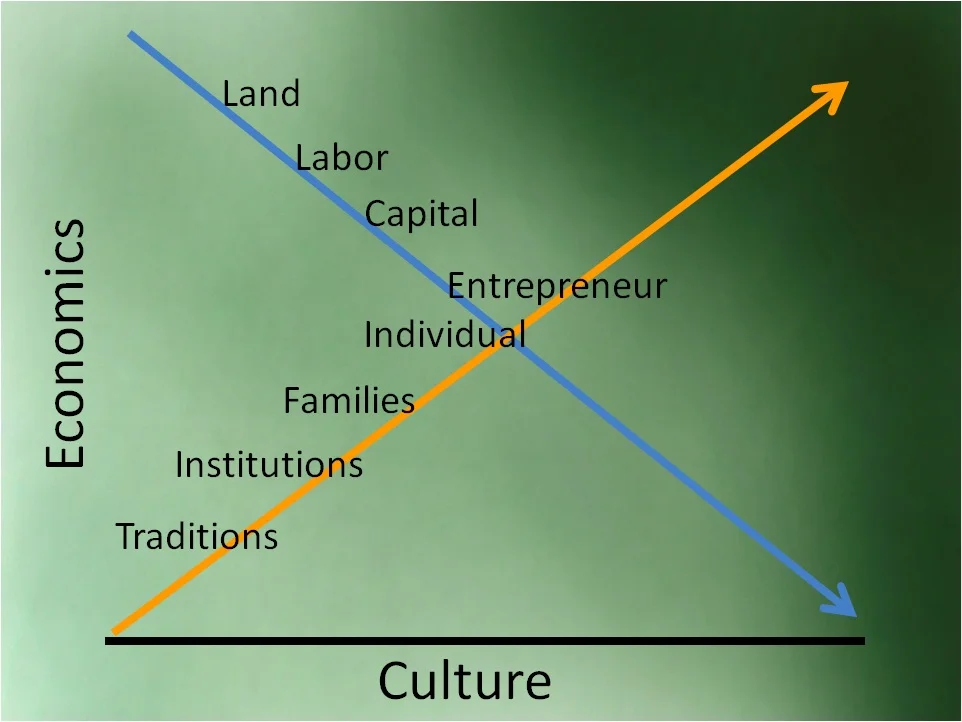
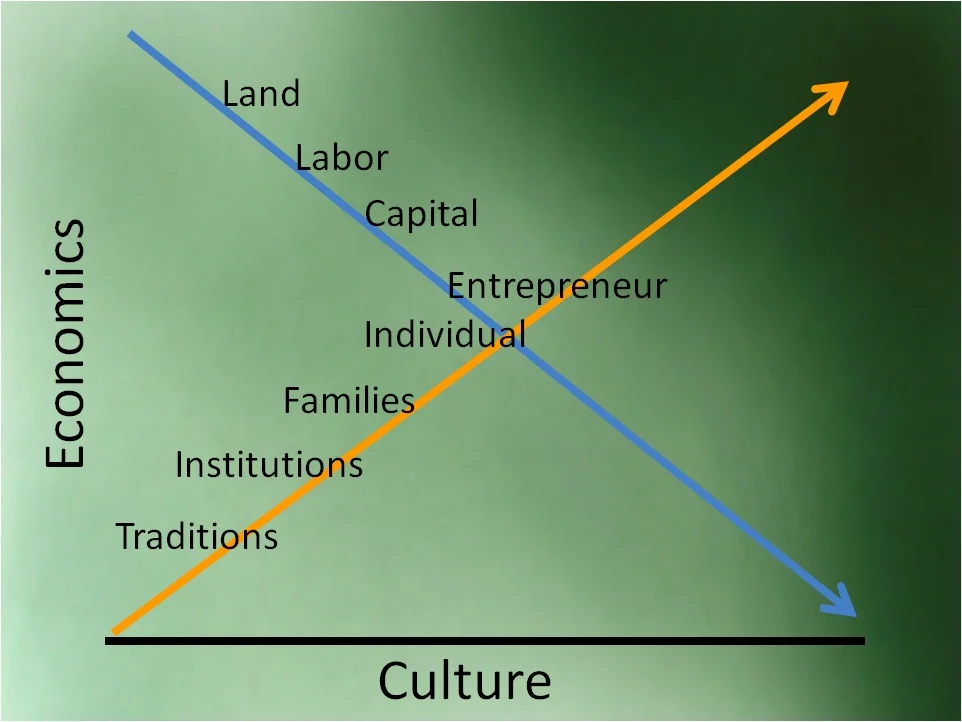
We have now discussed the components of economic production: Land, Labor, Capital, and the Entrepreneur, and also the components of our cultural structure: Traditions, Institutions, Family, and the Individual. Our premise is that Transformation takes place at the intersection of Culture and Economics. Wherever the components of Culture and the components of Economics cross in the intersection of real life, you can expect change.

I’m going to resort to the chalk board and see if we can walk through some common examples in order to see just how such a thing works. The components of Economics will be positioned along the left side of our matrix and the components of Culture will follow the bottom line. The dynamics of the situational example will determine the point of intersection and which of the components will be involved in the confrontation that sets up the incidence of transformation:

  • We talked earlier about the incredible global transformation that took place based on the intuition and action of Alexander the Great after being influenced by the cultural and economic insights of his personal teacher, Aristotle. He conquered the known world.
  • Two hundred seventy- one years later, Julius Caesar laid claim to Alexander’s dream and once again, transformed the global system at the intersection of culture and economics.
  • King James of England, in 1606, granted rights to a business investment company to establish the first American colony in an area designated as Virginia. But the second contract was made with another organization to establish a colony in America. That contract was born out of conflict and the desire for change and freedom. The Pilgrims were a group of settlers who had previously left England to seek relief and freedom in Holland. Disappointed there, they found investors willing to underwrite the expenses of a contract to colonize in America. On September 16, 1620, the Pilgrims set sail on the Mayflower and landed sixty-five days later. At the intersection of culture and economics, the Pilgrims employed their powerful traditions and even religious institutions and families. They set into motion transformation in areas of land use, labor, and capital and the individuals eventually realized the fruits of a new world


  • Eventually the American Revolutionary War between young America and England would be fought at the intersection of culture and economics. Institutions, traditions, families and individuals were pitted against each other on matters of land, labor, capital, and entrepreneurial enterprises.


  • Within recent years, China’s citizens have experienced immeasurable transformation due to national laws implemented in 1979 limiting the family’s size to one child per couple. I personally visited many orphanages throughout China and have been acquainted with the affects of the policy that was fully centered at the intersection of culture and economics. The policies were initiated to alleviate social, economic and environmental problems in China, but have set into motion firestorms of consequences.


  • A bit closer to home . . . we commonly experience the intersection phenomenon in controversial land use situations. Traditions endeavor to dictate how a certain piece of property will be used regardless of personal or institutional ownership rights. Or, a municipality may want to appropriate or condemn a property and build a big box store or commercial strip in order to generate higher tax revenues. The battle is waged at the intersection of culture and economics.


  • Divorce settlements, civil suits, and estate squabbles so very frequently find the principles yelling at each other in the middle of the intersection of culture and economics.


  • Individual families, also, find themselves hammering out philosophical differences at the intersection when it comes to making decisions regarding how they will earn and spend their resources.
Intersection Example Family Financial.png


  • Don’t be surprised when it dawns on you that this same matrix works even for such issues as dealing with the disciplining of the children, (Land = Resources, Labor = Activities, Capital = Rights and Rewards, Entrepreneur = Creativity and Independence). We can count on major transformation taking place at the intersection of culture and economics even when applied to the components involved in domestic situations.

We live in a world of transformation. It is good for us to concern ourselves with how we can more efficiently allocate and manage our resources and abilities. It is also to our benefit to discover and understand how various aspects of human cultures interact with economic events, behaviors, and conditions. Economic philosophies and systems have the power to affect and shape our culture, as well as our culture having influence on our political systems, inherited traditions, religious beliefs and the formation of our institutions. It is imperative to lay aside the notion that economic has only to do with money. It is also imperative to more fully comprehend the scope and sequence of culture.

As we move into a more complete understanding of the eight components listed herein, and see how they work together under a larger umbrella of cultural economics, our identification of problems and even our tasks of conflict resolution will be more easily accomplished.

Next Week: Our Market Basket

(Research Ideas from Dr. Jackson’s new writing project on Cultural Economics) 

© Dr. James W. Jackson  

Permissions granted by Winston-Crown Publishing House


At the Intersection: Cultural Components

Our stated premise is that transformation (global, national, corporate, domestic, personal) takes place at the intersection of culture and economics. We just finished discussing the four basic production components of economics: Land, Labor, Capital, and the Entrepreneur. Now it’s time to examine the cultural components.

It is necessary to have an agreed upon definition when discussing the concept ofculture. No, we are neither talking about growing a microorganism in a laboratory Petri dish, nor are we describing an artsy enlightenment trip to Carnegie Hall in New York City or an art museum in London. Culture, as we will be discussing, can be described as the inherited and shared beliefs, attitudes, feelings, values, ideas, customs, and social behaviors of a particular people.

There are at least four strategic components that are utilized in order to perpetuate a culture: Traditions, Institutions, Families, and Individuals. It is not my intention at this point to get involved in a thorough investigation or discussion of these four components. I must admit, however, that it is a temptation to get off track and share with you some of the incredible customs, traditions, and institutions I have witnessed in my world travels over the past nearly thirty-five years (everything from simple birthday celebrations to male and female rites-of-passage circumcision rituals of the Maasai tribe in Kenya and Tanzania). We will stay on point.

TRADITIONS

The term tradition comes from the Latin tradere that literally means to transmit, to hand over, to give for safekeeping. It is a belief or pattern of behavior in a community with special or symbolic meaning that has been handed down from generation to generation and might persist and evolve for thousands of years. The concept of tradition is viewed as a set of precedents valued by a culture and carries with it the notion of holding on to a previous time. Traditions are extremely important to a given group. History bears out those traditions are many times considered worth dying for. Wars have been fought and civilizations eradicated because of traditions.

INSTITUTIONS

Institutions are designed to formalize and perpetuate agreed upon traditions. They work to give structure, influence and even power to the sustainability of those social orders deemed most important to a people group.

On the surface, institutions look a lot like churches, hospitals, jails, banks, and schools. But, more formally, they describe normative systems that take care of regulating the distribution of goods and services, the providing for the legitimate use of power, the transmitting of knowledge from the present generation to the next generation, and the lending of structure to moral and religious matters. Institutions end up mediating the agreed upon rules that govern social behavior of a group.

FAMILY

As a component of culture, family has to do with kinship. Here again, this is not an involved dissertation on the current interpretation and aspects of the modern family.When dealing, however, with the premise that all transformation takes place at the intersection of culture and economics, the cultural component of family is paramount.

Family is considered more than just a basic social unit consisting of parents and their children, whether dwelling together or not. It extends to any group of persons closely related by blood, as parents, children, uncles, aunts, and cousins, etc.

Historically, kinship has played a huge role in developing, establishing, and perpetuating traditions. Likewise, the family units of a people group are the most powerful influence and factor of sustainability when it comes to the success of institutions.

INDIVIDUAL

Recall for a moment the list of production components of economics that we discussed last session: Land, Labor, Capital, and the Entrepreneur. We learned that nothing happens without the Entrepreneur. So it is with the components of culture . . . nothing happens without the Individual.

From the traditions, from the institutions, and from the family, the individual emerges as the ultimate building block of transformation and change.

Now we are ready to plug these eight components into our social economics matrix and apply them to the phenomenon of transformation.

Next Week: Examples for the Matrix

(Research Ideas from Dr. Jackson’s new writing project on Cultural Economics)