
Economics of the Interior Part 2: Some Characteristics of God's Economy

Throughout my reading assignment regarding God’s economy I noticed the reappearing of some interesting economic characteristics. Consistently, the model of the economic system in the ancient Scriptures elevated the individual above the collective, and it revered the law and goodness above raw power. Moral standards trumped oppression; integrity and perseverance proved to be stronger than brute force or skullduggery in the end.

Other characteristics that seemed to continually recur were a call for personal responsibility and accountability, a promotion of fairness, frugality, production, and a conscionable work ethic.

At all times the power of individual choice was emphasized and discrimination was frowned upon. Respect was one of the underlying characteristics, whether it was the respect required for all of God’s creations or the presumed respect for the phenomenon of time, and the relative shortness of a person’s life.

There was, in addition, an expectation that the participants in the economic model would strive to make things better while they were involved in the system, and that they would hold in high esteem the elements of wisdom and knowledge. I was impressed that there was an emphasis on society and even governments punishing wrong and encouraging good.

Especially in the Gospels, economics of the interior appeared to be almost counter-intuitive at times and mostly up-side-down in logic. This is particularly true in theSermon on the Mount. Instead of a person being concerned with activities of getting,it placed a premium on the behavior of giving. Instead of an emphasis on accumulation, it was concerned with relinquishment. Instead of consumption, it emphasized stewardship. That is counter-intuitive and up-side-down logic!

I think it is fair to say that, usually, economic models of a society are largely designed with group behavior in mind. The economic system of the interior deals more with the innate value system and behavior of the individual who, coincidentally, finds herself or himself actively involved in a society.

In addition to the above listed characteristics of an economic system of the interior, I would like to pull out and discuss six additional characteristics that we will refer to asprinciples of God’s economy. This list is in no way an exclusive list.

Principle # 1: God Has Given

If God has an economy, this characteristic would certainly be the most unique. All other economic models are based on the economic trilogy known as Scarcity, Choice, and Cost. It is assumed that all things are in limited supply, because all those supplies have alternative uses. Humans are presumed to have unlimited needs and desires. There is no way that all those desires can be met by the limited supply. It is, therefore, absolutely necessary that choices be made as to which needs and desires will be satisfied by the limited supply.

The real cost of making a decision as to which limited item will be used to satisfy the chosen need or desire has nothing to do with money or wealth. The real cost comes in the foregoing of the next highest need or desire that is forfeited. You decided to use the item or commodity on procuring the one good or service at the expense of not being able to procure your next highest desire. You, therefore, lost the opportunity to use that supply to meet another need or desire. That is known as opportunity cost.That is the reason that some people through the years have referred to economics as the science or study of making good choices. How can you make better decisions in determining which limited resource should be used for which need?

So, from whence did all those resources come . . . in the first place? My research found that there was no hesitation in the Holy Scriptures when it came to answering that question: 

. . . Everything in the heavens and earth is yours, O Lord, and this is your kingdom. We adore you as being in control of everything . . . Everything we have has come from you, and we only give you what is yours already! For we are here for but a moment, strangers in the land as our fathers were before us; our days on earth are like a shadow, gone so soon, without a trace. O Lord our God, all of this material that we have gathered to build a temple for your holy name comes from you! It all belongs to you! (1 Chronicles 29: 11-16 TLB)

Everything that exists came from the hand of God. Everything that I have has come to me as a direct gift from God or is a by-product of a gift exchange. Nothing exists that did not come from God.

The earth belongs to God! Everything in all the world is his! (Psalm 24:1TLB)

The balance of the entire economic system of the interior rests upon that factor. He never requires anything of his participants that He has not already given to them. In God’s economy there is no such thing as successfully cheating or robbing, because when the participants finally get through playing their greed-games with earth’s possessions, God ultimately reassumes and repossesses all the stuff.

O Lord, what a variety you have made! And in wisdom you have made them all! The earth is full of your riches. There before me lies the mighty ocean, teeming with life of every kind, both great and small. And look! See the ships! And over there, the whale you made to play in the sea. Every one of these depends on you to give them daily food. You supply it, and they gather it. You open wide your hand to feed them and they are satisfied with your bountiful provision. (Psalm 104:24-28 TLB)

God is the source; everything else is a resource in the economics of the interior. That is what prompted me to consider that the whole model is counter-intuitive and a bit up-side-down.

Since everything has always belonged to God, it is impossible for you to try to influence or bribe God by giving something to him first. But by giving first, God has set into motion the expectation for the participants in the model to join him in his giving and, likewise, give from their inventories to the needs of others whenever he so prompts or requests. That is called obedience.

If God is the source, then the whole paradigm of scarcity, choice, and cost must be revisited. Is that whole concept a ploy of political manipulation? How should we respond if there is truly no such thing as scarcity? Should not our real concentration then focus on abundance and allocation rather than accumulation and hoarding?

Next Week: More Economic Possibilities

(Research ideas from Dr. Jackson’s new writing project on Cultural Economics)

© Dr. James W. Jackson   

Permissions granted by Winston-Crown Publishing House

Economics of the Interior Part 1: Does God Have an Economy

In 1982, I ventured out in my economics book entitled What’cha Gonna Do with What’cha Got?, and asked the questions, is it possible that God has an economy? If He does, what would it look like? I wanted to stay away from my own platitudes and hyperbole, and I also desired to not engender any knee-jerk reactions on the part of my readers. I didn’t want the folks to race to judgment and say “see there, God is a Socialist, and believes what Karl Marx, Engles and even John Maynard Keynes were writing about.” I, likewise, didn’t want them to simply say “See there, God is a Capitalist, just like Adam Smith, Milton Freidman, and Michael Novak might have written about.”

So, I took the Holy Scriptures that I had available to me, and read all sixty-six books of the Bible (several books more than once). I tried reading them just with the mindset of an economist (whatever that means), attempting to discover if God had an economic system.

I hadn’t systematically read very far until I caught myself saying, “Oh, my goodness! This is a virtual economic text book . . . Just look at the Egyptian’s economic model of production, consumption and distribution and the Israeli’s division of labor model.” And by the time I got farther, into the Book of Proverbs, I was stunned at the 21st century wisdom of Solomon telling everyone how dangerous it was to even think about co-signing and guaranteeing a note for someone else. I didn’t know all that was in the Holy Scriptures! I was amazed.

Economists talk a lot about the differences between positive economics . . . the way things are, and normative economics . . . the way things ought to be. One of the first things I noticed in my reading was an interesting blend of positive and normative economics. Another thing I observed right away was that tribal and national politics kept getting the normative and the positive aspects of economics all jumbled up.

By the time I had finished my reading assignment, I had concluded that indeed God had an economy, and without doubt, He was the greatest economist imaginable. His economic principles were clear and consistent, and the principles fell more into the category of the normative economics. But the thing that continued to impress me was that even though the principles were couched in settings of society and cultures, yet they were particularly designed and aimed at the attitudes and behaviors of the singular individual.

The emphasis seemed to be on the interpretation and response of the individualwithin the society to a certain economic principle. Then would come the question,What’cha gonna do with what’cha got? The economic model was not one of politics or culture. It was more of a personal economic model that influenced and guided the individual. It was not an economic model of the outside, but rather an economic model that influenced the personal life of the individual. It was an economic system of the interior.

Once the economic system of the interior was embraced and implemented within the individual, then he or she could successfully impact the family. Eventually the family would influence and develop traditions. Then institutions would be established that were intended to carry on those accepted traditions into the future. The stories of Abraham and Joseph were great examples of the process.

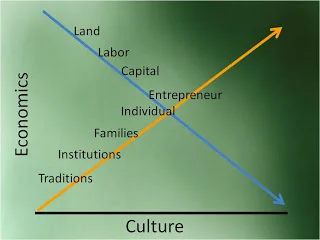
As has been repeated here so often, where the components of traditions, institutions, families and the individuals intersect with the components of land, labor, capital, and the entrepreneur, global transformation takes place.

I began to perceive that the nucleus of God’s economy, regarding people and societies, starts with the economics of the interior in the hearts and minds of individual people and then spreads out to influence and affect societies and cultures. It also seemed to me while reading that those individuals who were grounded securely in their own economic systems of the interior had the ability to operate with ease and security when they were expected to function according to outside models and systems of politically controlled economies. Frequently, those outside economic systems were not even compatible with their own interior systems. They seemed to successfully survive, and many times they excelled in those foreign or imposed systems.

Throughout my investigation I found many examples, like Daniel, who for one reason or another, were forced to live under the expectations of a contrary economic model. But they successfully survived, none-the-less, and functioned by staying true to their own individual system of interior economics.

Next Week: Other characteristics of God’s economy 

© Dr. James W. Jackson   

Permissions granted by Winston-Crown Publishing House


Economics of the Interior: Introduction

Since the summer of 2010, Winston Crown Publishing House has consistently posted my weekly articles on their site. I enjoy telling the riveting stories about Project C.U.R.E. and the unique and compassionate work being accomplished around the world. Those postings tally up to over 225 weekly articles.

I have also thoroughly enjoyed sharing articles about the economic systems and the different cultures I have personally experienced in the over 150 countries in which I have worked around the world. Those writings have eventually ended up in the gold medallion-winning books that Winston Crown Publishing House has produced and distributed.

In 2013, I began focusing my attention on finishing a book on Cultural Economics. Economics and business matters have always intrigued me. We feel that even not-for-profit organizations of charity should be run with the same care and efficiency as any Fortune 500 company. That is why it pleases me so much when Forbes Magazine lists Project C.U.R.E. in the top twenty most efficiently run not-for-profit charities in America. That’s just good stewardship.

Many of my weekly articles over the past year have been full of observations and insights regarding the economic systems and cultures of which I am familiar. I hope to include those ideas in the up-coming book. I find pleasure in bouncing ideas off of my reading friends and receiving back from them their candid responses. That process always gives me a clearer idea of what should be included in the book and what should be left on the floor of the editing room.

In the past articles we have used as an overall definition of the idea of economics as being; the discipline of study that deals with the production, distribution, and consumption of goods and services. The root is from the ancient Greek wordoikovouia, or the combination of oikos (the house) and nous (nomos, custom or rule), simply put, the rules of the house for good management.

In my studies over the years, I have pursued the subject of economics to a further interdisciplinary bias to express my interests and observations. Cultural Economics is a branch of economics that concerns itself with the relationship of culture to economic outcomes. It studies how various aspects of human cultures interact with economic events, behaviors, and conditions. A given culture will even influence the political system with its traditions, religious beliefs, the formation of institutions, and the value ascribed to individuals.

Cultural Economics certainly leans more toward the behavioral aspects of the study of economics rather than the pure analytical number crunching of the econometrics laboratory. It is aimed at how people affect economic systems and how cultures are affected by economic choices. In the study of Cultural Economics we have the thrill of taking some basic principles of economics and combining them with the unpredictable thoughts, choices, and actions of over seven billion people on earth today. That makes for an interesting adventure that can open our eyes to a better understanding of motives, methods, behaviors, successes, and failures regarding our world’s resources and human lifestyles.

The past fifty weekly articles have generously investigated the possibilities of Cultural Economics and the thesis that Global Transformation Takes Place at the Intersection of Culture and Economics. There is one more area of economics that I would like to pursue to finish out the Cultural Economics book. It deals specifically with the cultural component labeled Individual on the Cultural Economics matrix we have frequently shown in the articles.

We will call this division of economics the Economics of the Interior. What am I supposed to do with all the personal resources, liabilities, and opportunities inside my own individual and sovereign being (my own nation-state) in relationship to the arbitrary and compulsory expectations of the economic systems in which I find myself? We will investigate that subject beginning next week.

Next Week: Economics of the Interior, Part 1

(Research ideas from Dr. Jackson’s new writing project on Cultural Economics)

© Dr. James W. Jackson   

Permissions granted by Winston-Crown Publishing House


Unintended Consequences of 1776

It was an improbable experiment that took place in 1776 starting in Philadelphia with the signing of the Declaration of Independence. Seldom, if ever, had there been a nation-building endeavor organized on such uncommon denominators. The steadfast incorporators had declared liberty, and were determined to experience the fullness of freedom. But in reality they could scarcely even comprehend the world-altering power they were holding in their hands.

They had dreamed that they would know enough freedom to be able to experience the new and enticing system of free enterprise. But they discovered that it was in the dedicated pursuit of free enterprise that they found the fullness of freedom. It was an unintended consequence to find that the most precious thing provided by a free enterprise economy was not just the abundance of material wealth, but freedom itself.

The incorporators were bent on preserving their newly acquired liberty, improving the well- being of the new nation, and guaranteeing the wise use of their resources. They knew that their only hope was through the understanding and preservation of not only their coveted culture, but also through their development of a stable economy.

The historical serendipity of the 1776 experiment was in the fact that not only was it the year of the signing of the Declaration of Independence in Philadelphia, but 1776 was also the year of the publishing of the Scottish economist Adam Smith’s book An Inquiry Into The Nature and Causes of the Wealth of Nations. The book was a compilation of Adam Smith’s observations as he traveled and sought the answer to what causes one nation to be rich, and another nation to be poor.

Adam Smith equated wealth with income and the ability to generate income. His findings showed that a nation that can generate high levels of income is wealthy and one that is capable only of low levels of income is poor. What is it that allows a nation to create a high level of income? What is it that makes a nation wealthy? In his book he simply recorded his observations. He commented then on such unique observations as division of labor, specialization, incentives, levels of taxation, freedom of cultural and economic choice, and the opportunity to pursue the objectives and directions that are of most interest to each individual.

The incorporators of the 1776 American experiment had been greatly influenced by the observations of Adam Smith. His insights fit snugly with their ideals of independence, self- reliance, and limited government that was responsible to the people rather than the people being enslaved by the government. But what neither Adam Smith nor the young American leaders comprehended was what would be the history-making results, when for the first time those ideals could be worked out in real life, in a situation where it was possible for free enterprise to not just be haltingly tolerated, but encouraged to flourish. Since a national economic system of free enterprise had never really been tried in such laissez-faire settings, no one could fully predict the potency of the economic outcome.

The leaders of the new nation had a deep respect for the rule of law, and realized the unique necessity for a limited government to fully enforce the powers of the law. One of the basic concepts of free enterprise is that the individual citizen has the right to hold and own private property. With that goes the right to exclusively make use of the property or to transfer it to another individual of choice. People are free to make voluntary agreements with each other regarding their private property or personal labor. Contracts, therefore, are vital to the enterprise system.

Contracts and agreements, however, are meaningless unless they are enforced. Free enterprise could not exist without a legal entity to hold contract makers to their agreements. So, without a viable government to enforce agreements there could be no contracts, and without contracts there could be no free enterprise.

In addition, property rights, including intellectual property through copyrights, patents, or trademarks, work to facilitate those transfers and exchanges within the system. Because of the long- term protection of the rights, people are encouraged to write more books and music. The title to a piece of farm equipment or an indentured deed to a plot of ground assures the buyer that the seller is the legitimate owner. The right of property owners to designate who will receive their property when they die helps sustain the confidence in those property rights. Those are all subtle benefits of the free enterprise system. Those benefits were not necessarily designed and plugged into the free enterprise system before it was formalized. Those benefits came as unintended consequences of the pursuit of freedom of choice.

On the consumer side of the equation, free enterprise ensures purchasers they can buy the goods and services that best satisfy their wants and agree with their budgets. And workers are free to try to enter any line of work for which they are qualified.

Adam Smith is a hero to me because I see him as the first cultural economist. He was the first to note the curious connection between private interests and cultural interests. Individuals and businesses seeking to advance their own self-interests and operating within the structure of a highly competitive market system would miraculously promote the cultural best interest as well as the economic best interest at the same time. It began to prove out that as the individuals and businesses were allowed the freedom to choose their own options as to what they felt would be best for them, lo and behold, all the people of the culture began ending up better off. That was definitely an unintended consequence, but a welcomed and marvelous happening.

Adam Smith explained this simultaneous phenomenon as being guided by aninvisible hand. We even see it in action today as a business seeks to build a new and improved product to increase its profits. Those enhanced products like computer applications, smart phones, and industrial robots increase the culture’s well-being. Those businesses use the least costly combination of natural and human resources because in doing so it is in their own best interests. To do otherwise would put their business in jeopardy. But the company’s using scarce resources in the least costly way benefits the culture as a whole and frees up precious resources to produce something else that the culture wants.

Self- interest is different than greed. The freedom to pursue self- interest becomes the greatest method known to mankind to manage the billions and billions of individual small decisions of people seeking to better employ their resources and labor in ways other people find helpful. The socialist’s government model of centralized decision making could never come even close to determining the most correct and efficient answer to the billions of everyday decisions open to individuals and cultures. Adam Smith and the leaders of the fresh, new American experiment of 1776 seemed to get an intuitive glance into the possibilities of liberty and free enterprise. And a lot of the results were admittedly unintended and only realized as the experiment unfolded over time.

But over time their intuitions and dreams began to materialize. As they were free to pursue the free enterprise model, they began to experience true freedom for themselves:

  • Built- in Efficiency The new economic system encouraged the efficient use of resources and guided the new Americans into production of goods and services most wanted and needed by the citizens. They were encouraged to develop and adopt the most efficient techniques in utilizing their resources for production and consumption in the new country.
  • Built- in Incentives The free enterprise economic system promoted the acquisition of new skills and trades, gave people reason to work hard and be frugal in their lifestyles, and made it profitable for them to be innovative in solving their cultural and economic challenges. By assuming calculated risks and being innovative, they began to realize higher incomes and the creation of new opportunities of employment for fellow citizens. Many times the reward for those advances translated into higher standards of living.
  • Built- in Freedom The major reward for the pursuit of the free enterprise system flowing from the experiment of 1776 was the realization of personal freedom. The alternative economic systems of centralized government lacked in efficiency, incentives, and most of all freedom. The new system emboldened economic activity without coercion or undue interference, subject to the penalties and rewards built into the economic system itself.  

The unintended consequences set into motion as a result of the determined pursuit of freedom of economic and cultural choice were nothing less than astounding. Nothing else compares historically with the results of the America experiment of 1776. The system thrives on freedom and liberty. The multitudes of quiet and persistent cultural and economic entrepreneurs flowing out from that experiment have absolutely altered the history of this world.

The chances of the experiment ever happening again are very slim, indeed. It will never happen again the same way, for certain. But even were the restart button ever to be pushed again in the future, there is verifiable evidence recorded in history thatonce upon a time there lived upon the face of the planet earth a people whose hearts burned within them to experience a cultural and economic phenomenon where the people were willing to pay the price of personal responsibility to cultivate with kindness, justice, and righteousness an economic and cultural system that honored liberty and freedom and personal integrity.

In the meantime, I choose to pledge my allegiance to the grand and glorious experiment of 1776, and to honor those who stood for what they believed and lived to experience the extravagant results and even the goodness of the unintended consequences. 

Research ideas from Dr. Jackson's new writing project on Cultural Economics)

© Dr. James W. Jackson   

Permissions granted by Winston-Crown Publishing House


Uncommon Denominators of 1776

In all probability, had you just finished conquering your revolutionary foe, you would have hastened to set up a stabilizing organization of governance. For the sake of convenience and familiarity, that government would have looked a lot like the one with which you had been so familiar before all the revolutionary ruckus had begun. You, no doubt, would have lined up several essential common denominators in a row and filled the familiar governmental slots of polity and policy with trustworthy men of the revolution. As soon as the smoke and dust of the final battles had settled, everyone could have taken a deep breath and enjoyed the fresh fruits of the long rebellious conquest. You could then have comfortably taken on the activities of your new nation and set about on a serious development plan for the future.

Had that been the scenario of the rag-tag militia men of the American colonies, a stalwart fellow by the name of Washington would have been crowned as King George. Noble names would have been pinned on the faithful military men, and the valuable property would have been whittled up into pieces of dignified dirt and royal real estate.

All the players of the 1776 victory were former inhabitants of either the isle of England or someplace in Europe. Just why wouldn't they simply rely on the traditions, institutions, and government models of their parents and homelands? Wasn’t this whole idea of colonies, after all, a business model of new trade routes, new markets, new products, and additional revenues? Why wouldn’t the motivation simply be to establish domestic security as quickly as possible and get on with the activities of building the new business model in that part of the world?

The reason for those uncommon denominators was because the revolutionary war had not been fought over stealing away a business model and securing the opportunities to procure new revenues. The revolutionary war had been a slug fest over economic and philosophical ideals. Some of those ideals had been brewing in the hearts and minds of the revolutionary dreamers for a long time. Some of those ideals included vociferous beliefs in property rights, personal liberty, and representative government.

The majority of the victors had earlier exposure to the underpinnings of the English Common Law. That was not necessarily a common denominator across Europe. But the revolutionaries were determined to stake their lives in order to see that the rule of law would not be based on some willy-nilly government- of- the- day getting to set the rules. Their respect for the law was center stage and designed for perpetuity. The concept of the rule of law was based on a higher plane with a constitution determined by a body of independent magistrates and a stalwart balance of governing power. The law was not an instrument of state control or manipulation, but a mechanism open to any individual seeking redress. That was a new and uncommon denominator for that part of the world.

I have come to the conclusion that the successful likelihood of the 1776 experiment would have been very slim to none at any other time or in any other venue of the contemporary world. Colonialism did not prove to be successful because it was a business model not open to the equal participation of all the residents.

In 336 B.C., twenty-one- year- old Alexander of Macedonia, who had been trained at the feet of Aristotle, had been placed on the Greek throne. With cunning intuition he conquered the known world by the time he was thirty-three years old. He had brought to the world security, protection, fairness, a common currency, low taxes, and unlimited opportunities of international trade. But Alexander the Great’s brilliant experiment only lasted until his early death at age thirty-three.

When Alexander was no longer there to be the entrepreneur and protector, his generals greedily torpedoed the good work and sent the experiment to the bottom until Julius Caesar resurrected the concept two hundred seventy-one years later. Caesar’s Pax Romana, with the mild taxation and alluring opportunities for commerce, was dependent on a model of military boots on the groundOccupationism. But occupying conquered lands, whether by the British, the Romans, or the Israelis only lasts until it becomes more bother than it’s worth.

But the 1776 economic and cultural experiment seemed to find a perfect niche in history even though the denominators were mostly uncommon. Let’s look at some of those denominators:

  • No entrenched economic or cultural system had to be kicked out or purged from the country. When the British were defeated they simply went home
  • New citizens were open to system change
  • Many residents had already been reading and studying writings of freedom thinkers like John Locke, and economic thinkers like Adam Smith
  • Agreed that new government should answer to the people and not the people to the established government
  • Geographically private; no aggressive neighboring countries ready to attack and steal choice land parcels or ports
  • No state church to fight or demand tax payments
  • Positive inheritance and experience with Runny Meade and King John’s Magna Carta as model for a new Bill of Rights
  • Background and understanding of British Common Law
  • Agreement on idea of elected term leaders and civil transfer of power
  • No monarchical, social caste system of inherited titles and properties
  •  Healthy work ethic in order to exist on shores of north Atlantic
  • Existing citizens already possessed qualities of morality, honesty, industriousness, and God- fearing religious faith
  • Unity of language
  • Plenty of space for growth and new immigrants
  • Rough land; tough people
  • Huge blue water buffer between England and America
  • Citizens were forced to become independent from the outside, but dependent on those inside the experiment
  • Citizens never entertained demand for equality of outcomes . . . just equality of opportunity and dignity

The common denominators one might have anticipated seeing implemented in the new nation of 1776 could have been strong personalities grabbing positions of power and leadership and injecting rules that would have been massaged and twisted for their own and their personal family’s favor and advantage in the future. That is generally the rule of the day I observe in the developing countries where I have traveled and worked.

Military power, hereditary status, and the systematic looting of natural and human resources by the newly installed ruling caste are the characteristics and denominators that I see as the universal norms even today.

The dreams and ideals of the 1776 incorporators were like a breath of fresh air into the world of political and cultural governance. How refreshing to think that the executive would be controlled by a board of legislators and the lawmakers would be directly accountable through the ballot box. Taxes should neither be levied nor laws passed without the consent of the populace. Issues that required decisions should be taken as closely as possible to those people that were most directly affected. The individual citizen should be free from knee-jerk and capricious punishment and protected from having his goods and property confiscated on a whim. Power should be spread out, and no one including the leader or his family would be considered above the rule of law. Property rights should be absolutely secure, and disagreements should be heard and arbitrated by ad hoc magistrates. There would be freedom of assembly as well as freedom of speech and freedom of religion guaranteed by the very governance.

The more I research and study the improbable experiment of 1776, and the uncommon denominators upon which the experiment was established, the more I marvel that the incorporators were able to even articulate the ideals, to say nothing about getting the experiment off the ground and into the air to fly. And fly it did. And it has achieved the most singularly significant political and cultural environment for enabling human achievement, creativity, and productivity that the world has yet to provide.

The question was asked in a prior article, “but is this what we have in America today?” The simple and unflinching answer to that question is “no.” There has never been a time in the history of the United States when there has not somewhere been a pocket of problem-makers who were determined to dash the experiment and reassemble the American value system into a model of European Leftism where the created welfare state is the alternative.

But in spite of all the intrusions and modifications of the original thrust of the 1776 experiment, I choose to throw my lot with President Abraham Lincoln, who declared in his message to Congress in 1862 that America is “the best last hope of earth.” I am so terribly grateful that even though the dreamer’s experiment proved improbable based on all the uncommon denominators upon which it was built, yet it still stands today as the best last hope of earth.

Next Week: Unintended Consequences of 1776

(Research ideas from Dr. Jackson’s new writing project on Cultural Economics)

© Dr. James W. Jackson   

Permissions granted by Winston-Crown Publishing House


The Improbable Experiment of 1776

I was asked recently why, as a cultural economist, an entrepreneur, and humanitarian, I would be so interested in researching and writing on the brief history of the free enterprise system in America. My answer was pretty close to the surface. Over the past nearly forty years I have been privileged to travel around the world a lot of times. I have returned numerous times to many of the over 150 countries where I have worked.

As I observed and studied the cultures and economies, I became curious as to why some of those countries were wealthy, and why some were devastated by poverty. I began to perceive a pattern. The poverty had placed many of the residents in positions of sickness and helplessness. Poverty always develops dependence. It seemed logical that a country cannot build a strong economy on sick people, so helping the people get well should be a great starting point for a healthy economy in the future. That was when we began shipping donated medical goods into those countries. In the past nearly thirty years Project C.U.R.E. has carefully donated over one billion dollars’ worth of medical goods into more than 130 countries. The results have been spectacular.

I have observed, however, that even with the improvement in the health care delivery systems of those countries it is almost impossible for them to alter the reasons why they had gotten bogged down in the poverty in the beginning. It is extremely difficult to change the traditions, institutions, family structures, and the individual thinking of a citizenry when it comes to the basic economic components of land, labor, capital, and entrepreneurs.

I then began to do a little comparative research on the differences between the ways their countries’ economies worked and the basis of our U.S. economic system. After a lot of years of observation and research, I must admit that I still don’t have the mystery totally solved or the success formula perfected. But I have come to some conclusions of which I am rock-solid confident. If we were just dealing with a sterile set of graphs, charts, and matrices, we could pretty easily come up with what ought to be. But when we are dealing with human nature, traditions, ancient institutions, greed, the desires to control and manipulate one another, things get muddied quite quickly.

I learned early on that the economic and cultural difference between countries does not pivot on the tattered and benign phrase democracy. We have somehow allowed that word to be mercilessly mugged and relegated to the list of descriptors to cover nearly anything. As an example, “we will stay here in your country and support you until you are able to establish a democracy as evidenced by your first one-over-fifty-percent vote.” That is not the old criterion of a democracy.

My eight trips into North Korea (DPRK) resulted in friendships that allowed for robust discussions regarding economics and the free market. The North Korean government officials would inquire as to ways to get their people incentivized to work harder and produce more. They would joke with me and remind me that they were far more democratic than the United States: “We have more elections in our country than you do, and even our name declares that we are a democracy . . . DPRK is Democratic People’s Republic of Korea.” I have discovered that many countries include the wordDemocratic in their name, but remain far from agreeing to anything that would resemble a Magna Carta or Bill of Rights, where the leadership agreed to be limited by the powers of a constitution of the people, by the people, and for the people!

Most of the developing countries in which I have worked were state-run, centralized, and with economies controlled by redistribution politics. Ambitious leaders will form followings or factions. Throughout the pages of history insecure people have cried out for a king or a dictator to protect them and take care of them from cradle to grave. That power is then given over to a leader and his government. From that point on, the leader and appointed government have legitimate power to compel obedience. Sometimes we forget the fact that every law and regulation enacted ultimately has a gun behind it to enforce it. Punishment becomes the final incentivizing method to bring work habits up to envisioned expectations.

Also, throughout history we can observe that the power held by a leader and his appointed government has so much potential force and authority for advancing that leader’s own interests and ambitions that he will do practically anything to achieve and retain that power. It dawned on me while working in Cambodia and trying to learn about the history of Pol Pot that people living their own private lives have a propensity to be industrious, gentle, and civil. But people bent on factions and politics have a propensity to be equally industrious, but agitated, uncivil and dangerous. History is the recordation of all those individual events and personalities and stories of leaders and governments throughout the ages.

So, what happened in the case of North America and, specifically, that which became the United States of America? What made its economic and cultural history start out differently? What happened? I think I have faithfully done my due diligence in research, and admit that I have found no other setting in history that would have spawned such an economic and cultural experiment. The experiment was improbable and has no guarantee of perpetuity. There is no insurance policy protecting against the same historic demise brought on by dealing with tainted human nature, traditions, ancient institutions, greed, the desires to control and manipulate one another, and the feeling of being entitled to live comfortably off the efforts and labors of others.

But historical research also bears out that the improbable experiment was able to produce and achieve the most outstanding environment for enabling human achievement, creativity and productivity that the world has yet provided.

That is my answer to those who inquire why it is I would be so interested in researching and writing on the brief history of the free enterprise system in America. I was born before the U.S. began to fight in World War II. All of my life has been positively influenced by the improbable experiment of 1776. As I traveled to so many other countries, I became more conscious of the importance of freedom of economic and cultural choice. As I now research and write, I discover and more fully understand what a grand and anomalous experiment it was. I don’t want it to slip either by default or skullduggery into the cracks of time and be forgotten, swept over by tainted human nature, traditions, ancient institutions, greed, the desires to control and manipulate one another, or the feeling of being entitled to live comfortably off the efforts and labors of others.

Next Week: Uncommon Denominators of 1776

(Research ideas from Dr. Jackson’s new writing project on Cultural Economics)

© Dr. James W. Jackson   

Permissions granted by Winston-Crown Publishing House


Political Means of Transferring Wealth

Transformation takes place at the intersection of culture and economics. Where any of the economic components, e.g., land, labor, capital, and the entrepreneur intersect with such components of culture, e.g., traditions, institutions, the family, or individuals, you will probably find transformation taking place. In fact, you can, no doubt, predict that transformation will take place at that intersection. The American farm policy example, between the 1930s and the present, fits the Cultural Economics matrix perfectly:

Land use was intersecting with traditions. Traditions were intersecting with labor. Components of capital were intersecting with institutions; families were intersecting with everything, etc. This transformation was taking place on no less than six million family farms in America and affecting twenty-five percent of the voting population of the country. By the 1990s, less than two percent of the families still lived on the farms. It seems appropriate to ask, why did they leave? Where did the people go?

Some of the farmers simply got sick and tired of the government’s interference and moved on. Another reason for leaving the farms was that the small family farms had been an easy and convenient entry threshold and starting point for newcomers to America. As other American resources began to be developed, new job opportunities opened up that lured folk away from the family farm.

At the same time agricultural land values began to increase. As soon as the government began offering to pay for crops that farmers didn’t plant, many farmers began offering to buy their neighbors’ acreage so that they could ‘not plant crops’ on their ground, also . It only made economic sense. Then investors began to formalize corporations and purchase lots of fertile ground to qualify for the strange program in a larger way. Competition to purchase the ground began to drive the land prices even higher, making it a good time for the small farmers to grab their chance to sell, take their proceeds, and find a place in town close to a good paying job.

Land prices got a boost from another odd set of circumstances. Earl Butz was the Secretary of Agriculture from 1971 to 1976 under Nixon and Ford. It was his intent to drastically change America’s farm policies and reengineer some of FDR’s socialistic farm support plans. He soon abolished some of the programs that were paying the farmers to not raise crops or livestock. He was bent on expanding and increasing farm production and allowing the farmers to have a say in what crops they would plant. His exuberant theme to the agriculture business community was to “get big or get out.” He also beat the drum for the farmers to plant their crops “from fencerow to fencerow,” to increase their yield rather than cut back on production. (1)

That message was all that the corporations needed to hear. It sounded a lot like a policy shift back to the direction of a free enterprise agricultural model. It was a green flag to the land consolidators to increase in size and scope their involvement in the agriculture opportunities. Land prices surged and more small farmers grabbed the opportunity to make a profit by selling their land and leave the farm. Agriculture Secretary Butz proved to be a poor choice, however, to represent the Republicans’ attempt at farm policy reform. After two separate incidents of reprehensible verbal gaffes, Butz was pressured to resign his cabinet post in 1976. Later, he pleaded guilty to federal tax evasion. But the big corporate farms were there to stay.

From that point, however, the progressive, centralized government folk unleashed tremendous pressure to stymie any such free enterprise encroachment in the agricultural administration. And as we learned last session, The Freedom to Farm Act was sufficiently gutted, and the Farm Act of 2002 reinstituted the direct-payment provisions, and the “automatic emergency aid” provisions of the law were guaranteed annually whether there were any emergencies or not. That which had started out towean the farmers off unnecessary subsidies ended up entrenching the farm controls even deeper.

The government began to realize that having the corporations on the farm land could be far more politically advantageous than dealing with the individual farmers, especially where the individual farmers had been virtually marginalized by dwindling numbers. The government simply continued the subsidies and above-equilibrium price programs. The government and the new corporate farm operators became strange bedfellows. Together, they were able to utilize the rich fertile earth to produce big money for each institution, instead of just food crops for the nation. Hand in hand they walked together, reaping enough money to supply both the corporate institutions as well as the enormous agricultural bureaucracy. The land was now growing money, and not just food crops, through price controls and the ability to raise billions of dollars in tax revenues from the massive numbers of non-farm citizens.

To simplify this issue, let me tell you about what the economists call Public Choice Theory:

Farmers producing a particular crop (or, for that matter, this can be true for labor unions or any other group in an industry) can use political means to transfer income or wealth to itself at the expense of another group or of society as a whole. It is also possible for a small group to receive large benefits at the expense of a much larger group whose members individually suffer small losses without really ever realizing it.

For example, a group of grape growers or sugar beet farmers would organize and establish a powerful and wealthy political action committee (PAC).The purpose of the PAC would be to transfer income or wealth to the group through their efforts of promoting or soliciting government programs. One of their methods would be to aggressively lobby senators and representatives for their vote on price supports, tariffs, or quotas that affected the group’s products. Once the PAC secured the legislator’s vote, the PAC would reciprocate by doling out large political contributions to the participating politicians, who would otherwise have had nothing to do with the grape growing or sugar beet industries.

It is also possible for a special interest group to vigorously lobby and increase its own income at the expense of the ordinary citizens. Very large sums of money desired by the special interest groups can be collected from each individual citizen through collected taxes. Those citizens may never even become aware of being taxed. Busy taxpayers are not likely to be informed about the costs of government programs for the sugar beet industry if they have no formal connection with it. The taxpayer, subsequently, doesn’t even know enough to object about his legislators agreeing to support subsidy measures for a certain commodity. The special interest PAC group would receive little or no objection to their solicitations.

Let me quickly share one more political means of transferring wealth of a nation to groups that benefit at the expense of a much larger group, whose members individually suffer small loses. Trading of votes on governmental policies and programs is referred to by politicians as Political Logrolling. It is designed to perpetuate government programs and subsidies by special interest manipulation. For example, one senator agrees to vote for a subsidy program that benefits another senator’s voters. That senator then returns the favor by voting for a measure that benefits the first senator. One politician may vote for expanding the school lunch program and proffer his vote for a direct payment or subsidy for sugar beet growers, even though no sugar beets are grown in his state. The vote trade may not benefit his constituents, but have a lot to do with financing his next campaign to get reelected.

Companies that supply agrochemicals, farm machinery, farm insurance programs, and hundreds of other farm industry items are willing to support PACs as well as lobby for a generous menu of government subsidies and direct benefits to the farmers, be they individual or corporate. It furnishes them with more money to purchase farm related goods. Additionally, the tens of thousands of people who are employed by the government to service and administer the Department of Agriculture and its subsidiaries are highly supportive of political means of transferring wealth from the taxpayers to their monthly paychecks. Over sixty million dollars are spent for just agribusiness people to lobby our legislators each year. (2)

Those practices help to explain why farm subsidies are so entrenched and why the food stamp program, for example, expanded for so many years. But the simple fact remains that misappropriated natural resources and the loss of free cultural and economic choice make a nation poorer rather than wealthier.

Next Week: The Improbable Experiment

 (Research ideas from Dr. Jackson’s new writing project on Cultural Economics)

© Dr. James W. Jackson   

Permissions granted by Winston-Crown Publishing House

Recent Farm Financial Philosophy

No, I am not picking on the farmers of America. I have personally worked on farms, I grew up in Idaho completely surrounded by farmers, and when it came to picking someone to marry I chose the prettiest and smartest farmer’s daughter I could find. I have chosen the example of the government farm policies of America from the 1930s to the present as one of the kindest and simplest examples of government encroachment upon our free enterprise system. I recall here our observable objective that, to the same degree that a government manipulates a redistributive outcome of an economy, the right of economic and cultural free choice is taken away from the constituents. And to the same degree that the free choice is high jacked from the people, resources of the nation are misappropriated and that nation becomes poorer rather than wealthier.

Because of past governmental intervention in the farming industry, the constituents now pay two to three times what would be necessary for basic items such as milk and sugar. In addition, just as a result of unsound decisions, greed, and inefficiency of the leaders, the constituents pay on April 15th each year billions and billions of unnecessary taxes to cover the inappropriate expenditures.

No, the government’s intrusion and intervention of the free market aspects of agricultural products in America did not result in supplying Americans with more abundant and cheaper food products over the past eighty years. And if errant farm policies bother you, a little investigation into free cell phones, government contracts, free healthcare coverage, and other exorbitant giveaway programs of the government, aimed directly at procuring votes, will likely make you downright angry.

So, what is happening now with the farm financial philosophies? In the 1930s, when many of the major farm policies were established, the farmers represented about twenty-five percent of the total population of the nation. That was a very large portion of the voting block and political consideration. Following the Reagan administration, there were questions raised regarding a reexamination and revision of the economic farm policies. The farm population had dwindled from a full 25% to less than 2% of the population. Farm families had sold their acreages to large corporate agribusinesses and found other employment. Urban congressional representatives now constituted a 10-to-1 majority over the rural representatives. And by that time some of the farmers themselves had come to resent the involvement of the federal government into their farming affairs.

In 1996, Congress passed the Freedom to Farm Act that radically overhauled the previous seventy years of farming. People began to say that it was time to wean the farmers off their subsidies and cease giving the above-equilibrium crop prices. In real-world-language that meant that, with less than 2% of the voting population, the farmers were not that important any more to the election process. It was no longer necessary to buy their votes in order to get elected. It almost sounded like a consensus for a move back to free enterprise, where the farmers had a choice as to what crops they wanted to plant and how many acres they wanted to plant.

In order to ease the transition and wean the farmers off the dole, the Freedom to Farm Act and the Bill Clinton Congress provided to the farmers declining annual transition payments from 1996 through 2002. They set aside $37 billion to cover the payments to the farmers that were to be based not on the current levels of crops but on the production levels of the old system. That meant, for example, that a farmer who had previously raised wheat would receive a cash payment from the government for seven years regardless of the current price of the wheat or amount of wheat presently grown. So much for reform!

In 1998 and 1999 the reform measures completely fell apart. The government ultimately ended up supplementing the direct payments in what they called “emergency aid” to the farmers. The agriculture subsidies for 1999 through 2002 actually cost more than before the passage of the Freedom to Farm Act. How does a thing like that happen?

When the Freedom to Farm Act expired, a new law was passed called The Farm Act of 2002. You probably guessed it: it included the direct-payment provision (direct payment subsidies are provided without regard to the economic need of the recipients or the financial condition of the farm economy) and, additionally, set aside another $118 billion for “automatic emergency aid” to be paid whether there was an emergency or not. The law was a direct slap in the face for any intent to move toward any semblance of free enterprise. In the 1996 Act, the payments were intended to decline over the years to wean the farmers off subsidies and price supports. But the new payments do not decline from one year to the next; by law the payments are a permanent part of the subsidy program.

Another strange and counter-productive feature of the present law is called themarketing loan program. At the heart of that program is provision for the qualified farmer (or more likely an agribusiness) to receive a loan from a government lender. Should the crop price be higher at harvest time than the loan price (the amount agreed upon when the loan was taken out), the farmer can simply pay off his loan with the agreed upon interest and own the crop. But if the crop price should be lower than the loan price the farmer can simply wash his hands, keep the money, and walk away from the crop. There is no risk. There can be no loss. The government lender (the tax payer, i.e. you) pay all the losses. I called the program strange and counter-productive. Why would the government guarantee an end value and then wipe out any initiative or incentive for the farmer to be a good steward and invest and manage well the future crop? He has already struck his deal.

Allow me to introduce next week’s discussion regarding the enigmatic farm politics over the past eighty years by raising a question: “Whatever happened to all the farm families who were living on the 6,000,000 family farms when FDR thought it so necessary to go after their votes to keep him in office forever? They represented twenty-five percent of all the voters in America. All of the subsidies and above-equilibrium crop prices were to guarantee the farm families as a U.S. institution protected forever as an American way of life.

But somehow, as smooth as a seamless piece of fabric, we look around and the farm families are gone from their farms, and without any fanfare the farms have morphed into huge sections of land owned by gigantic agricultural corporations. But the farm policies all stayed the same just as if the little farm families were still living in the white painted farm houses with red barns and tall stuccoed silos. Ironically, even though the existing farm folk now made up only one to two percent of the voters, the corporations were still being coddled as an endangered American way of life. Did Washington, D.C. not know that the individuals had disappeared? Had they not seen? Why would the corporations continue to receive the same nanny affection when it came to politics and the system of economic redistribution?

Next Week: Political Means of Transferring Wealth

(Research ideas from Dr. Jackson’s new writing project on Cultural Economics) 

© Dr. James W. Jackson  

Permissions granted by Winston-Crown Publishing House  


Well, Try Messing With the Demand

Roosevelt’s objective seemed simple enough in the beginning. It had worked for his friend John Maynard Keynes in England: use borrowed federal money and tax revenues to buy the vote of the farmers. The redistributed monies would pay above-equilibrium prices for the farmers’ crops and additional subsidies for their unique farming lifestyles. They would be hooked. That was the plan.

But they failed to see that in the process they were running roughshod over the economic law of supply and demand. The farmers began investing their newly gained subsidies into their operations. That resulted in increased production and surpluses. Even a novice should have known that when there are surpluses the prices naturally go down in order to clear the market. But the government had to artificially keep the prices up to the consumers in order to pay the farmers. They had painted themselves into a corner, but could not admit it for fear of losing the farm votes. That was when they decided to start paying the farmers for not planting crops or raising livestock.

Of course, the matter worsened, and the surpluses kept growing. When it dawned on the planners that they could not manipulate and control the supply side of the equation, they came up with another brilliant idea. If they could get rid of the surpluses then there would be a demand for the products left, and the people would gladly pay the higher price for scarce products. If they played it right, they could dispose of the surpluses and buy yet even more votes through promising more redistribution and subsidies to new groups of voters.

April 20, 1939, the Food Stamp program was launched. “Food Stamps, the latest in Roosevelt’s administration plans to reduce the farm surplus, came off the presses today at the Bureau of Engraving and Printing . . . will be able to cash each one dollar stamp for food worth a dollar and fifty cents.”(1)

Of course I will continue to vote for someone who will just give me food, especially if the one dollar stamp will buy me one dollar and fifty cents worth of my items at the corner grocery store.

Congress frequently revisits the Food Stamp program to enhance it and expand it. In 1974, it was expanded into every state. The 1977 Food Stamp Act made broader accessibility. By 1988, the Act introduced the issuance of a debit type credit card called an Electronic Benefit Transfer (EBT) card. (You may have heard of the recent problem with folks here in Colorado swiping their cards at the ATM machines, then taking the cash to purchase marijuana with the taxpayers’ money.) The program now assists well over thirty million recipients per month. The Food Stamp situation is a whole other issue that is open for your own further research.

After the death of President Roosevelt, the legacy continued. On June 4, 1946, President Harry S. Truman signed the National School Lunch Act into law. Its purpose was to “provide a market for agricultural production . . . and to improve the health and well-being of the nation’s youth . . . the raw materials come from USDA as donated commodities.”(2)

The real story was that the donated commodities from the United States Department of Agriculture had just come from the commandeered tax monies that were used to buy the votes of the farmers who had just raised the commodities.

On July 10, 1954, the Agricultural Trade Development and Assistance Act was signed and became Public Law 480. The law created the Food for Peace program, “to promote the economic stability of American agriculture, to make maximum use of U.S. surplus agricultural products.”

The politicians could not cover the funds used to procure the support and votes of the farmers by trying to curb the supply of the expanding surpluses, so it was necessary to create a demand for the commodities by giving the farm products to those whose votes could additionally be procured.

One of the more recent endeavors of the U.S. Department of Agriculture to manipulate the demand for the government’s surplus crops was the production ofgasohol, a blend of gasoline and alcohol (ethanol) made from grain. Additionally,biodiesel, a fuel made from soybean oil and other vegetable oils, has been greatly subsidized in another effort toward demand enhancement.

Is it any wonder that the corporate and private exploration and development process of our own natural resources of oil has been so bitterly opposed? Why is the Federal Government tinkering in all of this?

I think I hear a voice of sanity and reason from somewhere hollering, “stop, Stop, and STOP all this tragic silliness. Why are we paying billions of dollars each year in individual subsidies to farmers, plus billions of dollars in above-equilibrium crop prices, and billions of dollars in administration costs to run a program that we are told is for our own good and we should be ashamed of ourselves for questioning any part of it? For all these expenditures we receive the privilege to pay at least two to three times the normal market price for such commodities as milk and sugar at the grocery store today, plus the privilege to pay additional billions in tax dollars on April 15th each year for what? . . . just for the securing of a vote that brings with it entitlement and power to promote and enact such waste and violation of public trust? What price greedy power and control?” Of course, that voice is ruckus and radical! Pay no heed.

There is already a simple solution to the Farm Policy problem that has already been set into motion and is today available. It is called free enterprise. There is no need for the Gosplan gurus to try to figure it all out with acreage allotments, long division, and stubby pencils.

Let the politicians earn their own votes on a platform of creativity, expansion, and production rather than manipulation, taxation, and redistribution. Wealth only comes through growth and economic production, not redistribution. Redistribution constricts, production expands. Let the farmers decide for themselves what they want to grow and to whomever they wish to sell. If they want to sell their crop at a discount to hot lunch programs, or even donate them of their own goodwill, then let them. Family farmers are very intelligent, caring, and industrious businessmen.

If their personal research tells them that the production of rice or oats will be short next year because of the floods caused by late snow melt or excess rain, let them grow those scarce crops on their own land and live with the expectation of abundant monetary reward because they took the risk to change their regular growing program to take advantage of the coming demand. If they mess up and miscalculate and fail to reap their expected return, they can adjust their crop choice the next year and be the wiser for it in the years to come. But if they make a good decision and they are rewarded handsomely, then they should be respected for being a creative part of solving real problems with their own investigation and initiative.

The free market will send immediate signals and distribute necessary information for all parties to make good decisions as they freely choose what is best for them. The results of all those free choices in the market will bring about the best good for the greatest number of people. Greed and manipulation of centralized economic systems, based on the concept of governmental redistribution, simply cripple creative efforts of the constituents and steal the justified wealth of nations. How a nation handles the concept of free enterprise, with its economic and cultural freedom to make and pursue individual choices, is the determining factor why some nations are poor and some nations are wealthy.

Global transformation takes place at the intersection of culture and economics.

Next Week: Recent Farm Financial Philosophy

(Research ideas from Dr. Jackson’s new writing project on Cultural Economics)

© Dr. James W. Jackson   

Permissions granted by Winston-Crown Publishing House


Farm Policy

If you eat, you are a part of America’s agribusiness. I have chosen to use the agribusiness system to demonstrate our often discussed maxim that transformation takes place at the intersection of culture and economics. It is also my intention to share here, just as an example, how our government’s political habit of intervention into our systems invades and destructively interferes with our basic economic principle of free enterprise.

Along the way, we may even discover that the further we wander from the simplicity of the market forces, the further we move away from effective and responsible allocation of our economic resources. Marx never got it right, and FDR couldn’t get it right. A centralized governmental economic system of redistribution, quite simply, has never been successful.

Our government has subsidized agriculture since the 1930s with farm policies that include: (1) propped up farm prices, and subsidized incomes, (2) agriculture-related research, (3) farm credit, (4) water and soil programs, (5) crop insurance, and (6) giant subsidies on the sales of farm products into world markets.

Roosevelt’s Agricultural Adjustment Act of 1933 was predicated on the assumption of the parity concept: if a farmer could take a bushel of corn to town in 1912 and sell it for enough money to buy a shirt, he should be able to sell a bushel of corn on any day and buy the shirt. The security of that logic really appealed to the farm families. They would vote for FDR forever. The relationship between the prices received by farmers for their output and the prices they must pay for goods and services would always remain the same. If the price of shirts tripled over time, then their price of corn would be guaranteed to triple also.

That bought Roosevelt the votes, but it didn’t buy him a Nobel Prize in economics or logic. Economists through the years have uniformly rejected the parity notion. There is no sound reasoning in the proposition that if a bushel of corn could buy a shirt in 1912, it should still be able to buy a shirt several decades later. The relative value of goods and services is established by supply and demand. When technology changes, or new resources or products come to the market, or styles or tastes change, those relative values also change over time.

In the 1980s you could buy a modestly-equipped, new automobile for the same amount of money that it would take you to purchase a well- equipped computer. But a decade later everything had changed. Certainly, neither the computer company nor the car company would vote for the parity concept.

It did, however, require the government to arbitrarily set price floors on farm products. Those minimum prices were called price supports. Just like Russia’s Gosplan, that approach failed miserably. So, our government simply established above-equilibrium price supports for farm products. That means that the government just ignored what the real world would pay for the products and went ahead with paying the farmers the hyper price. Oops. That really didn’t work.

The farmers dug in and began producing in excess because the government guaranteed that they would get paid for all they could produce at the ballooned prices. They now had money the government had paid them to place more of their land into production, excavate their land so that it would produce larger yields, buy fertilizer and better seed. Meat growers, milk producers, and poultry farmers could improve their operations so they could all produce more.

Huge surpluses were created. In the real world of economics when there are surpluses of a product the prices fall, consumers purchase the excess production at a reduced price, and the market quickly levels out. But, the government was obligated to pay the farmers not only the above-equilibrium price, but had to pay for transportation to move the crops around. They also had to pay for storage of the surplus . . . and there were more and more excessive harvests coming on!

The government was then forced to go to the public and raise taxes to cover their own ignorance. The government’s administrative costs exploded as they endeavored to manipulate the programs. The farmers formed lobby groups to protect the good thing they had going. The marginal costs of the extra production far exceeded the marginal benefit to anyone in the society because the product price to the consumer could not be lowered even though there was surplus going to waste.

Since the product price could not be lowered, the U.S. consumers were paying a premium. That made our agricultural markets very attractive to foreign producers, who enjoyed getting in on the premium amounts being paid. The U.S. then had to quickly impose import barriers, tariffs, and trade quotas.

So the Roosevelt Gosplan came up with a brilliant idea. They could save millions of dollars of administration, transportation, storage, and other program-support costs if the farmers would simply stop growing so many crops. But it was impossible to simply stop the whole craziness and let the free enterprise system straighten out the mess. They could not run the risk of making the farmers angry and lose a full twenty-five percent of the national vote. So, they decided to pay the farmers to not grow the crops, and the payments would be based on what they had been growing the past year. Oops.

In return for guaranteed prices for their crops, the farmers had to agree to limit the number of acres they planted in that certain crop. That was referred to as acreage allotments.

(I’m terribly sorry, but I must share with you the picture I am seeing in my mind. I am chortling to myself as I write this piece. We are so critical of Marx, Lenin, and Joseph Stalin and their Gosplan, but in this scene all the same people are sitting around all the same tables, with their heads all pointed into the group. They don’t have computers or calculators so there are reams of paper on the floors and on the tables as they try to figure out the Gosplan formula by using long division and multiplication with short, stubby pencils. The difference is that some are dressed in green Russian military uniforms and some are in ties, nice dresses and suits. Some are in Moscow, and some are in Washington, DC. All have a disdain for cultural and economic free choice, all are obsessed with the craze to totally control the economy, and all are running madly away from the concept of free enterprise.)

The policy designers of the U.S. Department of Agriculture had to estimate the amount of product the consumers would buy at the supported price. They then had to translate that amount into the total number of acres the farmers would have to plant to provide that farm product. The total acreage then had to be apportioned among states, counties, and down to the individual farmers. Oops! They could never make it come out right, because all their planning did not reduce the surpluses. The acreage reduction did not result in proportionate decline in production. Some farmers would include their worst land in the allotment and save out their best land to continue to grow their crops. Now they had even more money to purchase better seed, take advantage of pesticides and enriched fertilizers, and buy the newest farm equipment. All of that increased and enhanced their output per acre. It did not shrink the surpluses. Additionally, farmers who did not go along with the subsidies stayed out of the program and bought up more acreage and planted more in anticipation of the artificially increased overall prices that would be paid. The surpluses continued to grow.

Oh, what’s to be done? What’s to be done? The surpluses continued to build and the payments used to not grow crops kept increasing. Octave Broussard and his friend Bordeau continued to make money for not raising hogs and money for not growing corn that was not fed to the hogs that they were not raising!

Governments that ignore basic economic principles like supply and demand; scarcity, choice and cost; and the efficiency of the free market, in order to manipulate a nation’s culture for their own greed, have a difficult time making the intended results all come out right. Eventually, those governments step on the neck of the goose that has been laying the golden eggs of the economy.

Next Week: Well, Try Messing with the Demand

(Research ideas from Dr. Jackson's new writing project on Cultural Economics) 

© Dr. James W. Jackson   

Permissions granted by Winston-Crown Publishing House