The Seed of Possibility

In the spring of 1983 I was invited by Rev. Robert Schuller to present a financial seminar at the Crystal Cathedral in Anaheim, CA. As he welcomed the attendees he asked them an interesting question, “What great thing would you attempt if you knew you could not fail?” I still marvel at the uniqueness and subtlety of that question. Over the years I have tried to deal with the question while embracing the phenomenon of “Possibility.” The conclusion I came to was that I wanted to become a “change maker” and help other people in this world become “better off.”

I believe that Project C.U.R.E. became the vehicle that allowed over fifteen thousand of us as volunteers to help tens of thousands of people in at least 123 different countries become better off. People who were attracted to Project C.U.R.E. ended up with their lives changed for the good. I consider myself fortunate because over the years I was able to see the changes in the recipient hospitals, clinics and even entire healthcare systems wherever Project C.U.R.E. was involved. I vividly remember my dear friend, Dr. Vilmar Trombeta, the head of the University in Campinas, Brazil. “Jim,” he said, “you have brought millions of dollars of medical goods and donated them to our University and to our hospital. But, do you know what you brought most to us? You brought ‘hope’ to us.”

Dr. Trombeta went on to explain, “When you first came to visit us all of our people were excited, but they were secretly skeptical. Other Americans had been here and promised things and then never returned.” He continued, “but after the first container arrived and all of us saw that it was for real, our whole University and hospital changed. Even our staff meetings changed. Instead of our department heads and leaders getting together and complaining because we couldn’t do this or that, they started seeing ways that things could be done. Everything miraculously changed. If Project C.U.R.E. has enough faith in us to give us over a million dollars of medical goods, then we can surely figure out how to get things done with what we have.”

Then, of course, Project C.U.R.E. had brought incredible change to sick and dying moms and dads and kids all over the world, like the ten-year-old girl on the Serengeti in Tanzania, Africa, whose life was miraculously saved. Project C.U.R.E. was not the change, but it had become an “Agent of Change.”And change and miracles have not just happened on the other side of oceans. Some of the most dramatic changes associated with Project C.U.R.E. have taken place in the USA . . . in Denver, Houston, Phoenix, Nashville, Chicago, and eleven other operational cities.

Individuals have had a chance to express themselves in love and caring. The compassion that was bottled up inside of them did not have to be physically taken to a foreign country to be expressed and realized. They had the opportunity to do something for a hurting world in a tangible way right near where they lived. Project C.U.R.E. has been the vehicle that has carried those people’s feelings of love and compassion to the other side of the world and effected change. And it all seemed so impossible at the beginning.

The question Robert Schuller asked the people in Anaheim is equally relevant today. I would like to challenge you today with the very same question, “What great thing would you attempt if you knew you could not fail?” It is very possible that the dream could become a reality in your life if you would dare to act upon it.

Writing Your Story

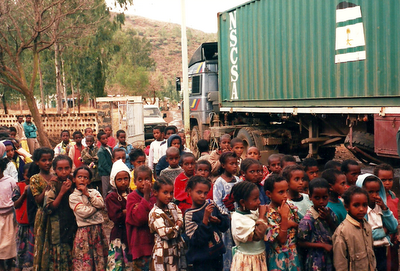
The story of the Soviet Union is one of sadness, greed and tragedy, not only domestic tragedy but exported tragedy as well. Early on, they had burned through the resources and accumulated wealth of the Czars and were forced to pursue a political philosophy of militarism and expansionism. After they had raped and pillaged Central Asia they still needed more tribute. The only economic component of growth known to their system was taking from someone else. Of necessity, they eventually turned their sights on the resources of Africa, but needed a stronghold. In 1974, a Soviet sponsored coup overthrew Haile Salassie of Ethiopia, the second most populated country in Africa. They established a Marxist-Leninist military junta known as the “Dreg.”

In 1977, neighboring Somalia captured part of Ethiopia. Fifteen thousand troops from Russia, Cuba, South Yemen, East Germany and North Korea arrived to support the “Dreg.” Following the border dispute, the USSR just kept pouring in more “advisors” as well as armaments, tanks, jet fighters, rocket launchers and guns until every strategic location was controlled by the Soviets. Then came the genocide and forced deportations of dissidents to neighboring countries. Man-manipulated “famines” forced millions to become refugees as the Soviet leadership explained, “You don’t need to kill all the fish, simply drain the pond and all the fish will die.” 

The “famines” galvanized the resistance groups under the leadership of Seeye Abraha in the northern regions. They, too, were going to write their story. Another story would be written by a young man of royal linage, Daniel Yohannes, from Addis Ababa who was whisked away from Ethiopia to be educated in the US. Daniel became one of Project C.U.R.E.’s first board members.

For over 20 years the freedom fighters desperately tried to overthrow the Soviet-directed regime but no one came to Ethiopia’s aid. The free world simply said. “Well, some day the Ethiopians will realize that the Soviets are a menace and will throw them out.” The only weapons the freedom fighters had to use against the enemy were ones they could take away from the communists. The only show of international help came from organizations shipping food in response to the “famine.” Much of that aid was confiscated by the communists and sent on to Russia to help cover the food shortages there.

In 1996 I met a dignified Ethiopian woman in Denver. Her name was Tadeleah and her home was Addis Ababa. I met her at a fund raising dinner where I was speaking to help raise money for the shipping costs of millions of dollars of donated medical goods from Project C.U.R.E. into Ethiopia. Tadeleah had been a freedom fighter during the Soviet occupation. Twenty years later she was a Cabinet Member in the newly formed government and Minister of Women’s Affairs for Ethiopia.

On my next trip into Ethiopia I was accompanied by Daniel Yohannes. We were welcomed at the Addis Ababa airport by Seeye Abraha, new Minister of Defense for Ethiopia. Also there were the Ambassador to the US, the Governor of the Tigray region, the Minister of Health, and Tadeleah. All had been leaders of the Ethiopian People’s Revolutionary Democratic Front (EPRKF). They were busily engaged in restructuring a new Ethiopia after the miracle victory over the communists. They were now writing their new story.

One of the evenings I was in Addis Ababa Daniel and I were invited to Tadeleah’s home for dinner. We were graciously received by her three daughters. Her lovely home featured wood floors and comfortable furnishings. Tadeleah had prepared a traditional Ethiopian meal where soft, spongy bread made from teff called “injera” was stacked four layers deep. Each slice was about 20 inches in diameter and the stack covered a low round table where we gathered. Placed on top on the injera were food items, such as spinach, squash, corn, fish, lentil beans and rice. As we talked we would tear pieces of injera from the top slice, pinch or scoop up a vegetable or meat and put it into our mouth. As we were finishing our injera one of the girls placed a covering on the wood floor and built an open fire of charcoal in a cast iron pot. She roasted coffee beans by gently shaking them over the fire and then meticulously brewed the coffee over the same fire. The uniqueness of the ceremony was exceeded only by the aroma and taste of the Ethiopian coffee.

During the dinner I commented about a picture close to the table and asked if the man in the picture was her husband. Tadeleah confirmed that it was and hesitatingly she began sharing with us the heart-rending tale of the price of freedom in Ethiopia. Her husband had been an early leader in the resistance fighting. The communists had captured him and forced Tadeleah to watch as they tortured him to death. Tadeleah became one of the fiercest and most respected leaders in the movement. 

When she was captured she was leading a group of women and girls out from a village that had been surrounded by the communists. They were firing mortar shells and grenades into the village killing the inhabitants in the crossfire. Tadeleah had sneaked into the village and tied the women and girls together in a group so they would not get separated as they attempted to escape to safety in the dark of night. The enemy discovered their escape and caught them. Tadeleah, who was dressed like an old pregnant peasant woman, managed to escape again, but as she was leaving, a young girl with tears in her eyes begged her not to leave them because they would then have nothing and no one. Tadeleah then came back to try to help them one more time. That time the enemy rec­ognized her and she was condemned to death. For the next 13 years she cheated the firing squad but remained in solitary confinement until she escaped again. She told us that close to half of the freedom fighters were women and when the com­munists would capture a group of their forces they would nearly always shoot all the women on the spot because they were the fiercest fighters, being the last to ever surrender their weap­ons. The women could absolutely terrorize the enemy and get the advantage in close hand-to-hand fighting. It was because of the important role that the women had played in the war that they now had been given some of the most important jobs in the new government. I listened very carefully as Tadeleah relived her story.

Rogue nations write their stories, insurgency freedom fighters write their stories, and each individual writes his or her story for history. We are the sum total of every moment and every event of our lives on this earth, and we decide how each episode will shape our story.


Gently Shake Your World

It was Gandhi who admonished his generation saying, “In a gentle way you can shake your world.” Gandhi certainly shook his world during his lifetime. While traveling throughout this world I have met my share of passionate persons who have likewise shaken their world in gentle ways.

One of my dearest international friends was Daniel Kalnin. He was born in the mysterious country of Burma. The British had colonized Burma, bordered by China, India, Thailand and a bit of Laos. Burma had become a strategic defense post for the Brits during World War II. But in 1948 Great Britain decided to pull out of Burma and sail home. The vacuum of leadership and stability threw Burma into political, economic and cultural chaos. They had grown to depend on the British rule of law, available health care, and the advantage of international trading. Power struggles, tribal wars and a lot of bloodshed became the rule.

Daniel realized that if he were to see any of his dreams come true he would have to leave Burma. When he was 18 years old he slipped across the Thailand border and became a fugitive. Eventually, some Americans rescued Daniel and brought him to America where he was educated and where he met his Canadian wife, Beverly. Upon graduation the two of them determined to return to Thailand and work with the hill-tribe people who lived on the border of Thailand and northern Burma.

In Thailand Daniel constructed, with the blessing of the King of Thailand, a small housing development. He tested 27 water sources to find an uncontaminated water supply for the village. None could be used. But high in the mountains he discovered a spring of pure water and built a water project of cisterns and pipelines to serve the people. One of the criteria for families to move into his development was to stop cultivating poppies for opium resale, take ownership of some of his land and start growing a cash crop of coffee. Daniel returned briefly to the US and raised money to buy coffee plants. While here he set up distribution outlets to market the new “Hill-Tribe” coffee brand in America. The villagers discovered they could make more money with coffee crops than poppies. Because of the new water system the villagers became dramatically healthier.

I traveled with Daniel on motorbikes over the steep trails of the lower Himalayas along the border of Burma to his new development of Bayasai and the bustling town of Prau. Daniel showed me the large brown church the people had built with a large red cross painted on the front. It was the only place in the insurgency area where the people from five different tribes were living together peacefully.

In the commercial city of Chang Mai, Thailand, Daniel and Beverly had additionally built the “Home of Blessing.” When I first visited the Kalnin’s home in Chang Mai there were 47 “throwaway girls” ages ten through twelve who had been taken from slavery and prostitution and were being housed, loved and educated in that home. But for 30 years Daniel had been estranged from his family and beloved homeland of Burma. Eventually, Project C.U.R.E. was privileged to join Daniel in returning to Burma and seeing his dreams come true in establishing the highly effective “Barefoot Doctors” organization that has saved literally thousands of the lives of the hill-tribe villagers and citizens of Thailand and Burma.

My dear friend Daniel recently died and I am still grieving the loss. This article is written to the honor of Daniel, his family and his never ending life’s work. Today, I salute him as a true champion because in a gentle way Daniel shook his world!


Gratitude

When I was a kid we used the word “dibs” a lot. I had dibs on sitting next to the door in the backseat of the family Buick on the way to church. I had dibs on the classroom’s leather football for the morning recess. When I was playing little league baseball I had dibs on the mahogany stained Louisville slugger bat with the electrical tape on the handle. I presumed that those positions or objects were sort of birthrights to me and I presumed everybody else had that figured out as well. I never really owned them. I never did anything to deserve them, and I was never really thankful for them . . . I just put “dibs” on them. 

Today, my native culture has graduated to a new level of sophistication. I look around and see my fellow travelers speeding down a newly paved freeway that allows for a much higher speed limit of cultural expression. I still sense the same spirit of “I dibs it,” but now I sense a frightening new power of selfish expression from the driver’s seat of the runaway vehicle. Instead of saying, “I dibs it,” I hear it repeated in rapid-fire sequence, “I deserve this . . . I’m entitled to this!” “Do it for me now!” 

If you look closely enough the seeds of tragedy can be found in the “I dibs it” statement. But the unraveling of civility can be found in the concept of “I’m entitled to this.” Recompense from a position of entitlement separates you from the attitude of gratitude. Why would you consider giving thanks for something that was due you and should have been given to you even earlier? But, Oh, how pleasing it is to hear the sincere and simple expression of gratitude from a meek and unassuming source. 

A couple of years ago Project C.U.R.E. teamed up with the Black Lion Hospital in Addis Abba, Ethiopia. Thousands of children in the area were dying each year with cardiac pulmonary problems brought on by a variety of African childhood diseases. We were able to install the very first cardiac catheterization equipment for children in the whole of East Africa, along with all the necessary supplies. The heart surgeons there are now saving the lives of about two thousand little kids each year! 


Recently, NBC Nightly News and Brian Williams dispatched reporter, Michael Okwu and a crew from Burbank, CA to follow up on our project. First, they visited the Denver headquarters of Project C.U.R.E., then the crew traveled to Addis Abba and the Black Lion Hospital. There, they interviewed little Teclemec’s mother. Teclemec was five years old and dying because her pulmonary artery was so narrow it obstructed the normal blood flow. “She didn’t eat or sleep,” her mother said. “She was a very sick little girl.” Then the Ethiopian heart surgeons worked their procedures and gave Teclemec a second chance to live. 

In the news video clip Teclemec, with sparkling eyes and a most engaging smile, speaks through the translators, “Now I can play and now I can run. Now I can do anything I want to do.” It is a perfect picture of a little girl with a million dollar smile and a mother with a heart full of simple appreciation. In the news segment Teclemec shyly dips her head to the cameramen, and with the countenance of an angel she simply says . . . “Thanks!” 

Oh, how refreshing. How beautiful. How rewarding, because, Gratitude is the soul’s expression of non-entitlement. 

To view the NBC News Clip in its entirety please click below:

Visit msnbc.com for breaking newsworld news, and news about the economy


The Colonel and Her Children

It wasn’t a sprint . . . it was a full throttle marathon race across the heartland of Vietnam. This race took me from government meetings with the People’s Party leaders in Hanoi, south to Da Nang, further south to Quang Nam Province, then to meeting Ministry of Health officials, hospital directors and Vietnam Charity Directors. I was assessing scores of Vietnam hospitals where surgery rooms were dangerously inadequate, hospital laboratories devoid of either lab equipment or supplies and discouraged doctors literally begging for medical goods.

When I reached Qn Du Province, the conversations were periodically punctuated with the name “Colonel Thuong Tuong Vi.” I presumed the person to be a Vietnamese military man until I heard someone say “Madame Vi.” Madame Vi was a respected icon and at the same time a mystery woman. When we reached the city of Tam Ky I was informed that we had been extended a special invitation to meet Colonel Thuong Tuong Vi at the “Mercy Center for Performing Arts.”

Thuong Tuong Vi was a full Colonel in the Vietnamese Army, a past member of the Central Committee of the People’s Party and a high profile citizen of the Hanoi cultural society. But, additionally, she was one of Vietnam’s most renowned artistic performers. She was a professional singer and dancer, and had received countless awards for her talents, especially for her entertaining of the military and the People’s Party members.

Madame Vi, however, had become a devout Christian. The change in her life intrigued the Communist Party elite as her comrades watched her go out and collect disadvantaged children from the streets and bring them into her “Mercy Centers for Performing Arts. “I no longer wanted fame and attention,” she told me. “I only had a burning desire to help other people, especially young, disadvantaged children.” Her Center in Tam Ky housed 72 children, in Da Nang she was housing and training 120, and in Hanoi 180 orphans were being housed and trained in the performing arts.

Anna Marie and I were met at the door of the Tam Ky Center by Madame Vi. She was elegant, dignified and graceful. She ushered us into a well-appointed conference room. While we were getting acquainted, Madame Vi shared with us that it was her dream to have Project C.U.R.E. establish and equip a small clinic for the children in each of her Centers. “I want to provide the best for my children, because one day they will be our new leaders. I want them to see and feel what is possible.”

Madame Vi then escorted us upstairs to a small performing theater. When seated, she leaned over and whispered, “God showed me that one day I would no longer have my talents and my beautiful voice, and that I should take those talents now and transfer them into orphans, homeless children, and crippled children who otherwise would have no hope of a good future.” A handsome young Vietnamese boy stepped forward on the stage and welcomed us in flawless English.

The first songs were traditional Vietnamese folk songs, performed beautifully with graceful choreography and hand signing. The mini-concert continued with the words, “In a moment like this, I think of a song, I think of a song about Jesus.” I looked around in amazement. The sound, quality and harmonies were overwhelming. Each word was phonetically sung in perfect English. There was not a smidgeon of doubt that the famed performer had poured her life and talents into the previous urchins. The meticulously trained young singers communicated with warm smiles, direct and sparkling eye contact, vibrant body language and stage presence. They ended the presentation with two familiar Christmas carols and the song, “He’s Got the Whole World in His Hands!” I took my eyes off the kids and looked around again. Everyone in the room was crying! It was a performance I shall never forget.

When the performance was over we were once again directed to the conference room where they had prepared lovely dishes of hot Vietnamese snack foods and tea for us. There, I promised Madame Vi that I would help her get her clinics for the Centers. I also asked her about what her People’s Party friends thought about her selection of songs.

“I teach diversity of culture,” she said. “I teach the underprivileged children perfect English. The officials love it. I first teach the children to sing the songs phonetically. While learning the lyrics they begin to ask questions about what the song writer was saying. I just simply answer all their questions so that they can sing the songs with understanding and feeling. Strangely, they all fall in love.”

“You see,” Colonel Thuong Tuong Vi confided to me, “I can’t go back and start a new beginning, but I can start today and make a new ending!”


You Can't Do That!

Indeed, you would be a wealthy person today if you would have received $20 for every time somebody hollered in your ear, “You can’t do that!” I’ve never figured out who it is that appoints and empowers all those guardians of the culture who are so intent on policing your possibilities. But there certainly is no shortage of volunteers who are eager to tell you not only that “you can’t,” but also give you “viable” reasons why you can’t. 

I have discovered, however, that one of the greatest joys in life is accomplishing something that other people adamantly declare cannot be accomplished. There seems to be within the nature of mankind a spirit that resists the declaration of the impossible. We want to keep turning the tumblers of the combination lock until we hear that magical “click” that opens the hasp. 

The intriguing history of Project C.U.R.E. is a simple sequence of happenings and miracles that people declared up and down would not and could not take place. I recall the prodigious occasion of my receiving a personal invitation from Great Leader Kim IL Sung to travel to North Korea and join him in celebrating his 81st birthday. I would be required to obtain a visa to be able to travel to Pyongyang. 

Let your imagination run as to the reaction of the staff persons in charge of the “Korea Desk” at the Department of State Building in Washington D.C. when we informed them of the personal invitation and the simple request for help in securing a visa to Democratic People’s Republic of Korea. “No, you don’t have a personal invitation from North Korea. We can’t get anybody into Pyongyang. You will be held hostage there. It is a Hermit Country and you can’t go there! We are here to keep people like you from creating an international incident.” 

Well, it’s been about 19 years since my first trip to DPRK. I have returned eight times and, believe it or not, the US State Department even entrusted some of the top DPRK decision makers to me and allowed them to come to Colorado and stay in our guest house. We have taken millions of dollars worth of medical goods to the needy people of that country. I was there when the dam broke on the Yalu River and tens of millions of dollars worth of damage occurred. We were the only ones to go to their aid. And there is a certain sense of pleasure that comes when I hold in my hand the first shipping license issued to Project C.U.R.E. by the U.S. Commerce Department and Department of State to deliver ocean going cargo containers of donated medical goods directly into the North Korean port of Nampo. 

I believe that one day in the not-too-distant future there will be a grand reunification of the two Koreas. I have even presented to the United Nations a paper encouraging those possibilities. But always in my ears I hear people saying, “That can’t be done . . . you simply can’t be a part of that!” And traditional logic and perceived reality would robustly second that motion . . . “That can’t happen!” 

But I have a word of encouragement for you today. If you cradle a dream in your heart and you desperately believe that dream can take wings and fly like an eagle, and you have dedicated yourself and your creative energies to seeing that dream become reality, then, pick up that combination lock again, embrace it and begin turning the tumblers with gentle passion until you hear that God-sent “click” resound in your heart. Can you imagine the joy and excitement of seeing the hasp of that lock fall open and with your own eyes, what others had declared, “That can’t happen, ”. . . you actually see become reality?


Improve Your World

In her diary, Anne Frank documents the horrors of Nazi Germany and her life of hiding, capture and efforts to survive in a concentration camp. Her wholesome attitudes and keen observations of life continue to amaze her diary readers even today. One of her statements leaves me defenseless and convicted: “How wonderful it is that nobody need wait a single moment before starting to improve the world.” She is right!

I am so appreciative to have had people in my life who were determined to make this world a better place, regardless of all the reasons imposed on them why they could not. Two such people were my aunt and uncle, Rev. Robert O. and Lela Jackson. Early in their marriage they had volunteered to go to Argentina as missionaries. Later, they traveled to Swaziland, Africa to help establish a medical mission in the 1940s and 1950s. They landed in a place called Manzini and served four years at a pioneer hospital and nurse’s training center. The next four years were spent out farther into the bush veldt at a place called Piggs Peak Station. Uncle Bob directed the efforts of the medical clinic and coordinated the activities of the mission. They literally poured their lives into the work.

One of the greatest rewards of my work with Project C.U.R.E. came in 2004, when Anna Marie and I were requested to travel to Swaziland. The Raleigh Fitkin Hospital in Manzini, Swaziland, 17 additional district clinics, and a nurse’s training college were in desperate need of help. The medical institution, as well as the Swaziland government, had requested that Project C.U.R.E. come and assess the health care facilities and see if we could be of assistance. The Swaziland government Health Ministry had promised to help financially underwrite the hospital. But the Swaziland government was having a tough time backing up their promises with money.

Over 100 years before, the King of Swaziland had given the missionary endeavor a huge piece of land that now was part of the city of Manzini, and had invited them to educate and minister to the people in Swaziland. Their presence in that part of southern Africa had been very successful and influential over the many years. Uncle Bob and Aunt Lela Jackson had been a part of that successful endeavor. The hospital administrators showed me records and evidence of the Jackson’s indefatigable efforts while they were there.

When we finished our assessment work in Manzini we were taken to the mountainous region of northwest Swaziland to view the outlying medical clinics in Piggs Peak, Endzingeni and 15 other clinics. Upon our arrival at Piggs Peak Station I stood just inside the entry gates of the compound and drank in a 360 degree view. “So, these were the views my relatives captured in their hearts day after day so many years ago.” They had worked in this very hospital and lived on this very compound during the critical days of growth and development of the care- giving ministry. As a young boy I had become vicariously acquainted with Swaziland. I had studied the pictures, listened to the wild stories, had touched and seen the artifacts from Africa that they had toted home with them. My soul now drank it all in as if I were a thirsty sponge with human legs. How soon we forget the exacting price others in the past have paid in their eternal journey to improve the world.

Upon my return to Colorado I called my 84 year-old “Uncle Bob,” who resided in an assisted living center near Roseburg, Oregon. My Aunt Lela had died a few years before. I told him that I had just returned from Swaziland. I let him reminisce and encouraged him to tell me once again about their experiences in Manzini, Endzingeni and Piggs Peak. “Do you remember seeing a long line of trees stretching from the church, past the clinic and toward the main house?” Uncle Bob asked me. “Oh yes,” I replied, “they are huge evergreen trees all in a straight row.”

“I planted all those with my own hands. I got them from a tree farmer who had come to plant a forest of trees on the rich and fertile hillsides of Piggs Peak.” “Uncle Bob,” I assured him, “you are to be commended for having planted all those trees in a straight line from the church building, past the clinic and toward the house. They stand today as a testimony that you left Swaziland a greener and better place than when you went there.”

“But,” I continued, “you and Aunt Lela are to be commended even more for the many years of your lives that you invested in Swaziland. Spiritual and physical seeds of help and hope were planted there by you that are far greater than the row of beautiful evergreen trees. Only heaven will reveal the waves of goodness that have lapped the shores of eternity since you and Aunt Lela affected that place by your committed lives and efforts. For Anna Marie and me, it was a great privilege to go to Swaziland and honor not only God but also you and Aunt Lela with additional medical goods for the hospital and clinics. Thanks for being a faithful worker and a good uncle.” Somewhere in their early journey they had discovered the eternal message also penned by Anne Frank, “How wonderful it is that nobody need wait a single moment before starting to improve the world.”


Better Off

I think it’s time that someone should bring to the discussion table the difference between the concept of “greed” and the idea of the pursuit of someone’s “best interest.” The two concepts are not the same. However, the intent to confuse the two has some ideological appeal and, as usual, time aids in the erosion of many traditional words and concepts.

Historically, greed has been considered as one of the “Seven Deadly Sins.” It is a sin of excess and inappropriate expectation . . . the “me first – regardless of cost or consequences.” Greed is not always easily identifiable in the beginning, and that makes it confusing. But, be assured that sooner or later, harbored greed will surface into observable behavior. Another thing I have noticed is that greed delivers a different result than what was anticipated in the beginning, and sad and terrible consequences of greed may take a long time to surface.

Pursuing one’s best self- interest, however, is not necessarily greed or selfishness. It has to do with appropriate expectations and comes along as a necessary component in the “free choice” package. When you are given daily alternatives it is the expected behavior to choose that which is highest, best and most fulfilling. Of course people pursue their own self- interests, thus the beauty of individuality and divergent creativity. Pursuit of their own self- interests includes seeing their families become “better off.” Pursuit of their own self- interests includes their concerns for their friends and neighbors being “better off,” as well as the entire citizenry of their communities.

I am a businessman and an economist . . . a compassionately involved cultural economist, dedicated to helping other individuals in the wholesome fulfillment of their self- interests.

I often tell people that “I have decided to give the best of my life for the rest of my life helping other people be better off.” So, what on earth does that mean? Albert Schweitzer acknowledged, “I don’t know what your destiny will be, but one thing I do know: the only ones among you who will be really happy are those who have sought and found how to serve.” Serving other people includes the concept of helping them become “better off.”

Lately, I am running into more articles and interviews where I hear frustrated folks bashing the concept of anyone advancing or moving ahead in their circumstances, saying, “They are getting more education and trying to acquire more skills just because they want more of the pie, and I get less of the pie as a result. They are just greedy, and it’s not fair,” . . . or . . . “The earth is sufficient to meet every man’s need . . . if only those profit people would just stop their greed.”

I have two dear friends, husband and wife, each is a talented medical doctor. They are highly motivated, full of energy, and are Nigerian. Their burning passion was to build a 50 bed hospital in Port Harcourt, Nigeria with a fine radiology department, laboratory and well- equipped operating room. Impossible!

Dr. I.C. Ekwem and Dr. Linda Ekwem heard about Project C.U.R.E.’s work in Nigeria. They pursued me aggressively and even secured the money, purchased airline tickets, came to Colorado, and stayed at our home in Evergreen. They shared their dream and passion with Anna Marie and me. They showed us what they had already done to accomplish their dream. I really wanted to help them become “better off,” so we helped them finish and furnish their dream hospital. Today, the Ebony Hospital stands as a miracle near the shores of the Gulf of Guinea and the Atlantic Ocean in Port Harcourt, Nigeria.

The doctors Ekwem were aggressive, passionate, and persistent in pursuit of their self- interests. They wanted to see their hospital become a reality. Today, they are “better off,” and hundreds of patients are alive and not dead, and thousands more are healthier . . . all are “better off.” But I implore the cultural levelers to never bash my friends as “greedy” and assign them to their contrived category of “selfish.” Acting in one’s self- interest is not the same as being selfish. Making good choices that serve one’s best interest is different than greed.

World Survival Tip #2: Forget Not the Photos!

I’ll bet you thought I was going to extol the wisdom of taking a backup camera along with you in case your cell phone camera went dead in Mongolia. Nope. I don’t want to talk about taking photos of your trip, but taking photos to your trip. Hundreds of times my trips turned from “minus” or “mundane” to “marvelous” because I had remembered to take photos with me. Updated photos of my family were never outside my reach during my forty years of international travel. People in Montenegro, Morocco and Mozambique, Papua New Guinea, Pakistan and Palestine all know my family.

In December 1997, I had just finished lecturing at the University of Kiev in Ukraine. I needed to travel to the Pirogov Medical University in the city of Vinnitsa, Ukraine. An Eastern European snow storm had blasted the region and many of the roads were closed. Riding the old Soviet train was my best option for making the four hour trip.

The train had been traveling all night before arriving in Kiev. When I got on the train the compartment was still made up into a sleeping car arrangement. Other people were already occupying my compartment. A middle aged couple had staked their claim on the upper berths; their clothes and food leftovers were strewn on the compartment table and around on the floor. Another fellow in the compartment was a shriveled- up old man with thick glasses and white hair. He wore a gray, hard wool suit with the entire left front of his suit jacket covered with Soviet military medals and badges of accomplishment. I had just put my two bags on the bench by the door. The old retired military man immediately began rearranging everything.

I smiled warmly at the old “czar” and he mumbled something in Russian. I replied with a mumble in English. When he realized I did not speak Russian, he simply snapped his head around to the opposite direction and stared at the compartment wall. The train was very hot and stuffy. The absence of any fresh ventilation exaggerated the foul smells of rancid food and the peasant peoples’ belongings.

Old, frumpy Ukrainian women with knurled faces and hands gathered in gaggles around the stopped passenger trains. Their ragged cloth bags contained homemade food being offered to the hungry passengers. Before we pulled away from Kiev Station the middle aged couple from our compartment jumped down from their beds and purchased some of the food. I scooted over on my cot and made room for them to spread their newly acquired goodies out on the already messy table. From the wrappers of old newspapers, they pulled a plastic bag of greasy potato chunks, slimy, cooked cabbage and chunks of strange looking meat. Small loaves of unwrapped bread, along with a smaller plastic bag of pickles, rounded out their breakfast meal.

I quickly used up as many Russian words as I knew. I smiled a lot and politely deferred the offer to share the greasy potato chunks and cold cabbage. The diplomatic ice was broken; then came the magic. I reached into my thin leather attaché and pulled out the photos of my family. Their eyes brightened and their whole bodies responded. They reached for the photos and handled them with their greasy hands and laid them on the table. Everyone began talking in chorus, waving their hands and smiling. Even the grumpy old “czar” smiled and pulled from his wallet two crumpled black and white photos from the past. He told me all about the women in the pictures, and I told them all about my wife, sons and grandchildren. He knew what I had said and I knew what he had said even though we didn’t catch the words. We had all become good friends.

I have shown photos of my family to kings, presidents, rogues, prisoners, dictators, refugees, priests, holy men of Tibet and hostile border guards. They almost always reciprocate by sharing a photo with me. Photos are full of “super glue.” They bond hearts together instantly and speak a language that surpasses words. They have opened doors that were solidly shut, shut doors that would have led to my demise, and skipped over years of relationship.

Photos have also been one of my best moral defenses while traveling. Cultures and folkways differ considerably throughout the world, but respect shouts its message from the mountain tops. If I find myself in a situation of uninvited familiarity or unwanted pursuit, I simply reach for my family photos and proudly display a picture of my beautiful wife, explain how much I love and respect her, and then show photos of my important sons and gorgeous grandchildren. Without being rude or judgmental, the conversation gets back on track or tapers to a respectable close.

The only travel documents I own that are more worn and used than my bulging passports are my travel photos. I never want to leave home without them!


Holding the Rope

Two of the finest international friends Anna Marie and I have made while traveling throughout the world are Dr. James Terbush and his lovely wife, Leigh. For years, Dr. Terbush worked for US Department of State as a medical liaison at many different US Embassies. Eventually, Captain Terbush became the Command Surgeon for NORAD, NORTHCOM and Home Land Security. We worked together in Senegal, Argentina, South Africa, and Afghanistan. We even sat together in the palace living room of the president of Albania, in Tirana, where we helped organize medical camps for the refugees fleeing the Bosnia-Herzegovina-Croatia massacres. 

We became better acquainted with the Terbush family when we spent time with them at the Embassy in Athens, Greece and explored the mystical Greek islands together with their 21 year old son, Peter. Jim Terbush and Peter loved to climb mountains together all over the world. Peter decided to enroll in Western State College in Gunnison, Colorado and started teaching climbing classes, talking incessantly about one day becoming a climbing guide.

Early on, Dr. Terbush had taught young Peter about the “belay” position used when you are holding the rope to secure a climbing partner on the mountain above you. “Always protect a partner at the end of his rope,” he would tell Peter. “Never let go!”

Peter and two of his college friends, Kerry and Joseph, decided to make a quick trip to Yosemite National Park and climb the legendary Glacier Point Apron. Sunday evening, June 13, 1999, Kerry had climbed about 60 feet up the mountain. Peter was in the belay position securely holding Kerry to the granite face as he climbed. Then the absolutely, unimaginable thing happened! With the roar of a hundred freight trains and the energy of an exploding bomb, the upper ledge of the famous mountain let loose and shed in excess of 200 tons of boulders down to the valley below. Peter looked up to see boulders the size of automobiles coming straight down upon him. The earth shook. He looked again and saw Kerry. Peter knew that if he moved the slightest he would lose his belay position and Kerry would swing out and catch the full force of the cascading granite from over 1,000 feet above. “Always protect a partner at the end of his rope . . . Never let go!” Peter could have made it to safety. He chose to stay. The valley filled with dust and people in the park fled.

Both Kerry and Joseph lived. Young Peter was crushed by the thunderous slide. In order to free the rope to let Kerry down they had to get to Peter. There he was . . . his left hand was gripping the rope above and his right hand pulled down hard against his right hip just in front of the belay device attached to the climbing harness at his waist. . . the perfect belay position. They had to pry the rope from Peter’s grip. The Park Rangers and Search and Rescue members on the scene hailed Peter as a hero, consciously giving his life for the lives of his two climbing buddies.

Today, I want to thank my friends, Dr. Jim Terbush and Leigh, for bringing Peter into this world and into this culture. And I want to honor his memory by thanking Peter for his dauntless character and selfless expression of sacrifice. Whenever my circumstances press me to the point of inescapable decision, I want to recall Jim’s life lesson to his son, Peter, “Always protect a partner at the end of his rope . . . Never let go!”

**If you would like to know more about the Peter Terbush Memorial Outdoor Leadership Summit-Western State College of Colorado, go to:www.western.edu/student-life/wp/outdoor-leadership-summit **