So, What is Money? Part 2

It might be possible to imagine a cashless society, but not a moneyless society. People will always fabricate some kind of money in order to help them facilitate trading the things they have for the things they want. What’s your preference to use as money?

Historically metal has been used most. It is a whole lot easier to make change with pieces of metal than with raw eggs. Economist Adam Smith said in the mid 1700s: 

    Metals cannot only be kept with as little loss as any other commodity, scarce anything be less perishable than they are, but they can likewise without any loss, be divided into any number of parts,  as by fusion those parts can easily be reunited again; a quality which no other equally durable commodities possess, and which more than any other quality renders them fit to be the instruments of commerce and circulation.

It became inconvenient over the centuries, however, to stand in line at the marketplace and pull out your bar of gold and whack off an amount for your purchase and weigh it with accuracy. So, the usage of coins became more convenient. Minted coins were easily identifiable and had their weight and purity stamped on them.

It was also common for the coins to bear the image and guarantee of some governmental leader. Sooner or later the governments have always taken over the sovereign control of the minting of coins. Even in the US, under the Mint Act of 1792, the debasement of coins by an individual was made illegal and a crime punishable by death. The government likes to have control of the monetary system. Down through history, however, sovereign governments have repeatedly abused their rights of minting coins.

Would some people accept commodities to be used as money? Yes. Would most people accept precious metals to be used as money? Yes.

But why would any reasonable person accept a small printed piece of paper as money?

(Research ideas from Dr. Jackson’s new writing project on Cultural Economics) 


So, What is Money? Part 1

Has there always been money? Where does it come from? Who determines its value? Are credit cards really money? Does the value of money always shrink with age? What happens when money fails to maintain its power to purchase? What would a totally cashless society look like?

In 1758, philosopher/economist David Hume stated: 

Money is not, properly speaking, one of the subjects of commerce, but only the                  instrument which men have agreed upon to facilitate the exchange of one                            commodity for another. It is none of the wheels of trade: It is the oil which renders the motions of the wheels more smooth and easy.

We have come a long way since David Hume’s discussions regarding money in the eighteenth century. In my travels I have observed different cultures using some pretty strange things as money: salt, animal hides, wives, cattle, wheat, and beads.

By the way . . . how is your confidence level these days in having all your store of wealth represented by numbers in your bank’s computer?

(Research ideas from Dr. Jackson’s new writing project on Cultural Economics) 


Production of Goods and Services

In order for a country to experience a functional economy, it must produce goods and services. Through that production income is created.

If the country does not successfully utilize its natural resources and encourage its human resources to produce, it will be poor. Production that results in income is mandatory.

In order to break the cycle of poverty in a developing country, income must be produced. Income can only be created when resources are efficiently used to produce the desired goods and services needed within that country, or can be traded in a broader market to meet the needs of another group of people.

Countries like Vietnam, Cambodia, and China, who now are beginning to understand and encourage that concept, are increasing their wealth.

Those countries that do not encourage or allow such practices, like Zimbabwe, Mauritania, and Cuba, remain in poverty.

(Research ideas from Dr. Jackson’s new writing project on Cultural Economics)


Enterprise

We have no way of predicting where or when we might be confronted with the opportunity to rewire our personal priority grid. It is not a one-time purchase from the app store.

Each day we are introduced to new pieces of information that come to us forming a lifelong adventure of filtering, redefining, and choosing. It is our choice to set into motion the best of consequences.

It makes for a great economic principle to let go of what we can never keep in order to lay hold of what we can never lose.

(Research ideas from Dr. Jackson’s new writing project on Cultural Economics)


Good Things Happenin'

For the past three years Winston-Crown Publishing House has carried my short stories and published them every Tuesday morning at 10 o’clock on the internet. I am indebted to them for allowing that to happen, and thank them sincerely. Every week the number of people reading the essays has increased and the acceptance has grown. That’s fun. 

Winston-Crown is very excited, and so am I. As soon as the book The Happiest Man in the World: Life Lessons from a Cultural Economist was released, people began requesting to have access to more adventure stories from around the world. Those requests prompted the next book Love and Common Sense: Stories from Around the World to Challenge your Mind and Ignite your Compassion. That book, released in 2013, has also been very well accepted. 

Earlier this year my lovely wife, Dr. Anna Marie Jackson, joined me in authoringHistorical Heartbeat: Project C.U.R.E.1987-2012, a book of info graphics and narrative celebrating the first twenty-five years of the life of Project C.U.R.E. 

Last week the manuscript for my newest book, Simplicity and Sophistication, was sent off to the copy editors and then it will go to the proofers. From there it will progress to the typesetters and finally to the manufacturers. Hopefully, it will be released in time for Christmas. It will be another book of seventy short stories of wisdom and kindness from around the world. 

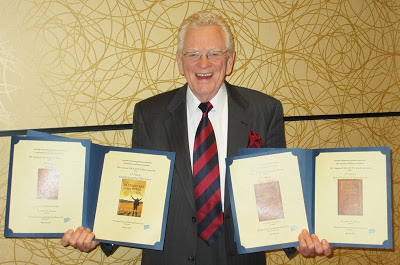
In March we were notified that The Happiest Man in the World: Life Lessons from a Cultural Economist and Love and Common Sense had been included as “finalists” in the 19th Annual CIPA EVVY Book Awards. At the Gala Award Presentation on May 18, 2013, it was announced that The Happiest Man in the World had been selected to receive the First Place Gold EVVY Award for Autobiography/Memoirs. A little later in the program it was announced that Love and Common Sense had been selected to receive the First Place Gold EVVY Award for Travel. Yes, of course we were shocked off our chairs!

Now Winston-Crown is even more excited, and I have signed two additional contracts with them. One is for them to publish all my field journals from my nearly thirty years of international travel. The other contract represents a thrill of a lifetime for me. My former major professor from the University of Colorado Economics Department, Dr. Paul Ballantyne, and I have each signed a contract to co-author a book on Cultural Economics, where we will investigate how the economics of a culture affect the people and how the people affect the economics of a culture.

So, starting next week you will probably notice a bit of difference in the Tuesday morning blogs. They will probably be shorter, more to the point, and tend more toward the everyday world of culture, economics, and stewardship of resources. As I begin doing the research for the new book projects I can already guess that there will be some concepts and stories that I won’t be able to wait to share with my internet friends in book form. Those ideas will probably show up through the inbox of your computer. We are still traveling on this adventure of helping other people become better off. Let’s keep traveling and learning those lessons together!


Not Just Best, But Legendary

I knew I was in trouble. There was no domestic air service from the Chinese city of Shaoyang to Zhengzhou. I would have to take an area transport bus for four hours to a city called Changsha. There I could catch a train to Zhengzhou for my next hospital assessment. 

Traveling in northern China was not easy. As soon as the Chinese people began to work their way out from under the restrictive and oppressive restraints of the government, and began to once again exercise their natural DNA talents for business and enterprise, the nation as a whole began to awaken like an aroused giant. Such things as transportation systems were still trying to catch up with the new demands. 

I successfully boarded the old rickety bus headed for Changsha, but mechanical problems with the bus had us stopping periodically to refill the leaky radiator. We were losing precious time, and I could see that it was going to be a close call for me to get to the train depot before my train left for Zhengzhou. As our driver approached the outskirts of Changsha, we encountered a stand-still traffic jam. 

I explained again to my young translator just how important it was that I not miss the train to Zhengzhou. When we realized that the bus could never possibly get us to the station on time, we agreed on a risky and creative option. We asked the bus driver to open the door and let us out. We scrambled out with my luggage and ran across the road to the lane of traffic that was traveling away from the city. It was not deadlocked. Within two minutes I was able to hail a local taxi. My translator explained our urgency to get to the train depot immediately. The driver was a young, aggressive man who liked the looks of the U.S. dollars I was holding in my hand. He took the next side road and we were off like the down of the thistle in a wind storm. 

The little taxi came sliding to a stop at a side entrance to the train depot with dust bellowing around us. I graciously paid the aggressive driver, and my translator and I went running down the platform to coach number fifteen in spite of all the train attendants waving their arms at us. The door on our coach was still open and I tossed my luggage up into the coach as the conductor began blowing his whistle to start the train rolling. Our goofy gamble had paid off and we had made it! 

The train coaches were completely packed, but eventually we were able to find a place where we could hunker down for the balance of the fourteen-hour trip to Zhengzhou. Upon arrival we located a small, clean hotel room where I was able to sleep a couple of hours and take a refreshing shower. I was ready to visit the next two hospitals. 

Zhengzhou is located in the province of Henan that claimed a population of over 100 million people. Our first hospital to assess was the Zhengzhou Affiliated Hospital, a one thousand bed hospital that was involved in some very extensive remodeling. Our second hospital to assess became the delight of my entire trip. 

As we walked through the front doors of the Zhengzhou 5th People’s Hospital, we were met by three young, attractive Chinese ladies in white, crisply starched nurse’s uniforms and caps. Across the front of each uniform was neatly draped a bright red satin sash with gold writing. One of the nurses approached us with a beautiful smile and kindly asked us how she could assist us? My translator told her we were there for an appointment with Dr. Rang Da Zhong, the Hospital Director. 

The young lady informed us that the director was anticipating us and to follow her. The other two ladies stayed near the door in the front lobby. As we followed our hostess I, couldn’t help but notice that the hallways, the lobbies, and even the elevators were bright and shining clean. As we passed through the Ophthalmology department, I mumbled that we just as well could have been walking down the halls of an eye clinic anywhere in Chicago or Los Angeles. The new equipment was state-of-the-art and the facilities were attractive in every way. I later found out that their eye surgeons had been trained abroad and they were already using their laser and microscopic surgery machines to their fullest. 

Dr. Zhong was a personable fellow and genuinely glad that we had come. He was not only the director, but was also one of the chief surgeons. He was an interesting combination of pleasing personality, high energy, and dignity. Following a couple of minutes of introduction we got into the process of the questions of the assessment. In addition to walking the halls of the facility and visiting every department, I asked if I could dress down in scrubs and observe the equipment and procedures going on in the operating theaters. The director was gracious in every respect.

When finished, I was welcomed back into the conference room where I met the president and vice president of the hospital. They shared with me briefly about their plans for new construction, then frankly asked me for my input and observations about their hospital and how they could make it better.

I told them that I had walked the halls of thousands of hospitals in developing countries around the world but their hospital was different from any other. From the greeting I had received in the lobby to the observations in the surgery theaters there was a sense that everything was under control, everyone there was happy to be there doing what they were doing and they were all headed in the same direction philosophically and administratively. I told them, “No organization will rise above its leadership. What I have observed today is that the success of your institution has started with you the leaders. In my opinion, you are the greatest example of entrepreneurial, capital-intensive marketing that I have seen in a developing country. You are effectively leading. Keep at it!”

They sat there stunned for a minute and then replied, “How could you see so much by just briefly walking through our hospital? We want to take you to lunch.” There we continued to talk about China, economics, and the healthcare industry. At one point I asked them to tell me what had happened at their hospital that had made them so different.

They looked at one another and then began telling me the story. A man by the name of Sam Walton had come to China to open up some super markets. The people fromZhengzhou 5th People’s Hospital had all gone to the Sam Walton School. They showed me what they had learned:


Rule 1: Commit to your business. Believe in it more than anybody else and pretty soon everybody around will catch the passion from you — like a fever.
Rule 2: Share your profits with all your associates, and treat them as partners. 
Rule 3: Constantly, day by day, think of new and more interesting ways to motivate and challenge your partners. Set high goals, encourage competition, and then keep score. 
Rule 4: Communicate everything you possibly can to your partners. Information is power, and the gain you get from empowering your associates more than offsets the risk of informing your competitors.
Rule 5: Appreciate everything your associates do for the business; all of us like to be told how much somebody appreciates what we do for them.
Rule 6: Celebrate your success. Find some humor in your failures. Don't take yourself so seriously. Have fun. Show enthusiasm — always.
Rule 7: Listen to everyone in your company and figure out ways to get them talking. 
Rule 8: Exceed your customers’ expectations. If you do, they'll come back over and over. Give them what they want — and a little more. Let them know you appreciate them. Make good on all your mistakes, and don't make excuses — apologize.
Rule 9: Control your expenses better than your competition. This is where you can always find the competitive advantage.
Rule 10: Swim upstream. Go the other way. Ignore the conventional wisdom. 
 

“Dr. Jackson, the government in China has stopped giving free medical service. We think that’s good for us. Now we need to figure how to finance the system because everyone still needs medical help at some time. We have decided that there will be enough money available to support our hospital, and if we are in competition with other hospitals for the money that is available then we will make the people want to come to our facility and buy our medical service from us. Sam Walton says that people want a good shopping experience. We will give the people the best medical experience. If they want good parking we will make good parking available.

“We will give the people friendly service from happy and helpful people. We will give to them clean and attractive facilities and the best and most modern equipment. But Sam Walton says most of all we must train our people to have teamwork and always attain excellence in everything. We must have goals and become the best. Dr. Jackson, if there is money in Zhengzhou for medical services, then we are going to capture that money for our hospital. We think people will find the money if we will give them good and happy results. When we receive the money we can continue to buy the best equipment and give even more excellent service. We don’t want to be just the best, we want to be legendary.” 


The Beauty of Letting Go

Author C. S. Lewis reminds us that “Getting over a painful experience is much like crossing monkey bars. You have to let go at some point in order to move forward.” Our current culture would persuade us that the important thing in this life is to grab, grasp, and accumulate. More is way better. But many are discovering the beauty of letting go. We are learning that it is possible to hold on too tightly and lose everything. The tighter we squeeze onto the things we are trying to hold, the more we squeeze them right through our fingers and we lose them anyway. 

Of course, there is an important difference between letting go and giving up. Letting go gives you an opportunity to move forward; giving up drops you clear off the monkey bars. 

It is a very subtle temptation that tricks us into thinking that always holding on proves we are strong. But sometimes, letting go allows us to become the person we really wanted to become all along. In fact, history reveals that some of the world’s greatest battles have been won by those wise enough to let it go and take a second strategic look. Alexander Graham Bell is quoted as saying, “When one door closes, another door opens; but we so often look so long and so regretfully upon the closed door, that we do not see the ones which open for us." 

It is especially difficult to let go of something you don’t even realize you are gripping so tightly. And usually it is pride that blinds us from recognizing the death grip we have applied. So don't let your pride bully your wisdom into thinking it is imperative to hold on when it is the right time to let go and move forward. The exciting challenge of life seems to be the fine art of deciding when to hang on and when to let go. 

Earlier in my life I had become involved with a local religious institution that later proved to not be a healthy situation for our family. I had to come to a place where I realized that it was prudent to quit allowing the strife, let go of the tension, and move on with our lives in pursuit of other worthwhile and honorable endeavors. It was one of the greatest decisions of my life. Great good has come as a result of that choice. I discovered that you can lose only what you are blindly clinging to, but strategic surrender is certainly not the same as losing. 

The concept of strategic relinquishment of our rights in certain situations, and to certain institutions, runs closely parallel to our relationships with the people who are closest to us. We have heard throughout our lives that if you truly love someone you will let go of her from a selfish and possessive sense in order to help her become all that her potential will allow. . I have seen that work with remarkable results. 

In 1994, Anna Marie and I witnessed an unusual story of love and relinquishment in the African country of Kenya. We were assessing the hospitals around Nairobi and throughout the enchanting Rift Valley. While there, we were invited to stay atElsamere, the famous home of Joy and George Adamson, located on the shores of the impressive Lake Naivasha. While Joy was alive she had gained international notoriety by writing the book Born Free in 1960, a book that sold more than five million copies. A popular movie had later been released in 1966 and had won three Academy Awards and a Golden Globe Award for Best Motion Picture that year. 

In 1956, George Adamson was a game warden for the local African region. He was forced to shoot a lioness as it attacked him, only to later find out that the shooting had left three lion cubs motherless. Two of the cubs were sent to a zoo in Rotterdam, but Joy and George kept Elsa. It was their intention to raise the cub and educate it sufficiently in order to safely release her back into the Masai Mara. They fell in love with Elsa. The book reveals the difficulty experienced by Joy and George in coming to the point of actually releasing Elsa back into the wild.  

At last, Joy succeeded. With mixed feelings and a breaking heart, she returned her friend back to the jungle, alone. Joy and George then traveled to England for a year before returning to Kenya. They were hoping when they returned that they would find Elsa. They did find her, and discovered that she had not forgotten them. In fact, Elsa brought along her three cubs to get acquainted. Elsa became the first lioness to be successfully released back into the wild, the first to have contact after release, and the first known to have cubs. Loving Elsa resulted in setting her free. Love demanded letting go. 

It just might be a better part of wisdom to consider the relationships and situations in which you find yourself today. Whether it is trying to save a lioness or negotiating the monkey bars, it just might be that letting go is what will allow you to move forward.


Quantifiable Responsibility

I don’t speak or write very often about the subject of fear. It is not that I am such a brave fellow . . . it is just that all the nooks and crannies of my Scotch/Irish disposition seem to be filled up with happy stuff. I try to choose “happy” over “scared.” In the past thirty years of international travel, however, there have been some occasions when I probably should have been more afraid. 

In 2004, I had just returned to Denver from a physically exhausting trip to Papua New Guinea, Tonga, and India, and was headed that July morning for Montenegro. I experienced a situation that shook me to my emotional core. It was a fear I had never known before. 

In order for me to catch my international flight, our alarm clock sounded at 4:30 Saturday morning. As I was headed to the shower I was nearly overwhelmed by a most unusual and austere sense. An intruding and powerful temptation was hammering me: “You have absolutely no need to head off to the Balkans this morning. You are exhausted. Go back to bed and sleep. There is really no quantitative measure of responsibility to what you are doing. No one can say, ’Jim Jackson did not go to old Yugoslavia today, so forty-two people died.’ Since it can’t be measured or quantified, there can be no measurable responsibility, either. You are justified in staying home!” 

Indeed, it was a strange confrontation that had taken place on the way from my bed to the shower. The implications of the incident frightened me. It was true: I was not observably responsible for goodness that might or might not come as a result of my going to old Yugoslavia early on that Saturday morning. No other person on the outside of me was forcing me to get up and catch that flight. My responsibility ran along a different line. 

I knew I needed to get on that airplane. The simplicity of responding to what I knew I needed to do was the real issue of responsibility. The rest would flow as a consequence of my obedience. I somehow knew that the compelling temptation to compromise—to lie down and go back to sleep—would have neutralized my clear imperative. I also intuitively knew that the neutralization would be contagious and affect my focus and dedication to what I was ultimately trying to accomplish. Exhaustion could not even compare to what it would have felt like to quit. 

For the next few weeks I could not get the incident of temptation out of my mind:There is really no quantitative measure of responsibility to what you are doing. No one can say, “Jim Jackson did not go to old Yugoslavia today, so forty-two people died.” Since it can’t be measured or quantified, there can be no measurable responsibility, either. You are justified in staying home! It scared me every time I thought about it! 

Six months earlier, while traveling in Zambia, I had performed a needs assessment at the Mwandi hospital. It was beautifully situated on a wide bend of the river that flowed into the great Zambezi River. I had already asked most of my needs assessment questions to Dr. Kaonga Wezi, who was the director of the hospital, when he related to me some tragic news. His wife was also a doctor in the pediatrics and community health departments. Dr. Wezi told me that he and his doctor- wife were getting ready to leave Zambia. Recently, their 2½ year old son had contracted pneumonia. That shouldn’t have been too difficult for mom and dad to handle, since they were both well-trained doctors, and mom was an experienced pediatrician.

Without warning, however, the little child died with both of them there. The complicated grief was unbearable. They had succumbed to the overwhelming and paralyzing temptation of concluding that, “If we are both doctors and cannot even save our own baby boy from pneumonia, then we should not be accepting the responsibility of trying to save the children of other people.” The mother had already moved out of Mwandi, having declared that she would never again practice in the field of pediatrics. 

My heart broke for them. It appeared they were accepting the quantifiable results of the failure of one situation to define their future responsibilities. 

In contrast to that sad situation of perceived responsibility in Zambia, I was reminded of my good friend Dr. Kunar who ran a free clinic in Rajahmundry, a city of nearly a half-million people in eastern India. He belonged to a family of the high Brahmin caste, but had specifically felt the need to take medical attention and help to theuntouchables, the lowest ranking of the people of India. That was not a very politically correct decision. “You see, Dr. Jackson, it was a miracle that I am a doctor in India. I was the first person to graduate from the medical school with that stated commitment. I finished second in my class, even though they did everything they could to turn me out and keep me from passing my exams. The governments of India had not addressed the severe needs of the poor and powerless. But I was supposed to be a doctor to the poorest people in this area, and it is now happening.” 

That was the same attitude that had made the endeavors of Mother Teresa such a startling phenomenon in India. As she had admitted, “I alone cannot change the world, but I can cast a stone across the waters to create many ripples.” Mother Teresa and my friend Dr. Kunar had each met face to face with insurmountable oppression and resistance in India. Others had demanded that their dedication to the task and their devotion to the hurting people were really quite foolish, unnecessary, and out of sync with the reality of the culture. 

Neither Mother Teresa nor Dr. Kunar yielded to the idea that you have absolutely no need to get involved in helping the untouchables in Calcutta or Rajahmundry. No one can possibly hold it against you if you never showed up to help, and thousands of people died because you were not there. Since the results can’t be measured or quantified, there can be no measurable responsibility, either. Each patently rejected that line of reasoning. 

Mother Teresa and Dr. Kunar were each dedicated to the understanding that even though they would never live to see the full results of their efforts, their simple and positive response to what they knew they should be doing was the real issue of responsibility. Over the years I have tried to keep track of the work of my friend Dr. Kunar in Rajahmundry. No one else really cared about the untouchable rock breakers, who earned the equivalent of four dollars a week, and on average lived to be only twenty-seven years old. 

I am also eternally grateful that I got up, showered, and caught my flight to Montenegro that Saturday morning in July. The thought of justifiably rationalizing out of what I know I ought to do still frightens me. I want my life to be defined by instant and complete obedience to what I intuitively know I ought to do, rather than cleverly justifying a defense that might ultimately neutralize the intended good.


A Matter of Economics

It is an economic virtue to be frugal corporately as well as personally. A strategy of waste reduction, pursuit of efficiency, and suppression of instant gratification just makes good business sense. There is, however, another subtle aspect of responsible economics that is sometimes less obvious: don’t let things go to waste just because they are in the wrong place.

Prior to the founding of Project C.U.R.E., I was involved in economic consulting in lesser developed countries. While working in Zimbabwe (formerly Rhodesia), I was taken out and shown that the grain storage facilities in Zimbabwe were full and running over with maize. For three years they had experienced bumper crops, and they had run out of room to store the grain. I was shown stacks and stacks of burlap bags filled with maize and covered with black plastic. The stacks were the size of very large buildings. But the rain was getting in from the top, and the rodents were getting in from the bottom. And all the while, the tribes across the Zambezi River in Zambia were starving. The irony was that Zambia was rich in copper production. The price of copper, however, had plummeted, and no one was buying Zambia’s copper, so they had no money to buy the maize.

There was nothing wrong with having the maize, and there was nothing wrong with having the copper. The commodities were just in the wrong place at the wrong time and they were not being utilized. It took a third party who was not involved in their tribal problems who could help them structure an exchange whereby Zambia could receive the needed maize for their hungry people, and Zimbabwe could take Zambia’s copper and put it in warehouses in London until the copper prices returned to normal. Everyone then came out better off!

Adam Smith, sometimes referred to as the father of modern economics, sought to explain that markets emerge out of the division of labor. When people divide up the labor and perform only certain specialized jobs as occupations, instead of trying to do everything for themselves, it is necessary for them to depend on others for fulfilling most of their needs. An efficient market will make those services and goods more readily available to meet those needs.

The word entrepreneur is sometimes a difficult word to pronounce and even harder to spell. The function of the entrepreneur is simple. It is to help the economy’s markets run more efficiently. The entrepreneur will see an opportunity to make the market run more smoothly by taking something from a position of “lower value” out of the economy and re-entering it back into the economy at a “higher value.” The idea is that the services or goods were simply in the wrong place in the economy.

For example, Jackson Brothers Investments (JBI), during the 1960s and 1970s, was our company that developed real estate in the ski areas of Colorado. We would purchase large, economically struggling ranch sites and develop them in accordance with the state and county regulations. We would provide roads, electricity, water and sewer districts, and approved tracts of land overlooking the ski slopes. The completed projects brought happiness to a lot of new owners, provided jobs, generated handsome profits, and greatly increased the tax base for the counties and the state.

The best example, perhaps, that I can think of regarding the economic principle ofdon’t let things go to waste just because they are in the wrong place, can be found in the phenomenon of Project C.U.R.E. Since its inception in 1987, it has aggressively collected, managed, and distributed over one billion dollars’ worth of goods and services to the neediest people around the world.

All of those goods and services, at the beginning, were in the wrong place. They were all subject to waste. Millions of tons of medical supplies, and countless numbers of pieces of medical equipment were vigorously pursued, secured, managed, and distributed. At one time those items took up space in someone’s warehouse with no plan for utilization. Countless hours of some of the most talented and devoted volunteers in the U.S.—medical nurses, doctors, physician’s assistants, and paramedics— have been focused on making well the sick and afflicted in the right places in over 130 countries around the world.

Of all people, I have been most fortunate, having been on the scene in university teaching institutions, hospitals, surgical centers, and clinics where those medical goods and services arrived at just the right time to save the life of some precious mom, dad, or child who would have died without the needles, syringes, sutures, IV apparatuses and solutions, scopes, monitors, and anesthesia machines.

I am, in another respect, one of the most fortunate persons on earth. The economic principle, don’t let things go to waste just because they are in the wrong place works in a spiritual realm. I clearly recall when I was personally in the wrong place and headed for the nearest dumpster, but the Eternal Economist graciously gave me another chance for recycle.

I have a faithful friend by the name of Paul Harris, who worked for JBI back in the 1970s. We made lots of money together in those heady days. Today, Paul takes his entrepreneurial skills every day to the offices of Project C.U.R.E. He knows well the economic concept don’t let things go to waste just because they are in the wrong place. He also knows the eternal value of saving a hurting life. His job is to vigorously go after medical things that are in the wrong place and save them from going to waste. In just the past few weeks he has located and procured through donations over a million and a half dollars’ worth of pieces of coveted medical equipment. Who can say how many precious families’ lives will be affected by just those pieces of equipment alone?

Whether you use this tested economic principle at your next garage sale, or to save the lives of thousands of hurting people around the world, never ignore the admonition, don’t let things go to waste just because they are in the wrong place!


Insatiable, Perpetual, and Universal

I had been traveling in and out of Cuba since the very early 1990s, and held the first shipping license allowing Project C.U.R.E. to ship donated medical supplies and pieces of medical equipment directly from Miami into Havana. That had been quite an accomplishment, since the borders of the island compound were tightly closed by Fidel Castro, and the U.S. continued a very strict embargo against the Communist regime.

No regularly scheduled flights were allowed between the U.S. and Cuba in those early days because of those economic and political sanctions. The only way to travel into Cuba from the U.S. was by a very unreliable airplane charter service. At the Miami airport the rag-tag ticketing process was absolutely crazy. It took nearly half a day, starting at 4:30 a.m., to negotiate for the tickets and finally board the plane.

When the plane dropped down low enough for the landing procedure, I could see the green countryside surrounding Havana. Everything was so grown over and run down! The runway landing lights were wired on either side of the runway with extension cord wires running on top of the runway. When the planes came across the runway, they had to run over the top of the heavy black extension cords.

By 1999, I was quite comfortable in traveling in and out of Cuba. By then I had discovered a more convenient routine for entering Cuba. My contacts had shown me how to travel to the Casuarinas Hotel on Cable Beach on West Bay Street in Nassau in the Bahamas. At the hotel would be waiting for me an official letter of invitation from Cuba’s minister of health. I would take the invitation letter to the Havanatur’s desk at the Nassau airport, show them my passport and board a prop-driven Aerocaribbean plane to Havana. Upon arriving, I would be met by special VIP services, issued a Cuban visa, and hustled through Cuban immigrations and customs.

On my 1999 trip, I was picked up at the airport by Julian, a Cuban gentleman in his Russian Lada car, and taken to the Hemmingway Marina area of Havana. It was an area of Havana I had never seen before. The marina was surprisingly filled with international sail boats, fancy yachts, and interesting tourists. My hosts had secured a small hotel room for me to stay for two nights near the activity.

Before we went to dinner my hosts introduced me to a fellow from the U.S. who had just sailed his yacht around the world and had dropped anchor in Havana. He invited me on board his breathtaking vessel, and I thought I was once again a little boy on his first trip to a candy store. It had taken the owner twenty-two years to design and build his spectacular blue water yacht. He had commissioned the Royal Huisman Shipyard in Vollenhove, Holland, to create the vessel under the watchful eye of master shipbuilder Wolter Huisman. World renowned co-designers Ron Holland and Pieter Boeldsnijder implemented the inception from what was virtually nothing but a dream into probably the world’s most magnificent piece of floating art and technology.

The magnificent yacht was 145 feet long, its main mast was 160 feet tall (the height of a 16-story building) and it weighed well over a half million pounds. During construction, no corners were cut in the design or creation of the finest and most technical floating vessel of the 20th century. When not under sail, it was propelled by three Mercedes industrial diesel marine engines. The cost of the yacht to the owner was far in excess of 100 million dollars. I asked and found that the owner had acquired his money, in part, by building and selling a very prestigious shoe company.

I tried to express to my new friend my appreciation for his quest for uncompromising excellence. Indeed, it inspired me. He was very curious about Project C.U.R.E., and he invited us to sit down at their dinner table and share with him and his dinner guests about Project C.U.R.E. Before we left, the owner slipped away from the table and invited me to take a complete tour with him below deck. It was a thrill of a lifetime for me. He stopped at one desk and pulled out a 200-page memorial picture and textbook entitled, The Creation of a Masterpiece. Only a few of the books were published. The text and photos documented the entire story of the designing and building of the yacht. I thanked him deeply for the gift and the opportunity to experience his work of art. The book was a very valuable gift to me.

The following night included the sheer joy of returning to the prodigious yacht. The owner had invited us to have some dessert with him. I was sure to take the coffee table picture book back with me for my new friend to autograph. I had stayed up until 1:30 a.m. the night before reading the book and discovered he had chosen anonymity throughout the book, and had requested that he be referred to as “the client” or “the owner.” However, he did include a lovely picture of his 80- year-old mother in the book on the day of the christening.

I asked him about his reason for never having his name mentioned or his photo included. He said, “Jim, people just don’t understand the inconvenience and burden there is attached to being rich … it’s really hard.” We talked about how the things we accumulate always have a way of spinning webs around us until we are nearly totally possessed by the possessions we have accumulated. We mused at how we only add more care and concern to our lives as we add the “stuff” to our lives. “It seems that when we really need to be adding peace and quiet we only attract more anxiety and dissonance to our lives.”

I asked my new friend to please do me the personal favor of at least autographing my personal copy. The following is what he inscribed:

Jim, The greatest joy of living and traveling on the yacht has been the wonderful new friends we have made along the way.  Your dedication and work with all the; needy of the world isa real inspiration. For all those whose lives you've touched,  a thousand thanks.
Your friend, 

After I had thanked him again for his example to me of excellence, I shared with him about my brother and I having owned the old steam locomotive and train, the “GW 75,” which had been in the different movies with Burt Lancaster, Lee Marvin, and others. He then asked about what business I had been in before Project C.U.R.E. that would include owning an entire steam train.

I went back and told him of how I had decided at an early age that I wanted to be a millionaire by the time I was twenty-five. He interrupted and said he had the same dream to become a millionaire by age thirty-five. I went on to tell him about getting involved in real estate developing, and how I had greatly surpassed my goal of wealth, but discovered that even so, I was not a happy man. Then I told him how God had radically changed my life and I had vowed to give away my wealth, start over again, and never use my talents and abilities to accumulate wealth again for myself.

I confided in him that I believed God had given me a chance to move from success to significance, and Project C.U.R.E. was only a symbol of what had really happened inside me. “I really respect you, my friend, for who you are and what you have accomplished in your life. But at some point, as you are sailing, I wish you would think about the excitement of moving from obvious success to the adventurous phenomenon of significance. There is a difference. I know you are a man of character and would respond to such a concept.”

The two of us hugged each other on the deck of his masterpiece, and I walked down the ladder to where my shoes were and waved goodbye to my new friend.

The old philosopher and economist, David Hume, once said, “This avidity alone, of acquiring goods and possessions for ourselves and our nearest friends, is insatiable, perpetual, and universal.”

It just might be insatiable, perpetual, and universal . . . but it doesn’t necessarily need to be unchangeable.